
Stone Countertop Installation: Material-Specific Expertise for Granite, Marble, Quartz & More
Professional countertop installation requires material-specific techniques—granite needs plywood decking for 2cm slabs and bracket support for overhangs beyond 10-12 inches, marble demands extremely flat cabinets with continuous plywood bases and careful seam placement away from veins, engineered quartz requires full perimeter support with 1/8-inch wall clearance and never tolerates mechanical fasteners, while quartzite needs reinforced sink rails and conservative overhangs despite its extreme hardness due to vein brittleness.
Installing stone countertops correctly means adjusting methods to each material’s unique properties. Granite, marble, quartz, quartzite, and specialty stones each have different support requirements, fastening specifications, and protection needs. Using generic installation techniques across all materials leads to cracking, failed seams, and premature wear.
Professional countertop installation in Denver adapts techniques to each stone type, ensuring flat, crack-free surfaces that perform beautifully for decades.
Granite: Heavy, Strong, Needs Smart Support
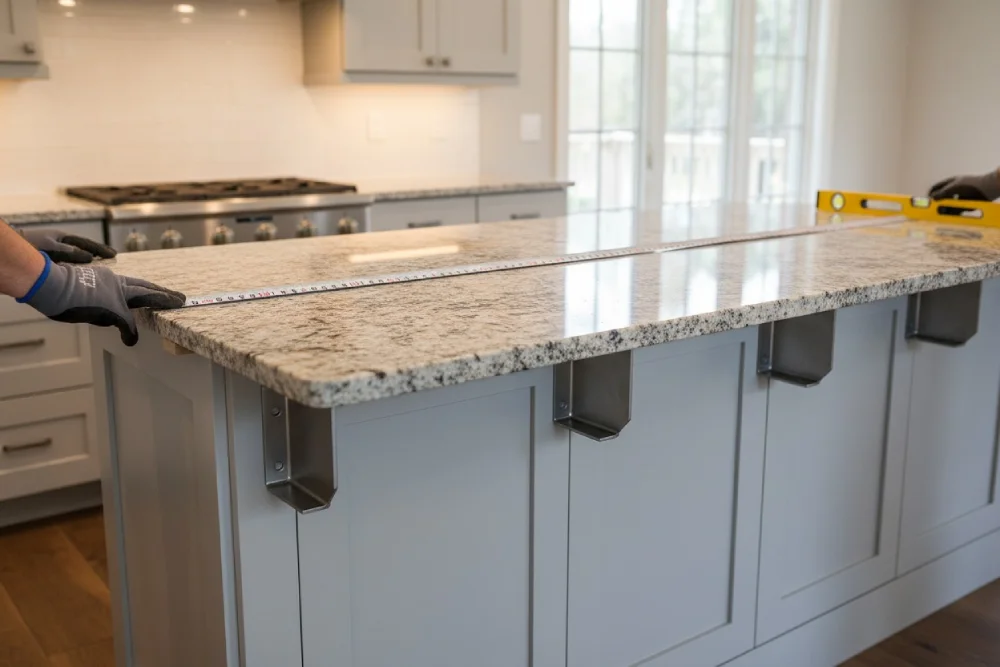
Granite is dense and strong but still brittle if improperly supported. Its weight and crystalline structure require specific installation approaches that differ from other materials.
Substrate and Support Requirements
3cm granite (standard thickness): Can usually sit directly on properly leveled cabinets without additional substrate. The thicker material distributes weight effectively across cabinet frames.
2cm granite (thinner slabs): Typically needs a 3/4-inch plywood deck to spread the load and prevent point stress that causes cracking. The plywood creates a continuous support surface.
Overhang guidelines:
- Standard overhangs up to 10-12 inches need no additional support
- Overhangs beyond 12 inches require brackets or corbels
- Bar seating overhangs (typically 12-15 inches) need support every 24-36 inches
- Island overhangs should be evaluated for specific support requirements
Unsupported long overhangs create stress that accumulates over time, eventually causing cracks that seem to appear suddenly but actually developed gradually.
Setting and Fastening
Installers use beads of silicone or construction adhesive on cabinet tops—never mechanical fasteners. Screws and nails must never penetrate the stone, as drill holes create stress concentration points leading to cracks.
Seam treatment:
- Seams pulled tight using vacuum seam pullers
- Pieces leveled flush to eliminate lippage
- Color-matched epoxy fills the joint
- Narrow seams (1/16-inch or less) for best appearance
- Excess adhesive cleaned before curing
Finishing and Care
A penetrating sealer is applied after installation, especially on lighter granites more prone to staining. Sealer penetrates the stone’s microscopic pores without changing appearance.
Post-installation care:
- Avoid abrasive cleaners that scratch the surface
- Avoid acidic cleaners that can dull polish
- Mild detergent and water for daily cleaning
- Reseal every 1-3 years depending on usage and stone porosity
- Use trivets for hot items despite granite’s heat resistance
Professional stone fabrication includes proper sealing protocols ensuring long-term stain protection for your granite installation.
Marble: Beautiful but Soft and Sensitive
Marble installation must account for the stone’s weight, softness, porosity, and structural vulnerabilities along veins. Techniques that work for granite cause problems on marble.
Cabinet and Base Requirements
Cabinet flatness is critical: Any sag, twist, or unevenness telegraphs into the marble as stress—eventually causing cracks. Marble doesn’t flex to conform; it breaks.
Plywood base benefits:
- Spreads marble’s weight across continuous surface
- Reduces point loads at cabinet edges and corners
- Essential under large spans and thin sections
- Prevents stress concentration at cutout corners
- Creates uniform support regardless of cabinet variations
Many installers use continuous plywood substrate for all marble installations, regardless of thickness, as insurance against cabinet imperfections.
Seams, Cutouts, and Handling
Seams require strategic planning on marble:
- Position away from high-stress zones (near sinks, dishwashers)
- Align along natural veins when possible
- Avoid crossing perpendicular veins at seams
- Dry-fit every piece before adhesive application
- Never force pieces into position
Cutout handling:
- Sink and cooktop cutouts need excellent surrounding support
- Marble chips and fractures more easily at thin rails
- Minimum rail widths must exceed other materials
- Corner radius prevents stress concentration
- Gentle handling throughout installation
Protection and Sealing
Marble’s porosity and acid sensitivity demand superior sealing:
- High-quality penetrating sealers essential
- Multiple sealer coats may be needed
- Careful caulking at all seams and joints
- Color-matched caulk at backsplash joints
- Reseal every 6-12 months in heavy-use kitchens
Finish recommendations:
- Honed (matte) finishes recommended for busy kitchens
- Honed surfaces hide etching and scratches better than polished
- Realistic client expectations about patina development
- Education about acidic substances (lemon, vinegar, wine)
| Stone Type | Support Base | Overhang Limit | Sealing Frequency |
| Granite 3cm | Cabinets only | 10-12″ unsupported | 1-3 years |
| Granite 2cm | Plywood deck | 10-12″ unsupported | 1-3 years |
| Marble | Plywood recommended | 8-10″ (conservative) | 6-12 months |
| Quartz | Full flat support | Per manufacturer spec | None needed |
Quartz: Non-Porous, Flat Base, No Sealing
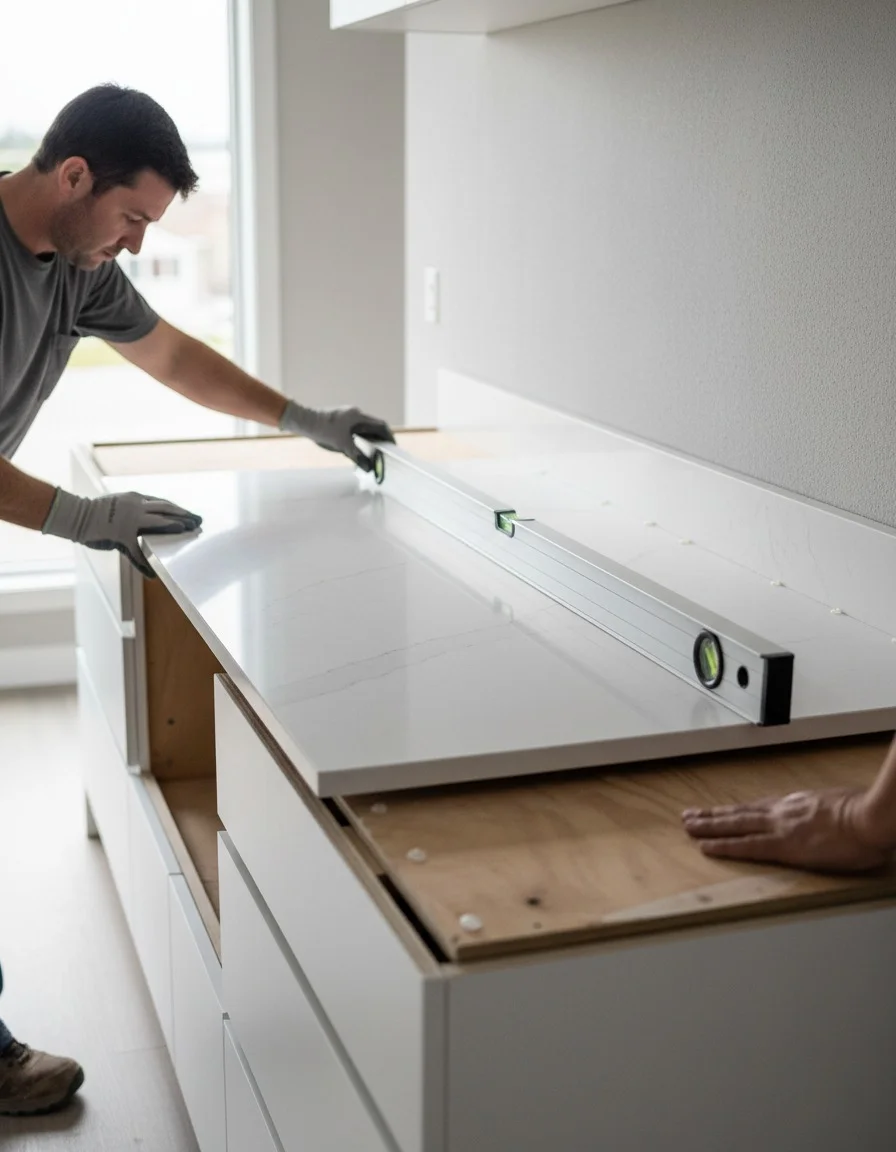
Engineered quartz is strong and consistent but behaves differently from natural stone. Its resin binders create specific installation requirements that differ significantly from granite or marble.
Flat, Continuous Support
Quartz demands extremely flat substrate—cabinet tops must be true to within 1/16 inch over 18-inch spans. Quartz dislikes flex and point loads that natural stone can sometimes accommodate.
Manufacturer requirements typically include:
- Full perimeter support on all cabinet frames
- Cross-member support every 24 inches front-to-back
- No “bridging” over gaps or open spaces
- Continuous substrate for spans over 24 inches
- Level cabinet installation within tight tolerances
Quartz that bridges gaps or rests on uneven surfaces will eventually crack from its own weight and use loads—sometimes months after installation.
Fastening and Clearances
Adhesive specifications:
- Only flexible 100% silicone adhesive
- Never construction adhesive that cures rigid
- Silicone dabs rather than continuous beads
- Allows slight movement without stress
- No mechanical fasteners ever penetrate quartz
Critical clearance requirements:
- Minimum 1/8-inch gap to walls
- Never jam pieces into tight fits
- Allows thermal expansion and contraction
- Prevents stress from building movements
- Silicone-filled gaps at walls and obstructions
Tight “jammed” fits that seem perfect at installation create stress as temperatures change and buildings settle, causing cracks that appear months or years later.
Thermal and Surface Behavior
Quartz requires no sealing—its non-porous resin matrix prevents staining without treatment. However, the same resins create heat sensitivity.
Heat and UV considerations:
- Hot pots and pans can discolor or crack resin
- Trivets required for all hot items
- UV exposure causes fading and discoloration
- Most quartz unsuitable for outdoor kitchens
- Only specifically rated quartz for exterior use
The stain resistance that makes quartz low-maintenance also creates vulnerability to heat that natural stone handles better.
Comprehensive natural stone supplier services include material selection guidance matching stone properties to your kitchen’s intended use.
Quartzite: Extremely Hard but Deceptively Brittle
Quartzite’s extreme hardness creates false confidence—it’s actually more demanding to install than softer stones because it won’t flex or conform to imperfections.
Cabinet and Support Requirements
Cabinet specifications:
- Must be extremely flat and level
- More demanding than granite requirements
- No flex tolerance—quartzite cracks instead
- Extra reinforcement at sink rails
- Conservative overhang limits
Sink rail reinforcement:
- Quartzite often cracks at narrow rails beside sinks
- Rod reinforcement or steel supports common
- Wider rails specified during fabrication
- Careful cutout positioning away from veins
- No forcing pieces into out-of-square conditions
Installation Approach
Installers treat quartzite installations as “high-risk” requiring extra care:
- Never force pieces into out-of-square walls
- Scribing preferred over forcing fit
- Seams and cutouts positioned away from fissures
- Extra support at all vulnerable points
- Conservative specifications throughout
Overhang guidelines:
- More conservative than granite (8-10 inches unsupported)
- Support brackets at lower thresholds
- No reliance on stone strength alone
- Planning for long-term stress accumulation
Sealing and Protection
Quartzite seals like granite with excellent heat and UV resistance:
- Penetrating sealer after installation
- Reseal every 1-2 years
- Excellent for outdoor applications
- Superior heat resistance to quartz
- Better UV stability than engineered stone
| Material | Support Needs | Fastening Method | Heat/UV Performance |
| Granite | Standard cabinets (3cm) | Silicone adhesive | Excellent both |
| Marble | Very flat, plywood base | Silicone, careful handling | Good heat, moderate UV |
| Quartz | Full flat support | Silicone only, gaps required | Poor heat, poor UV |
| Quartzite | Extremely flat, reinforced | Silicone, conservative fit | Excellent both |
Soapstone: Soft, Heavy, Oil-Enhanced
Soapstone presents unique installation characteristics—softer and more forgiving than other stones but heavy and requiring specific finishing approaches.
Support Requirements
Soapstone needs solid cabinet bases similar to granite or marble:
- Heavy material requiring robust support
- Standard cabinet installation acceptable for 3cm
- Plywood substrate for larger spans
- Level cabinets essential
- Overhangs similar to granite guidelines
Finishing Approach
Unlike other stones, soapstone typically receives oil or wax enhancement rather than penetrating sealers:
- Installed with honed (matte) finish
- Owner applies mineral oil or wax post-installation
- Oil darkens stone to characteristic deep color
- Wax provides surface protection
- No traditional sealing required
Maintenance expectations:
- Regular oil application develops patina
- Scratches can be sanded and re-oiled
- Natural wear patterns expected and valued
- Different care approach than sealed stones
Onyx and Fragile Exotics
Extremely delicate materials like onyx require specialized installation approaches limiting their practical applications.
Support and Backing
Continuous backing requirements:
- Plywood or fiberglass substrate throughout
- Conservative spans—no cantilevered edges
- Full continuous support under entire surface
- No point loads or concentrated stress
- Often limited to vertical applications
Practical Applications
Onyx works best in low-abuse settings:
- Backsplashes and feature walls
- Bar fronts with protective edges
- Backlit vertical installations
- Light-duty vanity tops
- Not recommended for high-traffic kitchen counters
Backlit considerations:
- Light transmission requires careful backing selection
- Pattern alignment critical for visual impact
- Backing material visible through translucent stone
- Electrical and heat management required
Material-Specific Best Practices Summary
Adapting installation techniques to each stone type does more than meet manufacturer specifications—it prevents callbacks, cracks, and premature failures.
Support Principles
Natural stone (granite, marble, quartzite):
- Weight distribution through proper substrate
- Plywood for thin materials and large spans
- Overhang support based on material properties
- Cabinet flatness critical for brittle stones
Engineered quartz:
- Full, continuous, flat support mandatory
- No bridging or gaps under any circumstances
- Manufacturer specifications strictly followed
- Clearances preventing stress buildup
Fastening Rules
Universal principles:
- Silicone or appropriate adhesive only
- Never mechanical fasteners into stone
- Flexible adhesives for engineered materials
- Color-matched epoxy for seams
Sealing Requirements
Seal required:
- Granite (1-3 year intervals)
- Marble (6-12 month intervals)
- Quartzite (1-2 year intervals)
No sealing:
- Engineered quartz (non-porous)
- Soapstone (oil/wax instead)
| Practice Area | Granite | Marble | Quartz | Quartzite |
| Base support | Standard/plywood | Plywood recommended | Full continuous | Reinforced |
| Fastening | Silicone adhesive | Silicone, gentle | Silicone dabs only | Silicone, no forcing |
| Wall clearance | Standard | Standard | 1/8″ minimum | Standard |
| Sealing | Yes, 1-3 years | Yes, 6-12 months | No | Yes, 1-2 years |
| Heat resistance | Excellent | Good | Poor | Excellent |
Key Takeaways
- Each countertop material requires specific installation techniques including different support substrates, fastening methods, clearance requirements, and sealing protocols that generic approaches fail to address properly
- Granite installation varies by thickness with 3cm slabs resting directly on cabinets while 2cm requires 3/4-inch plywood decking, and overhangs beyond 10-12 inches need bracket or corbel support
- Marble demands extremely flat cabinet bases with continuous plywood substrate common, seams positioned away from veins and high-stress zones, and frequent sealing every 6-12 months due to porosity
- Engineered quartz requires full continuous support with cabinet flatness within 1/16 inch, 1/8-inch minimum wall clearance, flexible silicone only, and strict avoidance of heat sources despite requiring no sealing
- Quartzite’s hardness creates deceptive brittleness requiring more conservative overhangs than granite, reinforced sink rails, and installation approaches that never force pieces into out-of-square conditions
- Sealing requirements differ dramatically from no sealing for quartz, to oil enhancement for soapstone, to 6-12 month intervals for marble, to 1-3 years for granite and quartzite
Frequently Asked Questions
Does granite countertop installation require plywood underneath?
3cm granite typically sits directly on level cabinets. Thinner 2cm granite needs 3/4-inch plywood decking to spread weight and prevent point stress that causes cracking.
Why does marble require different installation than granite?
Marble’s softness, porosity, and vein structure demand flatter cabinets, continuous plywood bases, careful seam placement, and more frequent sealing. Granite tolerates more variation.
Can I use the same installation method for quartz and granite?
No. Quartz requires stricter flatness tolerances, full continuous support, 1/8-inch wall clearances, and flexible silicone only. Granite is more forgiving of slight variations.
How far can granite overhang without support?
Standard guideline is 10-12 inches unsupported for 3cm granite. Longer overhangs need brackets or corbels spaced every 24-36 inches to prevent stress cracking.
Why doesn’t quartz need sealing like natural stone?
Quartz’s resin binders create a non-porous surface that doesn’t absorb liquids. However, those same resins make quartz sensitive to heat that natural stone handles better.
What makes quartzite installation more demanding than granite?
Quartzite won’t flex to conform to imperfections—it cracks instead. Cabinets must be extremely flat, sink rails need reinforcement, and pieces can never be forced into position.
How often should marble countertops be sealed?
Marble should be sealed every 6-12 months in heavy-use kitchens due to its porosity and acid sensitivity. Lighter-use areas may extend to annual sealing.
Can mechanical fasteners be used to secure stone countertops?
Never. Screws and nails create stress concentration points leading to cracks. All stone countertops use silicone or appropriate adhesive only.
Why do quartz countertops require wall clearance gaps?
The 1/8-inch gap allows thermal expansion and building movement without stress. Tight “jammed” fits cause cracks months or years after installation.
Is soapstone installed differently than other natural stone?
Soapstone needs similar support but uses oil or wax enhancement rather than penetrating sealers. The owner typically applies mineral oil to develop the characteristic dark color.
Conclusion
Professional countertop installation adapts techniques to each material’s unique properties rather than applying generic methods across all stone types. Granite needs smart support at overhangs, marble demands flat bases and careful seam placement, quartz requires strict flatness with clearance gaps, and quartzite needs reinforcement despite its hardness.
Understanding these material-specific requirements prevents the cracking, failed seams, and premature wear that result from one-size-fits-all installation approaches. When installers match their techniques to each stone’s characteristics, countertops remain flat, crack-free, and beautiful for decades.Ready for material-specific installation expertise? Contact Granite and Marble Designs for professional installation tailored to your chosen stone’s unique requirements.