
Natural Stone Fabrication: Material-Specific Expertise for Every Stone Type
Successful natural stone fabrication requires treating each stone family as its own material system—adjusting tooling speeds, feed rates, reinforcement strategies, edge profiles, and sealing protocols specifically for granite’s forgiving hardness, marble’s soft veined sensitivity, quartzite’s deceptive brittleness, and specialty stones like soapstone, slate, onyx, and travertine, rather than applying a one-size-fits-all “cut everything like granite” approach that leads to cracks, chips, callbacks, and costly failures.
Expert fabricators understand that granite cuts cleanly at aggressive feed rates while marble demands slower speeds through veins, quartzite requires patient precision with specialized blades, and delicate onyx needs full-bed support with backer materials. This material-specific expertise distinguishes quality countertop work from problematic installations.
Professional stone fabrication services match fabrication techniques to each stone’s unique properties, ensuring beautiful results that perform for decades without cracking, chipping, or premature wear.
Granite: The Forgiving Workhorse
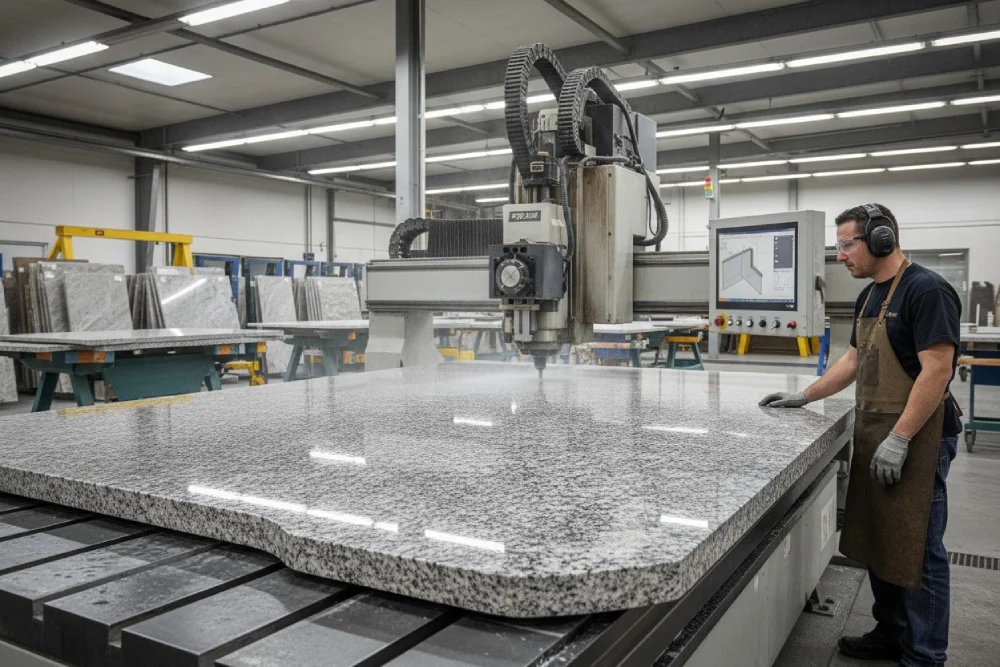
Granite is one of the most fabrication-friendly natural stones because of its hardness and resistance to chipping and cracking under proper tooling. This reliability makes granite the benchmark against which other stones are measured—though treating all stones like granite causes significant problems.
Tooling and Cutting Advantages
Granite cuts cleanly with diamond bridge saws, CNC routers, and waterjets at relatively aggressive feed rates. The stone’s crystalline structure resists edge blow-outs, making complex shapes and tight radii feasible without unusual risk.
Why granite forgives fabrication:
- Dense interlocking mineral crystals resist fracturing
- Less prone to chipping during cutout operations
- Tolerates standard diamond tooling without specialized blades
- Handles aggressive speeds that would crack softer stones
- Maintains edge integrity during profiling operations
Design and Edge Options
Granite handles almost any edge profile—including ogee, bullnose, and mitered waterfall designs—without unusual risk when properly supported. This versatility makes granite excellent for complex kitchen layouts with undermount sinks, large islands, and outdoor applications.
Granite strengths for applications:
- Undermount sink cutouts maintain structural integrity
- Large island overhangs supported without excessive reinforcement
- Outdoor kitchens benefit from heat and UV resistance
- Waterfall edges execute cleanly at miter joints
- Intricate profiles remain stable through fabrication and use
Finishing and Sealing
Most granite arrives factory-polished on the face, with fabrication shops focusing on edge polishing and cutouts. Many granites are relatively dense but still benefit from penetrating sealers improving stain resistance and maintenance ease.
Some very dense granites like Black Absolute require minimal sealing, while more porous varieties need annual reapplication. Fabricators assess each slab’s absorption characteristics to recommend appropriate sealing schedules.
Marble: Soft, Veined, and Sensitive
Marble demands more conservative fabrication and careful layout because of its softness, porosity, and pronounced veining. The same techniques that work beautifully on granite cause chips, cracks, and visual disasters on marble.
Tooling and Cutting Approach
Marble requires slower cutting speeds and lighter passes to avoid edge chipping and vein-related fractures. Sharp diamond tooling, abundant water, and gentle feed rates are essential—especially around cutouts and thin rails where stress concentrates.
Marble cutting essentials:
- Reduced feed rates through veined areas
- Fresh, sharp diamond blades preventing tear-out
- Abundant water cooling reducing thermal stress
- Multiple light passes instead of aggressive cuts
- Extra caution at narrow strips and L-shaped pieces
Vein-Aware Layout
Cutouts and seams must be planned with vein direction in mind. Crossing weak vein lines causes fractures during fabrication or months after installation. High-movement slabs need extra attention to where narrow strips fall in the layout.
Expert fabricators read slab structure before cutting:
- Position cutouts in solid zones away from dramatic veins
- Plan seams along natural vein breaks for visual continuity
- Avoid placing narrow rails across perpendicular veins
- Match vein patterns across multi-piece installations
- Orient waterfall miters for continuous visual flow
Finishing and Use Case
Honed finishes (matte) are often preferred for marble in kitchens because they hide etches and micro-scratches better than high polish. The naturally soft surface shows wear from acidic substances like lemon, vinegar, and wine—etching that becomes part of marble’s characteristic patina.
Marble needs more frequent sealing and realistic client education about maintenance. Professional Denver countertop installation includes proper expectations for marble’s behavior in high-use environments.
| Stone Type | Feed Rate | Edge Risk | Sealing Frequency |
| Granite | Aggressive | Low | 1-3 years |
| Marble | Slow, gentle | Moderate-High | 6-12 months |
| Quartzite | Very slow | High at veins | 1-2 years |
Quartzite: Extremely Hard but Deceptively Brittle
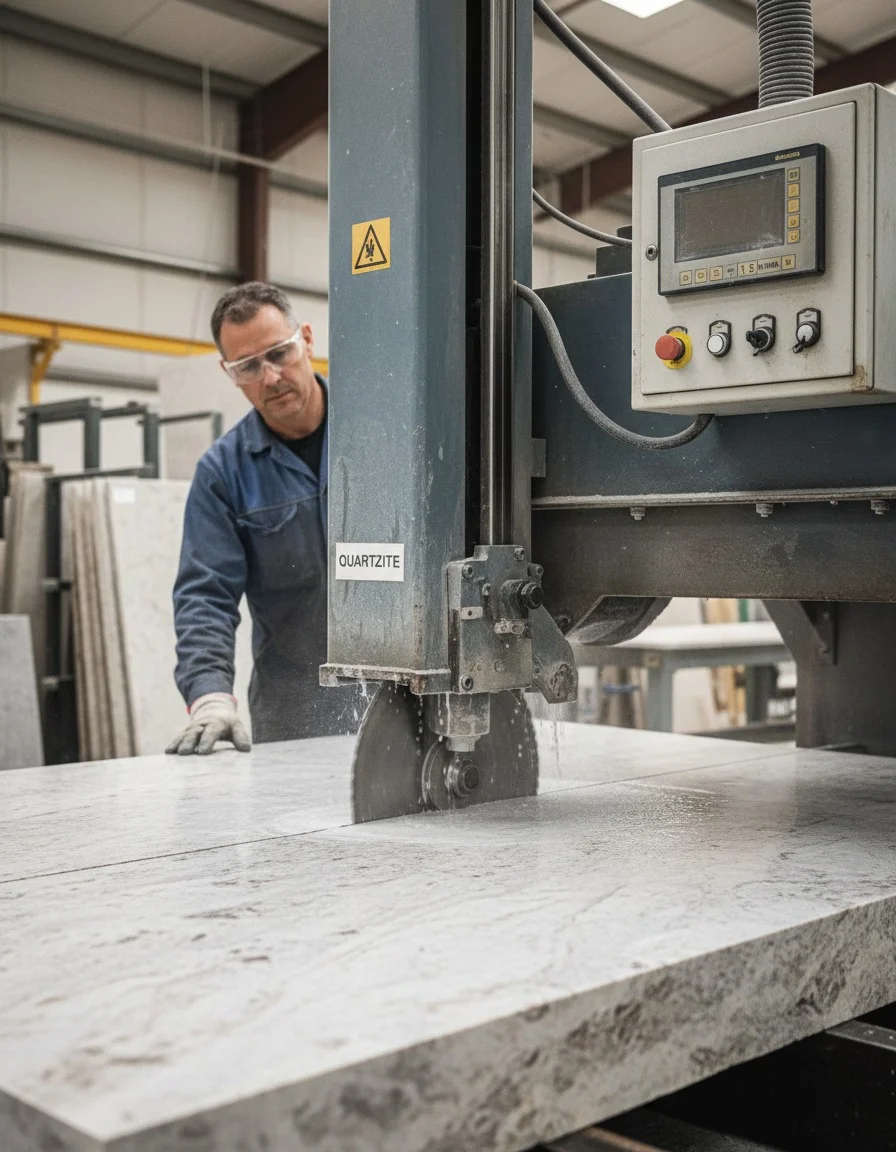
Quartzite is harder and denser than most granites but can be surprisingly brittle along certain veins. “Treat it like granite” is a common and costly fabrication mistake leading to cracks that appear months after installation.
Cutting and Tooling Discipline
Quartzite requires very slow feed rates, high-quality quartzite-rated diamond blades, and strict water cooling to prevent micro-fractures and premature tool wear. Aggressive cutting or dry grinding increases the risk of hidden cracks that manifest long after installation.
Quartzite tooling requirements:
- Specialized quartzite-rated diamond blades
- 30-50% slower feed rates than granite
- Continuous heavy water cooling throughout cuts
- Frequent blade inspection and replacement
- No dry grinding or rushed operations
The stone’s hardness wears tooling faster than granite, making blade quality and replacement schedules critical. Fabricators who cut corners on tooling create invisible stress fractures that become visible cracks over time.
Reinforcement Strategy
Sink and cooktop cutouts are the weakest zones in quartzite installations. The stone often needs rods, steel or fiberglass reinforcement, and carefully designed support around these high-stress areas.
Critical reinforcement considerations:
- Rod reinforcement around large cutouts
- Steel supports under overhangs exceeding 10-12 inches
- Fiberglass backing on thin sections
- Exceptionally flat and level cabinet bases
- No flexing—quartzite won’t conform to unlevel substrates
Cabinets must be exceptionally flat and well-supported. Unlike more forgiving stones, quartzite will not “flex into” out-of-square or unlevel bases. It cracks instead.
Layout and Edge Selection
Slab structure—strong zones versus fissured areas—should guide where cutouts, seams, and waterfall miters are positioned. Random placement based solely on material yield leads to cracks and visual mismatches.
Overly sharp or delicate edge profiles chip easily on quartzite. More robust edges (eased, pencil, half-bullnose) perform better in real kitchens than ornate profiles that work fine on granite.
Soapstone: Soft, Dense, and Distinctive
Soapstone presents unique fabrication characteristics—softer and denser than other countertop stones, cutting easily but scratching readily during use.
Fabrication Approach
Standard diamond tools cut soapstone efficiently without specialized equipment. The stone’s talc content makes it workable but also vulnerable to scratches and dents from everyday use.
Soapstone fabrication notes:
- Cuts cleanly with standard diamond tooling
- Requires careful handling to prevent surface scratches
- Edge profiles must account for softness
- Templates must capture precise measurements—no adjusting after cutting
Finishing and Enhancement
Soapstone typically receives a honed surface and enhancement with mineral oil or wax rather than typical penetrating sealers. The oil darkens the stone to its characteristic deep gray-green color and creates a rich patina that develops over years of use.
Clients choosing soapstone should expect and embrace the natural wear patterns, scratches, and darkening that define the material’s character. This requires explicit conversation about expectations versus other stone options.
Slate: Cleaving Along Natural Planes
Slate’s layered structure creates fabrication challenges unique among countertop materials. The stone cleaves along natural bedding planes, requiring fabricators to respect these structural characteristics.
Cutting and Support Planning
Fabricators must orient cuts and supports relative to slate’s natural bedding directions. Cutting against the grain risks delamination and edge failure. Proper support prevents flexing that separates layers.
Slate fabrication considerations:
- Respect bedding plane orientation during cutting
- Support planning prevents layer separation
- Edge profiles limited by delamination risk
- Cleft (natural) or honed finishes—rarely polished
- Sharp edges prone to chipping along layers
Finish Options
Slate typically appears in honed or cleft (natural surface) finishes. The material rarely receives high polish because its layered structure doesn’t develop the same reflective surface as crystalline stones. Sharp edges can delaminate if over-profiled, limiting edge design options.
Onyx: Brittle Beauty Requiring Delicate Handling
Onyx is very brittle and translucent—properties that make it stunning for backlit vertical applications but challenging for horizontal work surfaces.
Fabrication Challenges
Onyx demands gentle cutting, full-bed support, and often laminations or backer materials to prevent breakage. The stone’s translucency means any backing material may show through, requiring careful selection.
Onyx handling requirements:
- Extremely gentle cutting speeds
- Full continuous support—no cantilevered edges
- Fiberglass or mesh backing for stability
- Careful material selection for backlighting compatibility
- Limited to low-abuse applications
Appropriate Applications
Professional fabricators steer onyx toward vertical applications like backsplashes, bar fronts, and feature walls where backlighting showcases its translucency without subjecting the material to impact and wear. Horizontal countertop use requires extensive client education about the stone’s fragility.
Comprehensive natural stone supplier services include material selection guidance matching stone properties to intended applications.
Travertine: Porous with Characteristic Voids
Travertine’s highly porous structure with natural voids requires specific preparation before fabrication can proceed.
Pre-Fabrication Requirements
Travertine usually arrives with voids filled with resin at the factory before polishing. Fabricators must inspect fill quality before cutting—poor fills fail during fabrication or crack loose during use.
Travertine preparation checklist:
- Inspect factory resin fills for completeness
- Identify unfilled or poorly filled voids
- Apply additional resin where needed before cutting
- Assess overall structural integrity
- Plan cutouts away from large void concentrations
Appropriate Applications
Travertine performs better in bathrooms and low-abuse areas than high-traffic kitchens. Sealing and fill-quality inspection are critical before fabrication and installation. The stone’s porous nature makes it vulnerable to staining and etching in heavy-use environments.
| Specialty Stone | Key Challenge | Best Application | Finish |
| Soapstone | Scratches easily | Traditional kitchens | Honed + oil |
| Slate | Layer delamination | Rustic settings | Cleft or honed |
| Onyx | Extreme brittleness | Backlit features | Polished |
| Travertine | Porous voids | Bathrooms | Filled + polished/honed |
Cross-Cutting Expertise: Six Material-Specific Decisions
Expert fabricators tailor six key decisions to each specific material rather than using a one-size-fits-all playbook.
1. Tool Selection and Machine Settings
Blade type, RPM, and feed rate vary by stone hardness and brittleness. Granite tolerates fast, firm cutting. Quartzite demands slow, patient precision. Marble requires gentle passes through veins. Using granite settings on marble causes chips; using marble settings on quartzite causes incomplete cuts and tool wear.
2. Slab Layout and Vein Management
Position cutouts, seams, and waterfalls around strong zones and continuous veins—not just for maximum material yield. This vein-aware planning is especially crucial for marble and quartzite where crossing weak lines causes cracks.
3. Reinforcement and Support Design
Dense but brittle stones (quartzite, some marbles) need rods, more conservative overhangs, and robust cabinet structures. Forgiving granites need less reinforcement. Matching support to material properties prevents post-installation failures.
4. Edge Profile Selection
Bold, ornate edges that work beautifully on granite may chip or crack on fragile stones. Expert fabricators steer clients toward profiles matching both stone properties and usage patterns—simple eased edges on quartzite, elaborate ogee on stable granite.
5. Finishing and Sealing Strategy
Dense granites may need minimal sealing. Marble and travertine require high-quality penetrating sealers and maintenance plans. Some stones favor honed finishes masking inevitable wear that would show dramatically on polished surfaces.
6. Client Education and Expectations
Material-specific guidance about heat behavior, staining potential, etching characteristics, scratching vulnerability, and cleaning protocols prevents disappointment. Proper education directs each stone to appropriate applications where its properties become features rather than problems.
| Decision Area | Granite Approach | Marble Approach | Quartzite Approach |
| Feed rate | Aggressive | Slow, gentle | Very slow |
| Reinforcement | Standard | Moderate | Extensive |
| Edge options | Any profile | Conservative | Simple only |
| Sealing | 1-3 years | 6-12 months | 1-2 years |
| Client education | Standard care | Etching, patina | Brittleness risks |
Key Takeaways
- Each stone family requires material-specific fabrication with adjusted tooling, speeds, reinforcement, and finishing rather than a one-size-fits-all approach that treats every stone like granite and causes costly failures
- Granite is the most forgiving countertop stone tolerating aggressive feed rates, complex edge profiles, and standard diamond tooling while resisting chips and cracks that plague softer or more brittle materials
- Marble demands conservative fabrication with slower speeds through veins, vein-aware layout avoiding weak lines at cutouts, and realistic client education about etching and patina development over time
- Quartzite’s hardness creates deceptive brittleness requiring specialized blades, 30-50% slower feed rates than granite, and extensive reinforcement around cutouts where hidden stress fractures become visible cracks months after installation
- Specialty stones require distinct approaches including oil enhancement for soapstone, bedding-plane respect for slate, full-bed support with backers for onyx, and void-fill inspection for travertine
- Six material-specific decisions including tooling, layout, reinforcement, edge selection, sealing strategy, and client education distinguish expert fabrication from problematic work leading to callbacks and failures
Frequently Asked Questions
Why can’t all natural stone be fabricated the same way?
Each stone has unique hardness, brittleness, veining, and porosity. Granite tolerates aggressive cutting while marble chips, quartzite cracks along veins, and specialty stones have distinct structural properties requiring tailored approaches.
What makes granite easier to fabricate than other stones?
Granite’s interlocking crystalline structure resists chipping and cracking. It tolerates aggressive feed rates, standard diamond tooling, and complex edge profiles that would damage softer or more brittle materials.
Why is marble fabrication more challenging?
Marble’s softness and pronounced veining require slower cutting speeds and careful layout. Cutouts must avoid crossing weak vein lines, and fabricators must plan around structural vulnerabilities invisible to untrained eyes.
What’s the biggest mistake with quartzite fabrication?
Treating quartzite like granite. Despite being harder, quartzite is surprisingly brittle along veins. Aggressive cutting creates micro-fractures that become visible cracks months after installation.
How does reinforcement differ by stone type?
Granite needs standard support. Quartzite requires rods, steel supports, and fiberglass backing around cutouts. Marble needs moderate reinforcement at vulnerable points. Matching support to material properties prevents failures.
Why do some stones need specialized diamond blades?
Harder stones like quartzite wear standard blades quickly, causing poor cuts and heat buildup that creates stress fractures. Specialized quartzite-rated blades maintain cutting efficiency and prevent hidden damage.
Which edge profiles work on all stone types?
Simple eased and pencil edges work across most materials. Complex profiles like ogee perform well on granite but chip on quartzite and crack along marble veins. Edge selection must match stone properties.
How often do different stones need sealing?
Dense granite: 1-3 years. Marble: 6-12 months due to porosity and acid sensitivity. Quartzite: 1-2 years. Soapstone uses oil rather than sealers. Travertine needs frequent sealing due to porous voids.
What applications are best for specialty stones?
Soapstone suits traditional kitchens embracing patina. Slate works in rustic settings. Onyx excels in backlit vertical features. Travertine performs best in bathrooms rather than high-traffic kitchens.
How does client education differ by stone type?
Granite clients learn standard care. Marble clients must understand etching from acids and patina development. Quartzite clients need awareness of brittleness risks. Each stone requires material-specific expectations.
Conclusion
Natural stone fabrication succeeds when fabricators treat each stone family as its own material system rather than applying generic techniques across all materials. Granite’s forgiving hardness allows aggressive processing, while marble demands gentle handling through veins, quartzite requires patient precision with specialized tooling, and specialty stones each present unique challenges.
Expert fabricators match six critical decisions—tooling, layout, reinforcement, edge selection, sealing, and client education—to each specific material. This material-specific expertise prevents the cracks, chips, and callbacks that result from one-size-fits-all approaches. When fabricators respect each stone’s unique properties, natural stone becomes both a durable working surface and a long-lasting investment.Ready to work with material-specific stone experts? Contact Granite and Marble Designs for fabrication services tailored to your chosen stone’s unique requirements.