
Which Stone Works Best for a Bar Top in Denver?
Granite, quartzite and porcelain hold up best on a Denver bar top, because all three resist the citrus, wine and cocktail acids that etch marble. Engineered quartz works well indoors but not in direct sun, and backlit onyx suits a feature bar where the surface is the centerpiece.
A bar top takes a different kind of abuse from a kitchen counter. Drinks get set down and forgotten, citrus gets cut on the surface instead of a board, glasses sweat rings into the same spot every weekend, and people lean on the overhang with their full weight.
That is before you get to the structural side. Seating means overhang, overhang means support, and a bar top that was specified like a kitchen run often ends up either uncomfortable to sit at or held up by brackets nobody wanted to look at.
In this guide, you’ll learn which stones suit bar tops and entertainment areas, how overhang and seating clearance actually work, which edges and thicknesses suit a bar, what changes when the bar is outdoors, and how backlit stone is built.
Which Stones Suit a Bar Top?
The short answer is that acid resistance and hardness matter more here than anywhere else in the house. Lemon and lime juice, wine and mixers all sit on a bar surface longer than they ever would beside a stove.
| Stone | Holds up to drink acids | Sun and outdoor use | Best suited to |
|---|---|---|---|
| Granite | Yes, it does not etch from weak acids | Good outdoors when sealed | Family bars and outdoor kitchens |
| Quartzite | Yes, and harder than granite | Good outdoors when sealed | Heavy-use bars wanting natural movement |
| Porcelain | Yes, and highly stain resistant | Strong, holds color in sun | Outdoor bars and modern indoor bars |
| Engineered quartz | Yes | Not for direct sun, UV can discolor it | Indoor and basement bars |
| Marble | No, it etches from citrus and wine | Not recommended | Feature bars with a careful routine |
| Onyx | No, it is soft and reactive | Indoor only | Backlit feature bars and display tops |
Granite is the default for a reason, since it takes daily use, comes in a wide color range and does not react to weak acids the way marble does. Quartzite gives you similar resilience with the movement people associate with marble. Porcelain suits an outdoor bar particularly well because it holds color under Colorado sun.
Engineered quartz is a strong indoor choice, but prolonged UV exposure can discolor the resin binder, which is why it belongs in a basement or indoor bar rather than a patio. Marble and onyx are feature materials here rather than workhorses, and both need a gentler routine than most bars get.
How Do Overhang and Seating Actually Work?
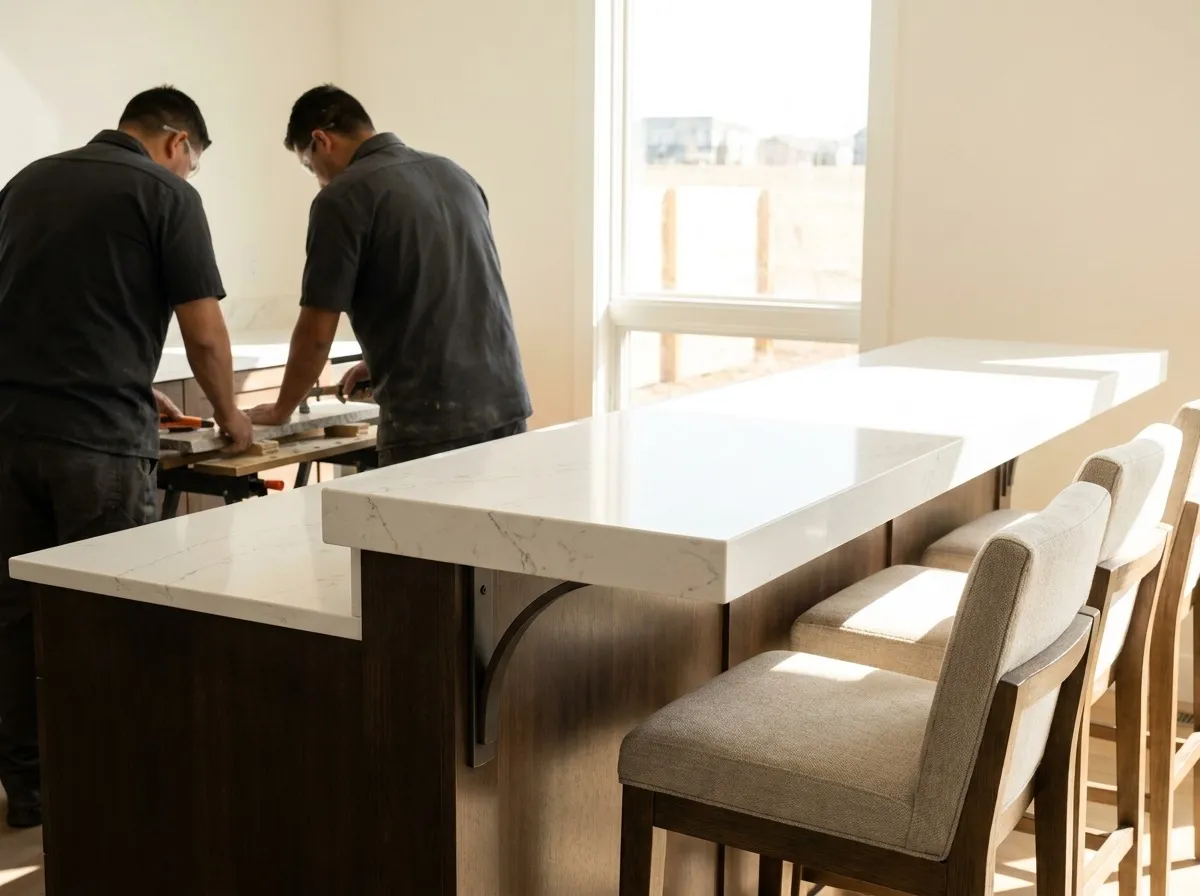
This is the part most bar projects get wrong. Seating needs knee room, and knee room means the stone extends past the cabinet or knee wall, which puts load on an unsupported edge.
Three things have to be agreed before templating: how far the top overhangs, how it is supported, and how much width each seat gets. Those decisions also change the slab layout, because a long unsupported run may need a thicker top or a different seam plan.
- Support brackets mounted to the knee wall carry the load and stay hidden beneath the stone.
- Steel plates or flat bar let you support a deeper overhang without visible brackets underneath.
- Corbels are the traditional visible option, and they suit more decorative bars.
- A knee wall or cabinet run can be built deeper so the overhang itself stays modest.
| Support method | How it looks | Suits |
|---|---|---|
| Hidden brackets | Out of sight from a seated position | Most residential bars |
| Steel plate or flat bar | Nothing visible underneath, deeper spans | Wide overhangs and thin tops |
| Corbels | A visible decorative support | Traditional and feature bars |
| Deeper knee wall | No support hardware needed | New builds and full remodels |
Stools set the rest. Counter-height bars and bar-height bars need different stool heights, and each seat needs enough width that two people are not knocking elbows. Measure the run, decide how many seats it honestly holds, then let the overhang follow from that rather than the other way round.
Which Edges and Thicknesses Suit a Bar?
A bar top is seen from more angles than any other counter in the house, including from a seated position, so the edge and the apparent thickness carry more weight here.
Simple profiles remain the practical choice on the working side, since glasses and bottles meet the edge constantly. Eased, pencil and half bullnose profiles all wipe clean easily and are comfortable against the forearm. Where the bar is a feature rather than a work surface, a mitered edge makes the top read far thicker than the slab.
| Treatment | What it gives you | Consider |
|---|---|---|
| Standard thickness | Clean proportions, lowest material use | Can look thin on a large feature bar |
| Mitered edge | A substantially thicker look with matched veining | More material and more shop time |
| Waterfall end | Stone carried down to the floor at one or both ends | Works best with stone that has strong movement |
| Full-height backsplash | Stone carried up behind the bar | Simplifies cleaning behind bottles and glassware |
Thickness is also a comfort decision. People rest their forearms on a bar for hours, so a softened edge on the seating side is worth more than an ornate profile that looks good only in photos.
What Changes for an Outdoor Bar?
Denver’s climate asks more of an outdoor surface than an indoor one. Sun exposure, temperature swings between day and night, and freeze-thaw cycles through the winter all act on the stone and on everything holding it in place.
Granite, quartzite and porcelain are the materials that handle it. Engineered quartz is the one to avoid outdoors, since UV exposure can discolor the resin over time. Sealing matters more outside too, and an outdoor bar generally wants a resealing routine on a shorter cycle than the same stone indoors.
The build details matter as much as the slab. Confirm the substrate and cabinet material, plan for drainage so water is not sitting under the stone, and decide where any appliance cutouts sit before templating. Professional natural stone fabrication in Denver, CO handles those cutouts as part of the same cutting file as the top itself.
How Does a Backlit Bar Top Work?
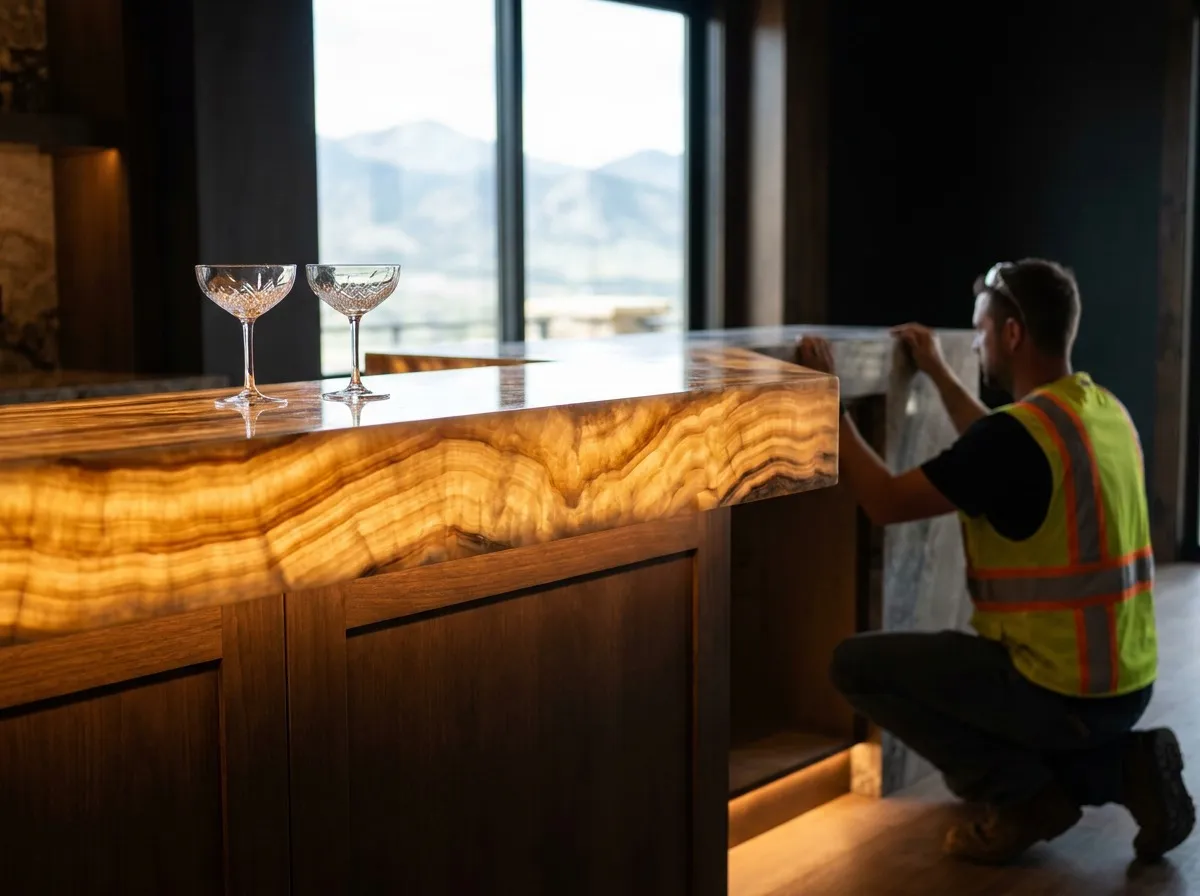
Backlighting is the reason onyx shows up in bars at all. Onyx, a banded variety of chalcedony, is translucent enough that light passing through it reveals the banding from behind, which makes a dramatic feature in a basement bar or an entertainment space.
The construction is what makes it work. The slab is usually cut thinner or laminated over a light panel, the lighting is planned before fabrication rather than after, and the supporting structure has to hold the panel and the stone together without casting shadows or hot spots across the surface.
Three things to settle early if you want this:
- The specific slab, since translucency and banding vary from piece to piece
- Where the light source sits and how it is accessed for maintenance later
- Whether the bar is a display surface or a working one, since onyx is soft and reactive
Translucent marble and some quartzite can be backlit too, though onyx remains the classic choice. In every case this is a feature surface, so pair it with a more practical material where drinks are actually mixed.
What Granite and Marble Designs Provides for Bar Projects
Granite and Marble Designs has served Denver homeowners, contractors and commercial clients since 2007, including schedule-sensitive commercial spaces such as hotels, restaurants and sports venues. That commercial side matters on a bar project, because bar tops are the surfaces those venues replace most often. A countertop design and installation company in Denver that handles both sides brings the same detailing to a basement bar.
Stone design consulting covers material selection for the way the bar will actually be used, along with project management from selection through completion.
Stone fabrication covers laser templating of the bar run and overhang, slab layout for veining and seams, and CNC fabrication with SABERjet equipment for cutouts and mitered edges.
Demolition covers removal of an existing bar top before the new one goes in.
Stone countertop installation completes the work with high-quality sealing and near-imperceptible seams where pieces meet.
Slab and remnant inventory includes onyx and specialty stone, and a bar top is often small enough that a remnant puts a striking slab within reach. Come view onyx and specialty slabs in person before you decide, then book a design consultation about your bar top with your seating plan in hand.
Key Takeaways
- Acid resistance matters more on a bar than anywhere else in the house, because citrus, wine and mixers sit on the surface far longer than they would in a kitchen.
- Granite, quartzite and porcelain are the workhorses. All three take daily use and all three suit outdoor bars when they are sealed on a sensible cycle.
- Engineered quartz performs well indoors but does not belong in direct sun, since prolonged UV exposure can discolor the resin binder.
- Overhang, support method and seat width have to be agreed before templating, because they change both the structure and the slab layout.
- Simple edge profiles suit the seating side, where people rest their forearms, while a mitered edge gives a feature bar a thicker, more substantial look.
- Backlit onyx is a display surface rather than a working one. The slab, the light source and the support structure all need planning before fabrication starts.
Frequently Asked Questions
What is the most durable stone for a home bar?
Granite and quartzite are the most durable practical choices, since both resist the acids in citrus and wine and take heavy daily use. Porcelain is equally resistant and holds color outdoors.
Can I use marble on a bar top?
You can, but marble etches when citrus, wine or mixers sit on it. A honed finish, coasters and prompt cleanup keep it presentable, which suits a feature bar more than a heavily used one.
Is quartz suitable for an outdoor bar?
No. Engineered quartz can discolor under prolonged UV exposure, so it belongs indoors. Choose granite, quartzite or porcelain for a patio bar or outdoor kitchen instead.
How much overhang does bar seating need?
Enough for comfortable knee room, which varies with stool height and seat depth. Agree the dimension with your fabricator before templating, since the support method depends on it.
Do bar top overhangs need support?
Usually yes. Hidden brackets or steel plates carry the load on a deep overhang, while corbels are the visible option. The right choice depends on the depth and the stone.
How many seats fit at a bar?
Divide the usable run by the width each seat needs, allowing room for elbows. Measure the run first, since the honest seat count often differs from the one in the plan.
What edge profile is best for a bar?
Softer profiles such as eased, pencil and half bullnose are most comfortable where people rest their arms. Save decorative or mitered edges for the display side of the bar.
Can a bar top match my kitchen counters?
Yes, and using the same material from the same slab keeps the spaces connected. Raise it during slab layout so enough material is reserved for both areas.
How is a backlit bar top built?
The stone is cut thin or laminated over a light panel, with the lighting planned before fabrication. Translucent onyx is the classic choice, and the support structure must avoid casting shadows.
Can a remnant work for a bar top?
Often yes, since bar runs are smaller than kitchen layouts. Remnant availability changes constantly, so check the inventory while you are still choosing the material.
Conclusion
A bar top succeeds when the material matches the way the space is used and the structure matches the seating. Granite, quartzite and porcelain handle real entertaining, quartz suits indoor bars, and marble and onyx earn their place as feature surfaces with a gentler routine.
Settle the overhang, support and seat count before templating, choose an edge you will be comfortable leaning on, and plan any backlighting before the slab is cut. Get those right and the bar becomes the part of the house people gather around.
Call Granite and Marble Designs at 303-536-8808 to schedule a design consultation about your bar top or entertainment area.