
Which Countertop Edge Profile Fits Denver Kitchens?
The edge profiles that fit most Denver kitchens are eased, half bullnose and bevel for modern and family spaces, and ogee, Dupont or cove for traditional cabinetry. Mitered and waterfall treatments suit islands that need to look thicker, and every profile is machined before installation.
The edge is the part of a countertop you touch most and think about least. It runs along every exposed side, it catches the light across the kitchen, and it decides whether the slab reads as slim and modern or thick and substantial.
It is also a decision with no second chance. The profile is machined and polished during fabrication, so once the stone is cut, changing your mind means new stone rather than a quick adjustment. That is why it deserves a real conversation before templating, not a quick pick from a photo board.
In this guide, you’ll learn what an edge profile actually is, which simple profiles suit modern and family kitchens, which decorative profiles suit traditional spaces, how mitered and waterfall treatments change the look of an island, and how to match a profile to your cabinets and daily routine.
What Is a Countertop Edge Profile?
An edge profile is the shape machined along the exposed edges of a slab after it is cut to size. Fabricators shape it with specialized tooling and then polish it so the finish matches the top surface, which is what makes a finished edge feel smooth rather than raw.
The names come from architectural moulding, which is why bullnose, bevel and ogee turn up in both stonework and cabinetry. That shared vocabulary is useful, since it means an edge can echo the trim, the cabinet doors or the built-ins already in the space.
The choice affects more than appearance:
- Perceived thickness. Some profiles make a slab look thicker, others make it read thinner.
- Comfort. Rounded edges feel softer against the body when you lean on the counter.
- Cleaning. Simpler shapes have fewer grooves where crumbs and spills collect.
- Light. Beveled and curved edges catch light differently than a flat face does.
- Cost. Intricate profiles take more shaping and polishing time, usually priced by the linear foot.
Which Simple Profiles Suit Modern Kitchens?
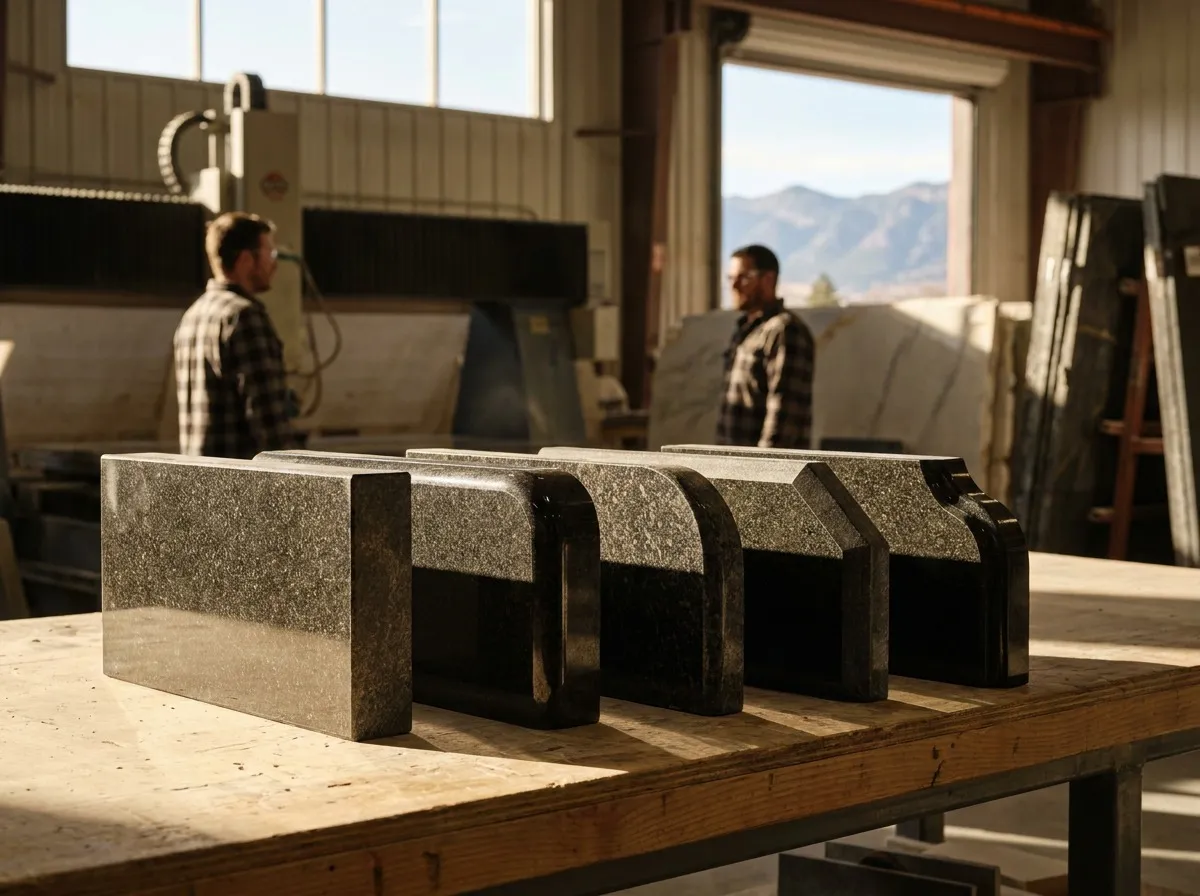
Clean, understated edges dominate contemporary design because they keep the attention on the stone. They are also the most practical profiles in a kitchen that gets used hard every day.
Eased and Square
An eased edge is a square edge with the sharp corners lightly rounded, which gives a crisp horizontal line that suits modern and transitional cabinetry. A true square edge keeps the corner at a right angle for a sharper, more architectural look, though it is less forgiving if someone walks into it.
Bullnose and Half Bullnose
A full bullnose rounds the entire edge into a smooth curve, while a half bullnose rounds the top and leaves the face flat. Both feel comfortable to lean against and shed water rather than holding it, which keeps them popular in family kitchens and bathrooms.
Pencil and Bevel
A pencil edge rounds only the very top into a narrow curve, softening the corner without changing the slab’s rectangular profile. A bevel cuts an angled facet along the top, usually at forty-five degrees, adding a light-catching line without introducing curves.
| Profile | How it reads | Suits | Upkeep |
|---|---|---|---|
| Eased | Clean and square with softened corners | Modern and transitional kitchens | Wipes down in one pass |
| Square | Sharp and architectural | Contemporary spaces | Wipes down in one pass |
| Half bullnose | Softly rounded top, flat face | Family kitchens and bathrooms | Sheds water, easy to clean |
| Pencil | Narrow rounded top | Square looks that need a softer corner | Easy to clean |
| Bevel | Angled facet along the top | Kitchens wanting subtle definition | One extra wipe along the facet |
Simple profiles also age well. Cabinet colours and hardware finishes move in and out of fashion, but a clean edge does not tie the kitchen to a particular moment, so it still looks right years later.
Which Decorative Profiles Suit Traditional Kitchens?
Detailed profiles add depth and shadow, and they belong in spaces with raised-panel cabinetry, substantial trim or a formal feel. Because they draw the eye, most homeowners use them where they will actually be seen.
The ogee, an S-shaped curve formed from a concave arc flowing into a convex one, is the classic traditional choice, and it casts a pronounced shadow line along the counter. A Dupont profile pairs a straight drop with a curve beneath it for something tailored rather than ornate, while a cove uses a softer concave curve.
Scale is the thing to watch. A pronounced profile looks best where there is enough visible edge to show it off, so a narrow bar top or a small vanity can make the same shape feel heavy. Looking at a full-length sample rather than a short piece gives you a truer sense of how it will read.
A practical compromise is to mix profiles deliberately:
- A decorative edge on the island, where people gather and the counter is most visible
- A simpler eased or bullnose edge on perimeter runs that take the prep work
- A matching profile on a bar top or built-in desk to tie the spaces together
- A plain edge on bathroom vanities when the kitchen is meant to be the feature
How Do Mitered and Waterfall Edges Change an Island?
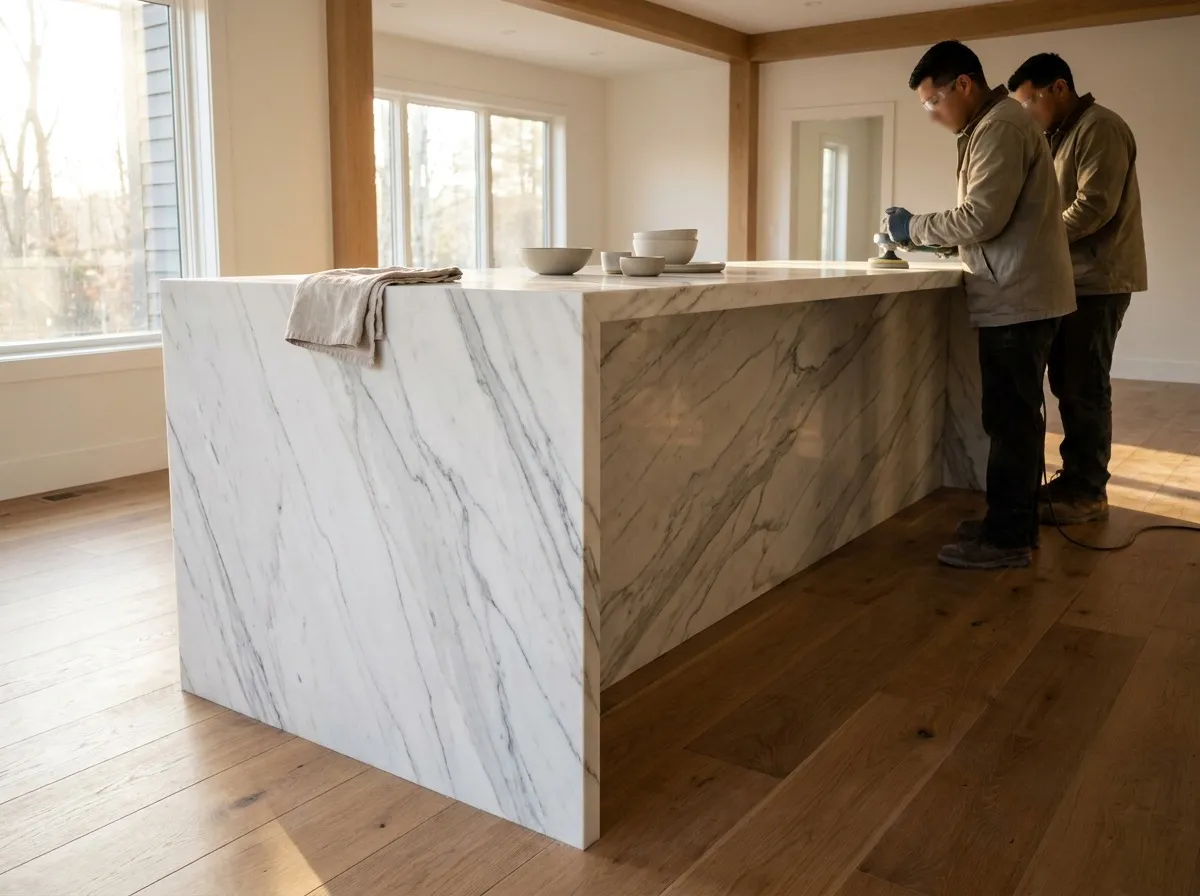
Apparent thickness changes the character of a kitchen as much as the profile shape does. Slabs come in standard thicknesses, but fabrication can change how thick the edge looks.
A mitered edge joins two pieces of stone at an angle so the edge reads far thicker than the slab, with the veining matched across the joint so the corner looks solid. A waterfall edge carries the stone down the side of the island to the floor, creating a continuous surface that works especially well with stone that has strong movement.
| Treatment | Visual effect | Material use | Where it belongs |
|---|---|---|---|
| Standard edge | Clean, expected proportions | Standard | Perimeter runs and most kitchens |
| Mitered edge | Thicker, more substantial | Higher | Islands and feature counters |
| Waterfall edge | Stone flows to the floor | Highest | Statement islands in open layouts |
| Laminated edge | Doubled thickness at the edge only | Moderate | Adding weight to a standard slab |
Both treatments use more material and more shop time, so they belong in the budget conversation early. They also change sight lines: a thicker island reads as grounded and furniture-like in an open layout, while a standard edge keeps a smaller kitchen feeling lighter.
How Do You Match a Profile to Your Kitchen?
A custom countertops in Denver will ask about your cabinets before anything else, and that is the right order. Start with the cabinetry style, then think about how the counter is used, then narrow to two or three profiles you can compare in person at the showroom.
Household habits matter more than most people expect. Homes with young children usually prefer rounded edges that are gentler on impact. Keen bakers tend to favour simple profiles that clear in one wipe. Frequent entertainers often put the detail on the island and keep the perimeter plain.
| Cabinet style | Profiles that usually suit it | Why |
|---|---|---|
| Flat-panel or slab doors | Eased, square, mitered | Straight lines echo the cabinet faces |
| Shaker | Eased, pencil, half bullnose | Simple curves sit comfortably with a simple frame |
| Raised panel | Ogee, Dupont, cove | Detail on the counter answers detail on the doors |
| Glass-front or mixed | Bevel, half bullnose | A light-catching edge without extra ornament |
The stone itself has a vote too. A slab with bold veining competes with an intricate edge, so a simpler profile usually looks better, while a quieter stone gives a decorative edge room to show. Some stones also fracture on certain edges, which is a question for your fabricator once you have chosen the slab. This is where countertop fabrication in Denver and design selection stop being separate decisions.
Before you commit, ask to see the profiles you are considering in your chosen material. Running your hand along the edge tells you things a photo cannot, and seeing the shadow line under real light usually settles it in minutes.
What Granite and Marble Designs Provides for Edge Work
Granite and Marble Designs has worked with Denver homeowners and contractors since 2007, with eight Parade of Homes awards earned between 2008 and 2020. Every edge is machined in house through the StoneDoneRight™ process rather than subcontracted, which is what keeps the profile consistent from the island to the last perimeter run.
Stone design consulting covers the profile decision alongside material selection, so the edge suits both the cabinetry and the slab you picked.
Stone fabrication includes laser templating that records every exposed edge and overhang, slab layout, and CNC fabrication with SABERjet equipment for consistent edge shaping and polishing.
Stone countertop installation completes the work with high-quality sealing and near-imperceptible seams where pieces meet.
The published edge profiles page shows the shapes, though samples are more useful than drawings. Bring a cabinet door when you see edge samples at our Denver showroom, and the comparison takes minutes rather than weeks. When you have narrowed it down, talk to our team about edge profiles for your counters before templating is booked.
Key Takeaways
- The edge profile decides how thick your countertop looks, how comfortable it feels to lean on, and how quickly it wipes clean. It is a daily-use decision, not only a styling one.
- Eased, square, bullnose, pencil and bevel profiles suit modern and family kitchens, and they all clear in a single wipe.
- Ogee, Dupont and cove profiles add formality and pair with raised-panel cabinetry and substantial trim, though they need a moment more attention when you clean.
- Mitered and waterfall treatments make an island look thicker and more substantial, at the cost of more material and more shop time.
- Bold veining competes with an intricate edge, so match the profile to the slab as well as to the cabinets.
- The profile must be final before fabrication, because reshaping a machined edge after the fact is not practical.
Frequently Asked Questions
What is the most requested countertop edge profile?
Eased and half bullnose edges are among the most requested because they suit a wide range of kitchen styles and clean easily. Ogee remains popular in traditional kitchens with detailed cabinetry.
Does the edge profile change the price?
Yes. Edge work is generally priced by the linear foot, so intricate, mitered and waterfall edges cost more than simple ones. Ask for pricing on your actual layout rather than a general estimate.
Can I use two different profiles in one kitchen?
Yes, and many homeowners do. A decorative edge on the island with a simpler profile on the perimeter runs balances visual interest against everyday cleaning.
Which profile is safest in a home with young children?
Full and half bullnose profiles soften the corner and are gentler on impact. Square and sharply beveled edges look crisp but are less forgiving in a busy kitchen.
Can an edge profile be changed after installation?
Reshaping an installed countertop is not practical, since the edge is machined and polished during fabrication. Confirm the profile before templating and cutting begin.
Do all profiles work on every stone?
Most profiles can be machined in granite, marble, quartzite and quartz, but some stones fracture on certain shapes. Your fabricator will tell you which profiles suit the slab you chose.
Does a thicker edge mean a thicker slab?
Not necessarily. A mitered or laminated edge joins stone at the edge so the counter reads thicker while the slab itself stays standard thickness.
Which edge makes a kitchen look most modern?
Eased and square edges read as the most contemporary, and a mitered edge on the island adds a thicker, architectural line. All three keep the focus on the stone.
Does the edge profile affect sealing or maintenance?
The edge is polished and sealed like the rest of the surface, so care is the same. The only real difference is time, since a grooved profile takes an extra moment to wipe.
Should the bathroom vanity match the kitchen edge?
It can, though it does not have to. Many homeowners use a simpler profile on vanities and save the decorative edge for the kitchen island where it is most visible.
Conclusion
An edge profile is a small detail that carries a surprising amount of weight. Simple shapes keep the focus on the stone and stand up to daily use, while decorative and mitered edges give an island presence and tie a traditional kitchen together.
Compare a short list in person, with your cabinet style and daily routine in mind, and settle it before fabrication. Do that, and the finished counters look intentional from every angle in the space.
Call Granite and Marble Designs at 303-536-8808 to schedule a design consultation about countertop edge profiles.