
What Does a Full-Service Stone Company in Denver Do From Design to Installation?
A full-service stone company in Denver handles a countertop project from the initial design conversation to the installed, sealed stone. That means a design consultation, slab selection at a showroom, templating, slab layout and fabrication, removal of the old countertop, and installation, all planned and coordinated by one business instead of several.
In this guide, you’ll learn what each stage of a full service stone company project involves, which decisions belong to you along the way, how one company compares with separate trades, and how Granite and Marble Designs runs the same path through its StoneDoneRight™ process. It’s written for Denver homeowners planning a kitchen or bathroom countertop and for the contractors and designers who coordinate the work.
Key Takeaways
- One business, every stage: A full-service stone company covers design, fabrication and installation, so one company is accountable for how the stages connect.
- The path has a fixed order: Design consultation, slab selection, templating, slab layout, fabrication, demolition and installation follow each other, and each stage depends on the one before it.
- Your decisions come early: The stone, the specific slab, the fixtures, the edge profile and the finish are settled before the first cut.
- Measurement is the hand-off point: Templating records the finished space, so cabinets and fixture choices need to be final before it happens.
- The old top comes out as part of the plan: Demolition of the existing countertop is scheduled with installation, not left as a separate job.
- Honest limits still apply: Granite and marble need periodic sealing, every surface needs routine care, and no company can make natural stone stain-proof.
What Is a Full-Service Stone Company?
A full-service stone company is a business that supplies the stone, fabricates it and installs it, carrying one project from design to the finished countertop.
The term describes a business model, not a material. Some stone businesses only sell slabs, some only cut them, and some only install. A full-service company brings those jobs together, a small-scale form of vertical integration, where one business handles several stages of the same supply chain.
The material is usually natural stone such as granite, marble, quartzite, onyx or limestone, or engineered quartz, which is made from quartz aggregate and resin binders and is not a natural stone. The product is most often custom stone countertops for kitchens and bathrooms, a fireplace surround or an outdoor counter, built for one space.
For a buyer, the practical difference is coordination. When one company owns every stage, the slab you pick, the measurements of your space, the layout of the cuts and the installation are planned together, and you have one place to take questions.
Which Stages Does a Full-Service Stone Company Cover?
A full-service stone company covers seven connected stages, from the first design conversation through fabrication to installation and sealing in your space.
| Stage | What happens | What you decide |
|---|---|---|
| Design consultation | The project, the space and the stone options are discussed | Material family, look and how the space is used |
| Slab selection | Slabs are viewed in person at the showroom | The specific slab, not only the stone name |
| Templating | The installed cabinets and walls are measured | Final cabinet positions and fixture models |
| Slab layout | Each countertop piece is planned on the slab | Where seams and veining fall |
| Fabrication | Pieces are cut, cutouts are made, edges are shaped and finished | Edge profile and finish |
| Demolition | The old countertop is removed | What stays and what goes |
| Installation | Pieces are set, seams are joined and stone that needs it is sealed | Final review of the installed work |
The order matters: a slab can’t be laid out until the space is templated, and templating waits for final cabinets and fixtures.
What Happens at the Design Consultation for a Denver Kitchen or Bathroom?
The design consultation is the first step of a Denver kitchen or bathroom stone project, where the space, the way it’s used and the stone options are talked through before anything is ordered.
Expect to discuss how you cook, how much daily wear the surface takes, and how the stone should relate to your cabinets, flooring and tile. You’ll also talk about finish: a polished finish is glossy and reflective, while a honed finish is smooth and matte.
At Granite and Marble Designs, stone design consulting covers the selection of stone, recommendations based on what the space needs, and project management. The company guides the choice, and the customer makes it. Bring photos, cabinet drawings and the sink, faucet and cooktop models if you have chosen them, because those details shape every later stage.
How Does Slab Selection Work at a Denver Showroom?
Slab selection means choosing the exact slab your countertop will be cut from, in person at a showroom, rather than picking a stone name from a small sample.
Every slab of natural stone is different. Two slabs sold under the same granite or marble name can differ in color, movement and veining, which is the network of lines and streaks running through the stone. A sample board shows the material family, but only the full slab shows how your stone countertop, island or long run will look.
At a Denver showroom, you can walk the slabs, compare them in daylight and mark the one you want. If a backsplash or a waterfall edge will come from the same slab, mention it now, because it changes how much stone the layout needs. A waterfall edge carries the countertop down the side of an island or cabinet to the floor.
What Happens Between Templating and Custom Stone Fabrication?
Between templating and custom stone fabrication, the measured space becomes a cutting plan: the template is matched to your slab, the pieces are laid out, and the stone is cut and finished.
- Templating: On-site templating records the exact shape of the installed cabinets, walls and corners, and the template becomes the pattern for every piece.
- Engineering and slab layout: Slab layout places each countertop piece on the slab so cutouts, seams and veining land where they should. A seam is the joint where two pieces of stone meet.
- CNC fabrication: CNC fabrication is computer-controlled cutting that follows a programmed path drawn from the template, including sink and cooktop cutouts.
- Edges and finish: The exposed edge is shaped to the chosen edge profile and finished to match the surface.
- Inspection: Finished pieces are checked for fit, edge detail and surface finish before they leave the shop.
This is where a full-service company earns its name. Measurement, layout and installation work from the same information, so a change to a cabinet or a sink model reaches everyone before the slab is cut. Once the stone is cut, the layout and the cutouts are permanent.
Why Does Countertop Demolition Belong in the Same Plan?
Countertop demolition belongs in the same plan because the old top has to come out cleanly, and at the right moment, before the new stone can be templated or installed.
On a kitchen remodeling or renovation project, removing the existing countertop touches the cabinetry, the plumbing and sometimes the backsplash. Careless removal can shift or damage cabinets, so the measurements for the new stone may no longer match the space.
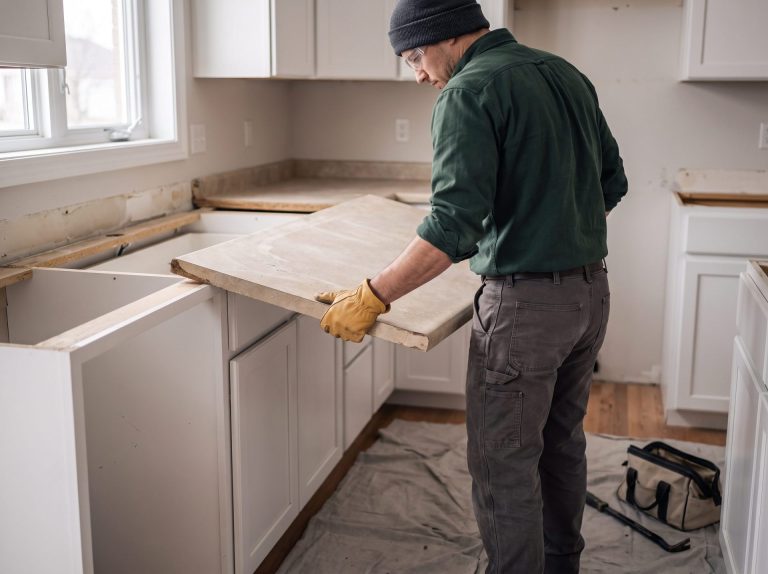
When demolition is part of the same project, its timing is planned around templating and installation instead of being booked on its own. Professional demolition is one of the five documented steps in the StoneDoneRight™ process at Granite and Marble Designs, which keeps the removal of the old surface inside the same plan as the new one. Ask whether demolition is included or needs another trade.
What Happens When a Professional Stone Installation Company Sets Your Countertop?
When a professional stone installation company sets your countertop, the finished pieces are placed on the cabinets, leveled, secured, joined at the seams and sealed where the stone needs it.
Installers check each piece against the cabinets and walls, fit any undermount sink, and join seams so they are near-imperceptible, with the color and veining carried across the joint as closely as the stone allows. Sealing is the application of a protective treatment that helps slow how quickly natural stone absorbs liquids. Granite and marble both need periodic sealing, and sealing is not optional for those materials. Marble also etches from acids such as lemon juice.
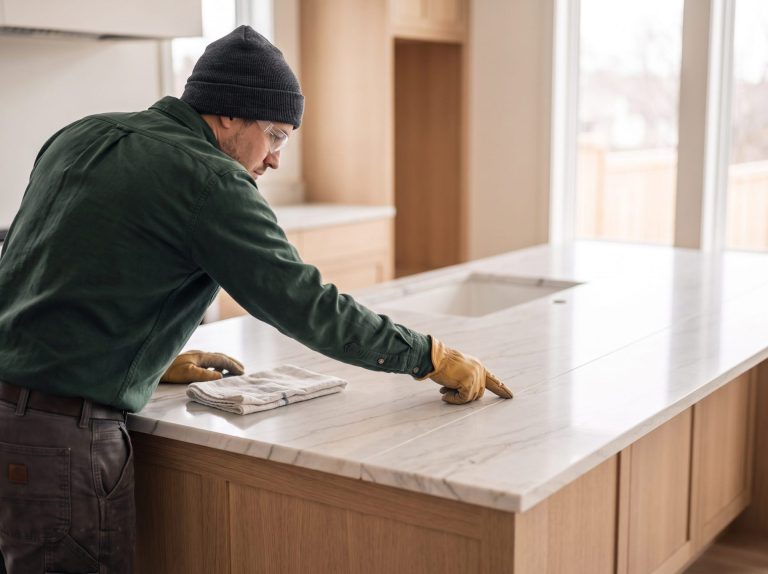
In a full-service model, installers set pieces cut from a layout planned for this space, so a question about a seam or an edge can be traced back through one company’s records. Even so, no installer can make natural stone stain-proof, and every surface needs routine maintenance to stay durable.
Actionable Tip
Before your design consultation, write down three things: the sink, faucet and cooktop models you want, whether the old countertop needs removing, and where you would accept a seam on your longest run. Then ask the stone company which of those stages it handles and who owns the measurements. The answers show you how the whole project will be coordinated.
How Does a Full-Service Stone Company Compare With a Separate Fabricator and Installer?
One full-service stone company keeps responsibility for every stage in one place, while separate trades split the work, and the measurements, across several businesses.
| Question | One full-service stone company | Separate supplier, fabricator and installer |
|---|---|---|
| Who owns the measurements? | The company that also cuts and installs the stone | Often the fabricator, with the installer relying on its template |
| Who plans seams and veining? | Planned on the slab you chose | Depends on who receives the slab and the template |
| Who removes the old countertop? | Scheduled as part of the project | Often a separate booking |
| Who answers questions? | One contact for the whole project | A different contact at each stage |
| Where does a problem go? | One company | Shared between businesses |
Separate trades can still produce good work, and some buyers prefer to choose each business. If you go that way, ask who owns the template, because it is the hand-off point between fabrication and installation.
Who Does a Full-Service Stone Company Serve in the Denver Metro?
A full-service stone company in the Denver metro serves residential and commercial work: homeowners, commercial builders and clients, and contractor and designer partners.
- Homeowners: A homeowner usually needs guidance through every decision, from the stone to the edge profile, and one contact for the whole project.
- Commercial clients: Commercial work for schedule-sensitive hotels, restaurants and sports venues depends on dependable coordination between fabrication and installation.
- Contractors and designers: Contractors and interior designers often rely on a stone fabricator as a long-term fabrication partner and bring their own drawings and specifications.
The stages stay the same for all three; what changes is who decides and how installation fits the wider construction schedule.
How Does Granite and Marble Designs Run a Project From Design to Installation in Denver?
Granite and Marble Designs runs each project in Denver through its StoneDoneRight™ process, a documented sequence that starts with design and ends with sealed, installed stone.
Granite and Marble Designs is a natural stone supplier and countertop contractor in Denver that has served the Denver metro and the wider Colorado region since 2007. It was co-founded by Michael Clifton and Jack Wilt, and its full-service model covers design, fabrication and installation for homeowners, commercial builders, and contractor and designer partners.
The StoneDoneRight™ process follows five steps:
- Design consultation: A personalized design consultation settles the stone and the plan.
- Engineering and slab layout: Expert engineering and slab layout place every piece on the chosen slab.
- Fabrication: Precision CNC fabrication cuts and finishes each piece.
- Demolition: Professional demolition removes the old countertop.
- Installation: Meticulous installation finishes the project with high-quality sealing and near-imperceptible seams.
The company has worked on projects for 1,354+ homeowners, 1,650+ commercial projects and 1,400+ contractor projects, and it has earned eight Parade of Homes awards between 2008 and 2020.
Frequently Asked Questions
What does full service mean for a stone company?
Full service means one stone company handles the whole residential or commercial project instead of a single stage. It covers the design consultation, slab selection, templating, slab layout, fabrication, removal of the old countertop and installation with sealing where the stone needs it. The buyer works with one business from the first conversation to the finished countertop, and that business is responsible for how the stages connect.
Is a full-service stone company the same as a countertop contractor?
Not always. A countertop contractor installs countertops and may buy fabricated pieces from someone else, while a full-service stone company also supplies and fabricates the stone. Some businesses fill both roles. Granite and Marble Designs, for example, works as a natural stone supplier and countertop contractor in Denver, covering design, fabrication and installation. Ask any company which stages it covers before you commit.
What should you bring to a stone design consultation?
Bring photos of the space, cabinet drawings or measurements, and pictures of your cabinet finish, flooring and tile. If you have already chosen the sink, faucet and cooktop, bring the model details, because cutouts are cut to those exact fixtures. A short note on how you use the space, such as cooking habits and daily wear, helps the consultant recommend stones that suit it.
Do you have to choose your slab in person?
Choosing in person is strongly recommended for natural stone. Slabs sold under the same name vary in color, pattern and veining, so a small sample can’t show how a full island or long run will look. At a showroom you can compare whole slabs in daylight and mark the exact one your countertop will be cut from.
Does a full-service stone company remove the old countertop?
Many do, and it’s worth confirming before you start. Removal of the old countertop, often called demolition, is one of the documented steps of the StoneDoneRight™ process at Granite and Marble Designs. When demolition sits inside the same project, it is planned around templating and installation, so the cabinets are protected and the measurements for the new stone still match the space.
When are cabinets and fixtures finalized in a stone project?
Cabinets and fixtures need to be final before templating. The template records the exact shape of the installed cabinets and the positions of the sink and cooktop, and every piece is cut from it. If a cabinet moves or a fixture changes after templating, the space usually has to be measured again before the slab is cut, because cut stone can’t be made bigger.
Does natural stone need sealing after installation?
Granite and marble both need periodic sealing, and sealing is not optional for those stones. Sealing helps slow how quickly the stone absorbs liquids, but it doesn’t make any natural stone stain-proof. Engineered quartz is not a natural stone and doesn’t absorb liquids the way natural stone does, yet it still needs routine care. Ask your stone company which care steps suit your chosen material.
Planning a Denver Countertop Project With One Company From Start to Finish
A full service stone company gives a Denver countertop project one path and one point of responsibility, from the design consultation to the sealed stone in your kitchen or bathroom. The path runs most smoothly when your decisions come early: choose the slab in person, finalize cabinets and fixtures before templating, approve the layout, and settle the edge and finish before the first cut. With those choices made, each stage can build on the one before it.
Call (303) 529-1932 to map out your project from the design consultation to installation day, or send a message with your plans and a few photos of the space through the contact page.