
What Bathroom Countertop Ideas Work in Denver Homes?
The bathroom countertop ideas that work best in Denver homes are custom stone vanity tops matched to how the space is used. Granite and quartz suit busy family bathrooms, marble and quartzite suit primary baths and powder rooms, and every one of them is cut to the exact cabinet with the sink cutout planned in advance.
You probably notice your vanity most on the mornings when it fails you. The counter is too shallow to hold anything beside the faucet, the sink rim traps toothpaste, the surface stains where a bottle of toner sat overnight, and the whole space feels smaller than the square footage suggests. None of that is a decorating problem, and no amount of new hardware fixes it.
Almost all of it traces back to decisions made before the countertop was cut: the cabinet depth, the material, the sink style, and the edge. Get those four right and a modest vanity works beautifully. Get them wrong and even an expensive slab feels like a compromise every day.
In this guide, you’ll learn which vanity layouts suit different Denver bathrooms, how granite, quartz, marble and quartzite actually behave in a bathroom, which sink and faucet choices change the way the stone is cut, and how edges, backsplashes and finishes pull the space together.
Which Vanity Layout Suits Your Bathroom?
Layout comes before material, because the footprint decides everything that follows. A vanity that fits the space comfortably leaves room to open drawers, stand at the sink, and move past without catching a hip on a corner.
Four patterns cover most Denver bathrooms, and each one asks something different of the countertop.
| Layout | What the stone top needs to do | Suits |
|---|---|---|
| Single vanity | Hold one sink with usable counter on one or both sides | Family and guest bathrooms |
| Double vanity | Span two sinks with enough counter between them to be usable | Shared primary baths |
| Floating vanity | Work as a narrow top on a wall-mounted cabinet | Small spaces where visible floor matters |
| Powder room vanity | Carry a small, highly visible surface | Half baths where the stone is the feature |
Counter depth is the decision homeowners skip and later regret. A standard depth suits most bathrooms, a shallower top frees walking space in a narrow space, and a deeper top gives you room behind the faucet for the things that otherwise crowd the sink. Because depth affects cabinet selection and plumbing placement, it belongs in the first conversation rather than the last.
Clearance matters just as much as the cabinet itself. Check the door swing, the shower entry and the towel bar before you settle on a width, since a vanity that measures well on paper can still make the space awkward to use.
Which Stone Works Best on a Denver Vanity?
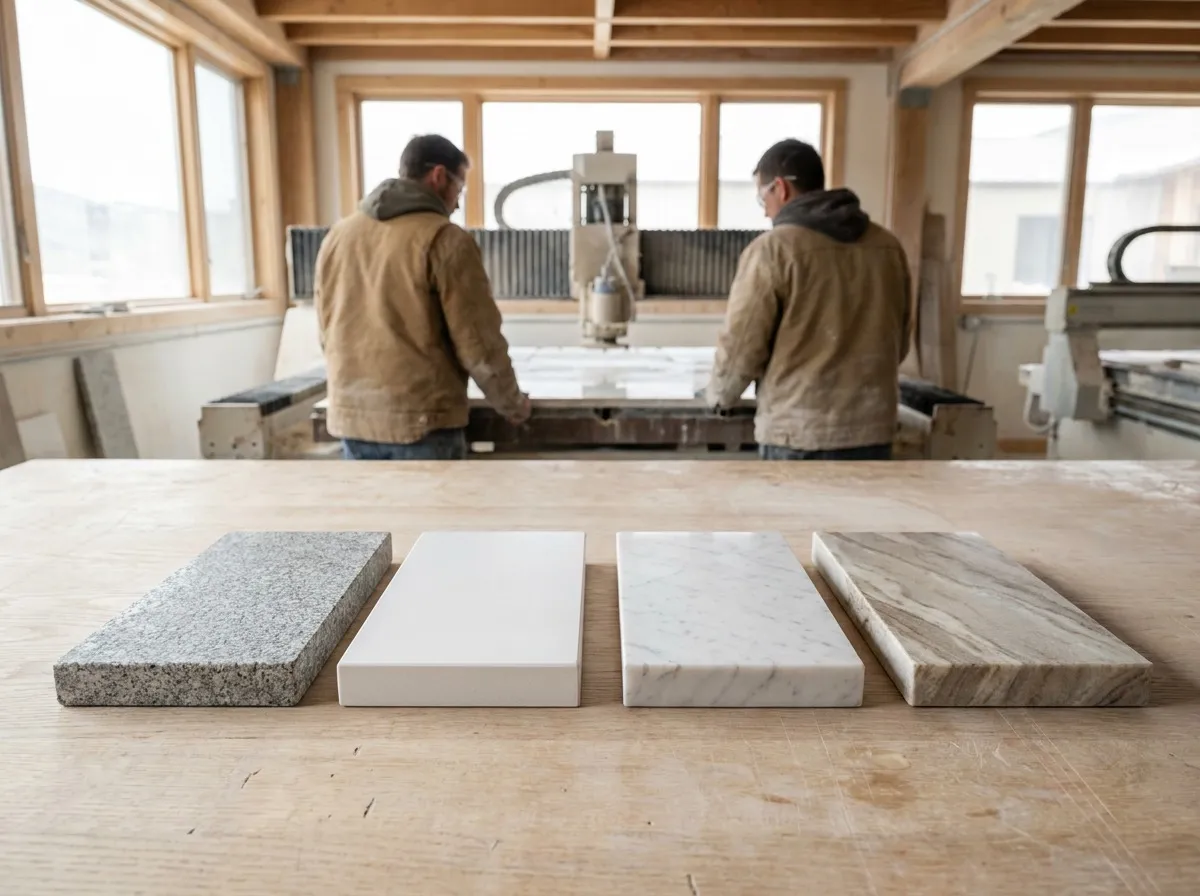
Bathrooms are gentler than kitchens in some ways and harsher in others. There is no chopping and very little heat, but there is standing water at the faucet, hairspray overspray, and a cabinet full of acidic products, so material behaviour matters more than appearance alone.
Granite
Granite is a dense natural stone that takes daily bathroom use well and comes in a wide range of colours and patterns. It needs periodic sealing like any natural stone, and unlike marble it does not etch from the weak acids in most bathroom products, which is why it remains a practical pick for the busiest space in the house.
Engineered Quartz
Quartz is engineered stone, made by combining quartz aggregate with resin binders, so colour and pattern stay consistent from one slab to the next. That consistency appeals to homeowners who want a calm, uniform surface, and the material does not require sealing. It is not heat-proof, which matters less on a vanity than it does in a kitchen.
Marble
Marble gives you veining no other material reproduces, and each vanity top is genuinely one of a kind. Marble is porous and etches when acidic products sit on it, so it belongs in a primary bath or powder room where a gentle cleaning routine is realistic rather than aspirational.
Quartzite
Quartzite is a natural metamorphic stone, harder than granite, with the kind of movement people usually associate with marble. It needs periodic sealing, and it suits a homeowner who wants natural character on a surface that puts up with a lot.
| Material | Etches from bathroom acids | Sealing | Character |
|---|---|---|---|
| Granite | No, not from weak acids | Periodic | Wide colour and pattern range |
| Engineered quartz | No | None required | Consistent, uniform pattern |
| Marble | Yes | Periodic | Soft veining, unique per slab |
| Quartzite | No | Periodic | Marble-like movement, very hard |
Whichever direction you lean, view the full slab rather than a sample chip. Veining that reads as quiet on a four-inch piece can dominate a vanity top, and the fastest way to settle it is to pick out a slab in person with your cabinet sample in hand.
How Do Sink and Faucet Choices Change the Countertop?
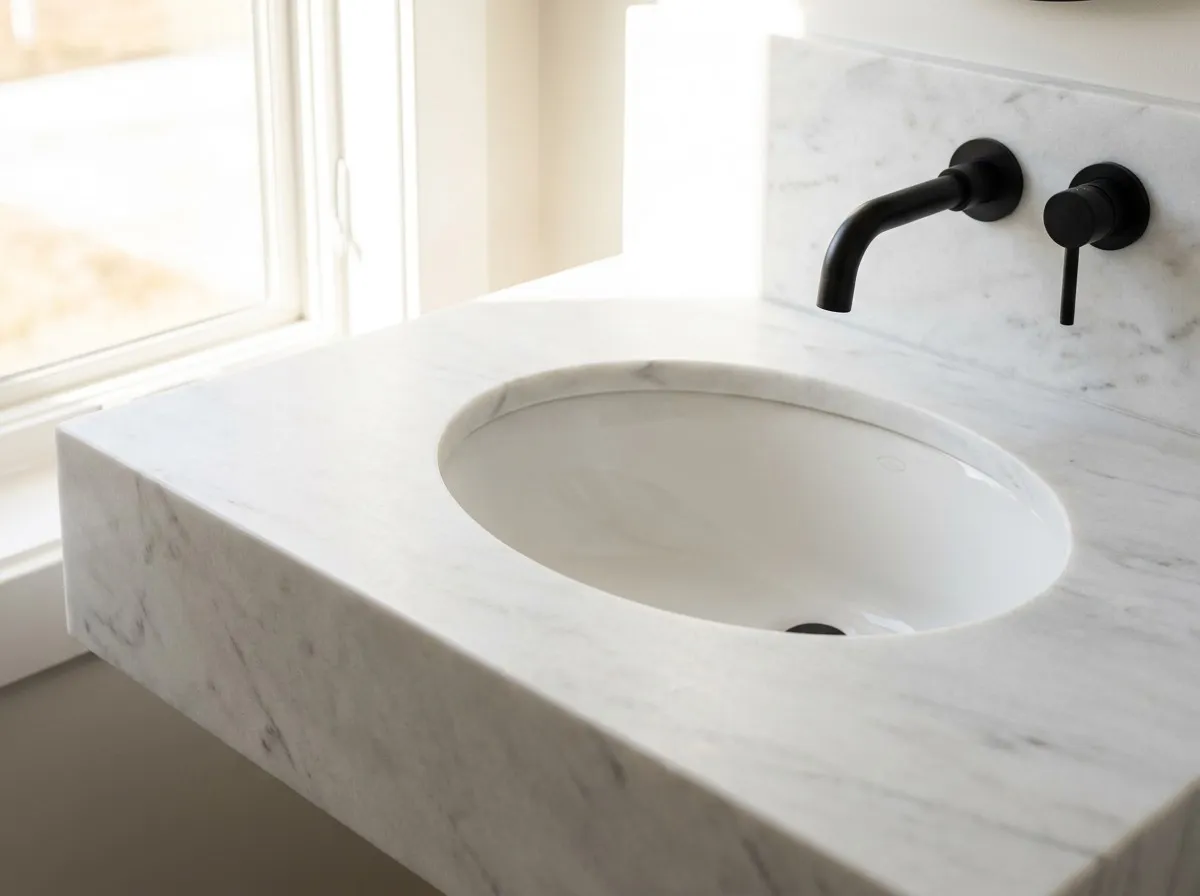
Sink style and countertop are a single decision, because the cutout, the surrounding stone and the faucet holes are all machined during fabrication. Choosing the sink after the slab is cut is not an option.
Undermount sinks sit below the counter and leave a clean stone edge around the basin, which wipes down in one pass and keeps the surface uninterrupted. Vessel sinks sit on top like a bowl, turn the sink into the focal point, and need a taller faucet and a lower cabinet to stay comfortable. Drop-in sinks rest in the opening with the rim on the stone, which is the practical route when you are reusing an existing basin.
Faucet details drive the rest of the cutting plan, and they are easy to leave until too late:
- Whether the faucet is deck-mounted on the counter or mounted on the wall
- How many holes it needs and how far apart they sit
- Whether a soap dispenser or filtered tap needs a hole of its own
- How much clearance sits between the faucet and the backsplash or mirror
Bringing the actual sink and faucet specifications to your consultation is what makes bathroom countertop installation straightforward rather than a series of phone calls during fabrication.
How Do Edges, Backsplashes and Finishes Finish the Space?
The details around the counter are what make a vanity look finished, and they are the ones most often decided in a hurry. A bathroom counter sits at hip height in a space where people move closely past it, so a softer edge usually beats a sharp one.
An eased edge keeps a modern, square line with the corners taken off. A half bullnose rounds the top and feels comfortable to lean against. A bevel adds a crisp facet that catches light. All three wipe clean easily, which matters more in a bathroom than an intricate profile does.
| Edge profile | How it reads | Why it works on a vanity |
|---|---|---|
| Eased | Square with the corners taken off | Clean modern line, wipes down in one pass |
| Half bullnose | Rounded top, flat face | Comfortable to lean against, sheds water |
| Bevel | Angled facet along the top | Adds a light-catching line without curves |
| Pencil | Narrow rounded top, flat face | Softens a square edge without rounding it fully |
Backsplash height sets the tone of the vanity area:
- Short stone backsplash: a few inches of matching stone that keeps water off the drywall
- Full-height stone backsplash: stone carried up the wall, which draws the eye upward and simplifies cleaning
- Tile backsplash: more pattern options, with grout lines that need occasional attention
- No backsplash: workable with a well-sealed wall finish and a sink placed away from heavy splashing
Finish is the last piece. A polished surface reflects light and deepens colour, which helps a windowless space feel brighter, while a honed surface has a soft matte look that hides minor etching and water spots more readily. Both perform well, so the decision is about the look you want to live with.
What Granite and Marble Designs Provides for Bathroom Projects
Granite and Marble Designs has worked with Denver homeowners, contractors and commercial clients since 2007, and the work runs through the StoneDoneRight™ process from the first conversation to the final seal. A countertop contractor in Denver, CO that handles every stage keeps the details consistent, which is exactly what a small space demands.
Stone design consulting covers slab selection, recommendations based on how the space is actually used, and project management from selection through to completion.
Stone fabrication includes laser templating that measures the real cabinet and walls, slab layout that decides where the veining lands, and CNC fabrication with SABERjet equipment for cutouts, edges and finishes.
Demolition covers removal of the old countertop so the new top goes onto a clean, level cabinet.
Stone countertop installation finishes the work with high-quality sealing and near-imperceptible seams where pieces meet.
Slab and remnant inventory matters more on a vanity than anywhere else, because a bathroom top often comes from part of a slab, and a remnant can put a striking piece of stone within reach.
If you are weighing layouts and materials, you can schedule a design consultation about your vanity layout and bring your cabinet details with you.
Key Takeaways
- Layout and counter depth are the first decisions, not the last. They determine cabinet choice, plumbing placement and how much usable surface you end up with, so settle them before you shop for stone.
- Granite and engineered quartz suit busy family bathrooms because neither etches from the weak acids in everyday bathroom products. Both handle daily use without special handling.
- Marble and quartzite bring natural character, with marble reserved for spaces where gentle, pH-neutral cleaning is realistic. Quartzite gives you similar movement on a much harder surface.
- The sink has to be chosen before fabrication, because the cutout is sized to that specific basin. The same applies to the faucet and any additional deck fittings.
- Softer edge profiles such as eased and half bullnose are the practical choice in a bathroom, where people pass close to the counter every day.
- Finish changes how the space feels. Polished stone reflects light in a windowless bathroom, while honed stone hides minor etching and water spots more readily.
Frequently Asked Questions
What is the most practical countertop material for a family bathroom?
Granite and engineered quartz are the most practical choices because they handle heavy daily use and do not etch from common bathroom products. Both come in colours that suit almost any cabinet finish.
Can I put marble in a bathroom that gets heavy use?
You can, but marble etches when acidic products sit on it. In a heavily used bathroom, choose a honed finish, keep toiletries on trays, and clean with pH-neutral products to keep etching to a minimum.
Does a bathroom countertop need sealing?
Granite, marble and quartzite need periodic sealing to resist absorbing liquids. Engineered quartz does not require sealing. A simple water-drop test tells you when natural stone is ready to be resealed again.
How deep should a bathroom vanity countertop be?
Standard depth suits most bathrooms, though a shallower top frees up floor space in a narrow bathroom. Confirm depth with your fabricator before cabinets are ordered, since it affects plumbing and sink fit.
Can a stone top fit my existing vanity cabinet?
Usually yes, provided the cabinet is level, sound and the right depth. Laser templating measures the actual cabinet and walls, so a custom top fits far more precisely than a stock vanity top would.
Which sink style keeps the counter easiest to clean?
An undermount sink leaves a smooth stone edge around the basin with no rim to trap residue, so the counter wipes down in one pass. It is the most common choice on stone vanity tops.
Is a full-height backsplash worth it in a small bathroom?
It often is. Carrying stone up the wall protects more drywall, removes a grout line behind the faucet, and draws the eye upward, which makes a compact space feel taller and more finished.
What edge profile is safest around children?
Rounded profiles such as full and half bullnose soften the corner and are gentler on impact. Square and sharply beveled edges look crisp but are less forgiving in a busy family bathroom.
Should I pick polished or honed stone for a vanity?
Polished stone reflects more light, which brightens a bathroom with little natural light. Honed stone has a matte surface that hides minor etching and water spots. Both perform well on a vanity.
Can I use a remnant for a bathroom countertop?
Often yes. Vanity tops are small enough that a remnant frequently covers them, which can bring a striking slab within reach. Availability changes, so check what is in the inventory when you visit.
Conclusion
A bathroom vanity works when the decisions behind it were made in the right order. Layout and depth first, then the material that matches how the space is really used, then the sink and faucet, and finally the edge, backsplash and finish that pull it together.
Take them in that sequence and the finished vanity feels comfortable from the first morning, not just photogenic. View slabs in person, bring your cabinet and fixture details, and let the fabricator template the actual space before anything is cut.
Call Granite and Marble Designs at 303-536-8808 to schedule a design consultation about your bathroom vanity.