
Stone Countertop Remnants: Quality Projects at Lower Cost
Stone countertop remnants are leftover slab pieces from previous projects, sold at 40 to 70 percent below full-slab pricing. Denver remnants work for small projects (bathroom vanities, laundry rooms, bar tops, fireplace hearths) and let homeowners access premium stone at reduced cost. The tradeoff is limited size and first-come-first-served availability.
Remnants are one of the best-kept secrets in stone countertop pricing. A dramatic Calacatta quartzite that would run $8,000 for a full slab might yield a 20-square-foot remnant available for $1,500 to $2,500. For homeowners with a small project, the savings are substantial and the material quality is identical to full-slab work.
After 18 years of Denver fabrication, remnants deliver some of the most cost-effective projects the shop produces. The applications are specific (small surfaces where a full slab would be overkill) but the value is real. Understanding when remnants work and when they do not helps homeowners direct the technique to projects that benefit.
What Stone Remnants Actually Are
Stone countertop remnants are the leftover pieces from previous fabrication projects. A large kitchen project might consume 60 square feet of a 100-square-foot slab, leaving 40 square feet as remnant. Some fabricators discard these pieces; others keep them in a remnant yard and resell them at reduced prices.
Denver remnant availability varies by fabricator. Shops that regularly cut large projects generate substantial remnant inventory; shops that focus on small projects have less. The stone remnant inventory at Granite and Marble Designs typically holds 100 to 300 pieces at any given time across material categories, all cut from natural dimension stone varieties as well as engineered quartz.
The pricing model reflects the fact that remnants are unsold inventory. The original slab cost has been recovered by the project that produced the full-slab work. Remnants get priced to move at a substantial discount from full-slab pricing:
- Small remnants (under 15 square feet). Typically 50 to 70 percent below full-slab pricing.
- Mid-size remnants (15 to 30 square feet). Typically 40 to 60 percent below full-slab pricing.
- Large remnants (30+ square feet). Typically 30 to 50 percent below full-slab pricing.
The discount reflects both the size limitation and the shop’s incentive to clear inventory. The material itself is identical to full-slab material because it comes from the same slabs.
Best Applications for Remnants
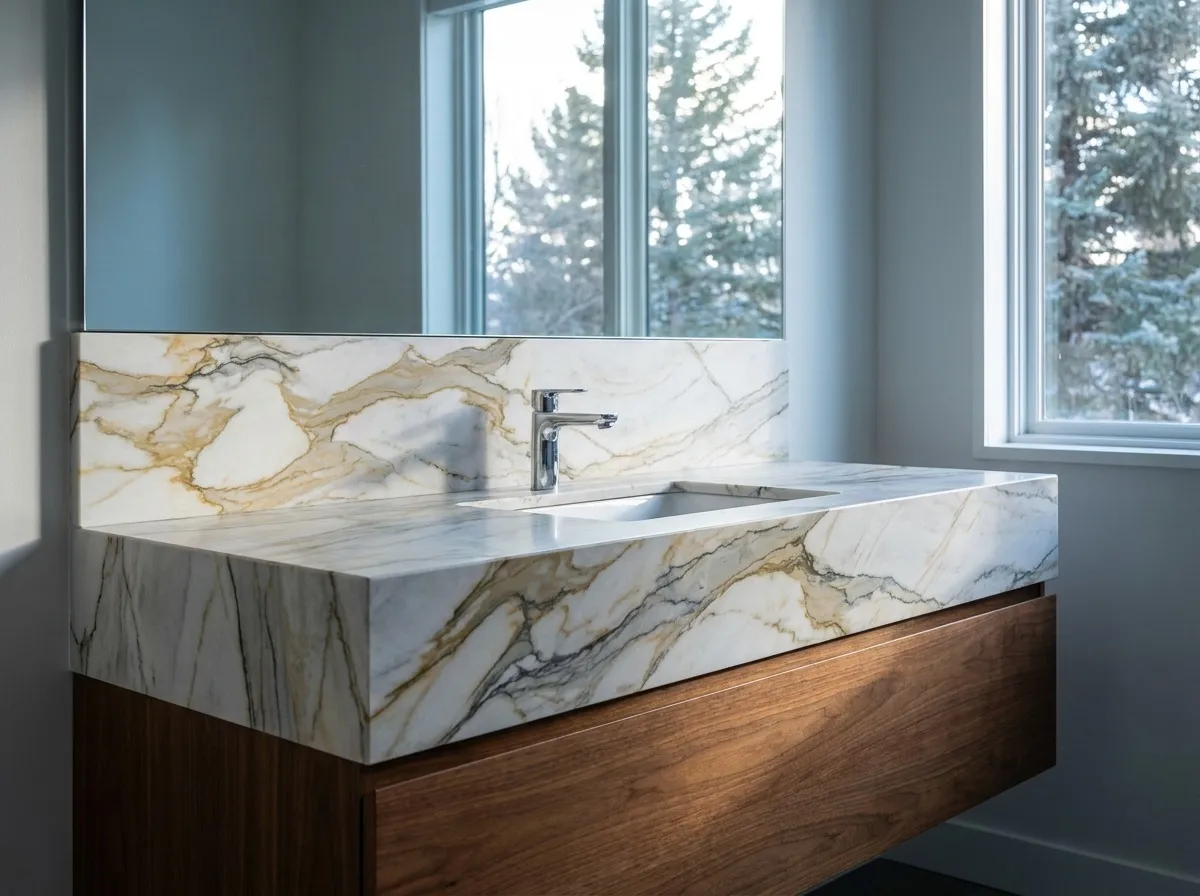
Remnants shine in specific applications where the size limitation is not a constraint. Common Denver applications where remnants deliver excellent value:
- Bathroom vanities. Most common remnant application. Standard vanity tops run 15 to 25 square feet; powder room vanities run 6 to 10 square feet. Remnants let homeowners access premium quartzite or exotic granite that would be cost-prohibitive as full-slab work.
- Laundry room counters. Typically 10 to 20 square feet, a natural fit for remnants. Well-priced remnants produce beautiful laundry room counters without full-slab investment.
- Bar tops and beverage centers. Run 8 to 15 square feet in most residential applications. Backlit onyx home bars, butler’s pantry counters, and wet bar surrounds all work with remnant sourcing.
- Fireplace hearths and accent surfaces. Typically 6 to 20 square feet. Remnants let homeowners specify dramatic stone for hearths without full-slab cost, particularly when the hearth material differs from the main countertop stone.
- Small kitchen islands. Under 25 square feet can sometimes work with a single remnant piece, though the sizing has to match specific remnant availability rather than any custom dimension.
Homeowners bring specific project dimensions to the stone fabrication services team so remnants get matched to real applications quickly.
What Remnants Cannot Do
Being clear about remnant limitations prevents the most common form of remnant disappointment:
- No custom sizing beyond the remnant dimensions. A remnant that is 4 feet by 7 feet cannot become a 5-foot by 8-foot counter. The project must fit within the remnant’s actual dimensions.
- No exact matching for future replacement. If part of a remnant install needs replacement in 10 years, matching material will not be available because that specific slab is gone.
- No book matching from remnants. Bookmatch pairs are always full-slab; remnants are single pieces.
- Limited color and pattern selection at any given time. The remnant yard has whatever comes in from previous projects, which may not include the specific stone the customer wants.
- First-come-first-served availability. A perfect remnant available today may be gone tomorrow. Decisions on remnants need to happen quickly.
These limitations do not disqualify remnants for small projects; they just require the homeowner to be flexible about specific stone choice and decisive when the right remnant appears.
How to Shop Remnants Effectively
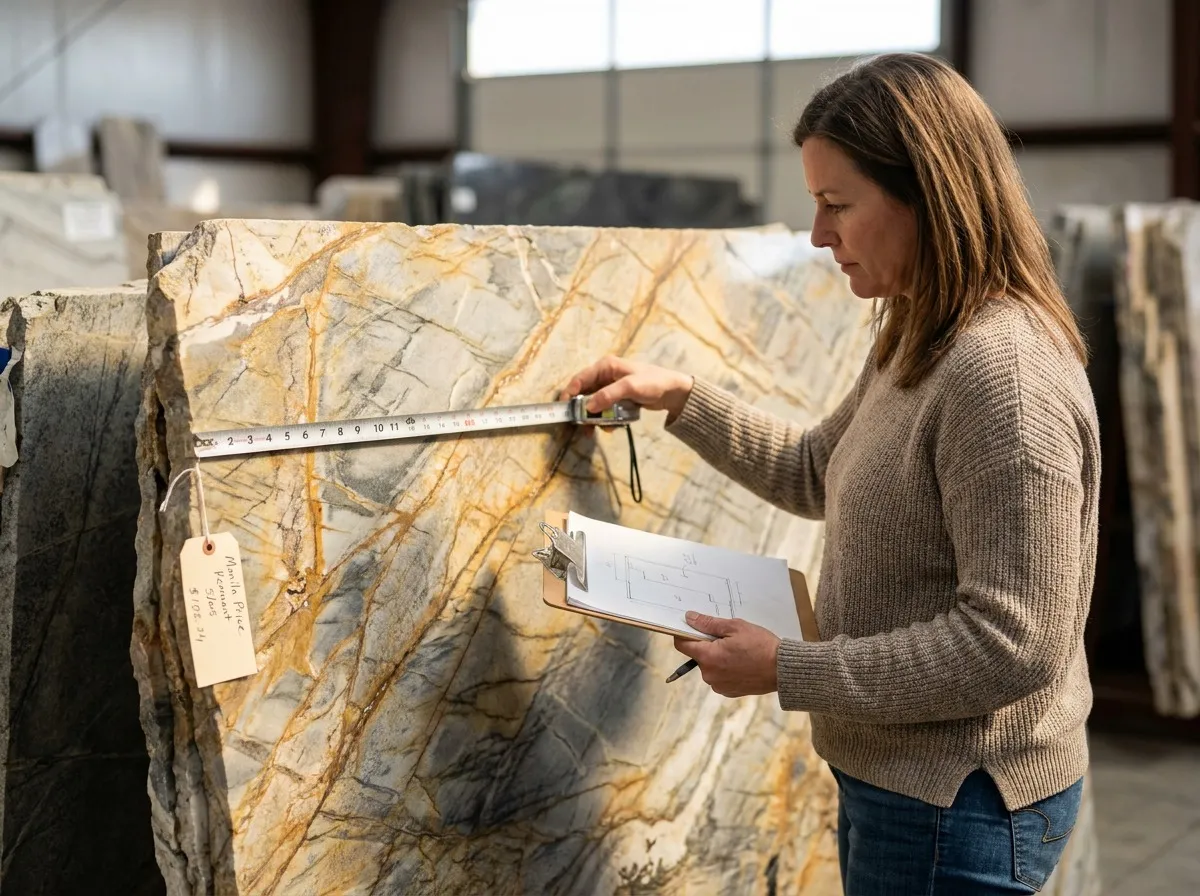
Remnant shopping works differently from full-slab shopping. Understanding the process helps homeowners find the right remnant for a project:
Bring project dimensions before shopping. A specific measurement of the surface being fabricated (length, width, cutouts) helps quickly identify remnants that fit. Guessing at dimensions during the visit wastes both the homeowner’s and the fabricator’s time.
Visit the yard in person. Photos of remnants do not convey the color, pattern, and character the way seeing pieces in person does. Denver remnant yards are typically organized by material category, letting customers walk through granite, quartz, marble, and quartzite sections systematically.
Understand pricing at the visit. Remnant prices are usually attached to each piece with a tag showing dimensions and price. Comparing prices across similar pieces helps identify the best value. The full stone inventory at Granite and Marble Designs shows current remnant availability.
Be ready to decide same-day. Popular remnants sell quickly. A customer who wants a specific remnant but takes 2 weeks to decide will typically find it gone. Decision-ready shopping produces better outcomes.
Ask about fabrication timeline. Remnants often move through fabrication faster than full-slab projects because the material is already at the shop. Typical remnant fabrication runs 1 to 2 weeks from purchase to install, versus 2 to 4 weeks for full-slab.
Fabrication Considerations for Remnant Projects
Stone fabrication services for remnant projects use the same equipment and techniques as full-slab work but with a few specific considerations.
Templating happens the same way, but the templating file has to fit within the specific remnant dimensions rather than being optimized against a large slab. Sometimes creative layout (using the natural slab edge as one edge of the counter, orienting cutouts to fit within the remnant’s pattern) produces better results than forcing a standard layout.
Edge profile choice matters more on remnants because the material is limited. A homeowner who wants an ornate edge that consumes 2 inches of the counter perimeter needs a remnant that has 2 inches of extra material beyond the finished dimensions. Simpler profiles waste less material.
Seam decisions are different. On full-slab projects, seams get planned for aesthetics. On remnant projects, seams may be forced by the piece’s original shape. A homeowner selecting a remnant that requires a seam has to accept the seam location as part of the deal.
Sealing and finishing happens the same way as full-slab work. Remnant material is identical to full-slab material, so the finish quality, hardness, and durability are all the same. There is no compromise on the actual stone.
Combining Remnants with Full-Slab Projects
An interesting Denver design pattern combines full-slab work for the primary counters with remnant work for smaller adjacent surfaces. The combination delivers coordinated design at reduced total cost:
A kitchen with full-slab granite counters plus a remnant bathroom vanity in coordinating stone reads as intentional design continuity rather than budget compromise. The homeowner accesses two stone surfaces for the cost of one full slab plus one small remnant.
A great room with a granite fireplace surround plus remnant hearths and side tables uses the same stone throughout the room without paying full-slab pricing for every surface. The design coherence stays intact.
Coordinating the two purchases requires timing. The full-slab project happens first, and the shop may set aside the resulting remnant specifically for the coordinated small project. Some homeowners plan both purchases together to ensure the remnant will be available.
Warranty and Quality on Remnant Projects
Remnant projects carry the same fabrication and install warranty as full-slab projects. The material is identical, the fabrication techniques are the same, and the quality control gates apply consistently. There is no reason to expect lower quality from a remnant install than from a full-slab install.
Manufacturer warranties on engineered quartz remnants transfer to the new project the same way they would on full-slab work. Natural stone remnants have no manufacturer warranty in either case because the material comes from the earth.
The only warranty consideration specific to remnants is the future-matching issue. If a remnant install develops damage 10 years later, the specific stone will not be available for exact matching. This risk is inherent to remnant work and worth accepting up front rather than being surprised by later.
Key Takeaways
- Stone remnants are leftover slab pieces from previous projects, sold at 40 to 70 percent below full-slab pricing.
- Best applications include bathroom vanities, laundry rooms, bar tops, fireplace hearths, and small kitchen islands.
- Limitations include size constraints, no exact future matching, no bookmatching, and first-come-first-served availability.
- Denver remnant yards typically hold 100 to 300 pieces across material categories with prices tagged on each piece.
- Fabrication runs faster than full-slab projects (1 to 2 weeks vs 2 to 4 weeks) because material is already on-site.
- Combining full-slab primary counters with coordinating remnant work for adjacent surfaces produces design continuity at reduced total cost.
Frequently Asked Questions
How much do stone remnants cost compared to full slabs?
Remnants typically run 40 to 70 percent below full-slab pricing. Small remnants (under 15 square feet) see the largest discount (50 to 70 percent). Mid-size remnants (15 to 30 square feet) run 40 to 60 percent below. Large remnants (30+ square feet) run 30 to 50 percent below. The discount reflects both the size limitation and the shop’s incentive to clear inventory.
What projects work best with remnants?
Bathroom vanities (10 to 25 square feet), laundry room counters (10 to 20 square feet), bar tops (8 to 15 square feet), fireplace hearths (6 to 20 square feet), and small kitchen islands (under 25 square feet). Any project that fits within a typical remnant piece and does not require future matching is a candidate.
Are remnants lower quality than full-slab material?
No. Remnants are the same material as the original full slab; they were just leftover after the original project’s cuts. Fabrication techniques, quality control, sealing, and finishing all happen the same way. There is no quality difference between a remnant install and a full-slab install of the same material.
Can I use remnants for a full kitchen countertop project?
Rarely. Full kitchens typically require 50 to 80 square feet of continuous material, which exceeds most remnant sizes. A remnant might work for a small galley kitchen or a compact island, but most full kitchens need full-slab work. Combining full-slab primary counters with remnant secondary surfaces is more common than remnant-only kitchens.
How do I find remnants in Denver?
Visit Denver stone fabricators’ remnant yards. Most fabricators keep remnants organized by material category with prices tagged on each piece. Bring specific project dimensions to identify remnants that fit. Call ahead to confirm remnant availability, as inventory changes frequently.
Can remnants be book-matched?
No. Bookmatching requires two adjacent slabs cut from the same quarry block. Remnants are single pieces left over from previous projects. If a bookmatched effect matters, full-slab bookmatched pairs are required.
How long does a remnant project take from purchase to install?
Typically 1 to 2 weeks from purchase to install. The fabrication timeline is shorter than full-slab work because the material is already at the shop. Templating happens after purchase, fabrication runs 5 to 10 days, and install typically takes 1 day for a small project.
Can I combine multiple remnants for one project?
Sometimes, if the pattern and color match well enough that the seams do not read as a jarring transition. Combining remnants of the same variety from adjacent quarry blocks can work; combining random remnants of the same stone name from different quarry runs usually produces visible color mismatch. A fabricator can assess whether specific remnants combine well.
Are engineered quartz remnants available?
Yes. Quartz remnants are less common than natural stone remnants because engineered quartz is often ordered in specific sizes for specific projects, but Denver fabricators do maintain quartz remnant inventory. Quartz remnants get priced with the same discount pattern as natural stone remnants.
What if I find a great remnant but do not have a project ready?
Buy it and plan the project. Denver fabricators can hold remnants for reasonable periods (typically 30 to 60 days with a deposit) to give the homeowner time to complete design decisions. Popular remnants sell quickly, so waiting for the project to be ready before buying often means missing the remnant.
Next Step
Remnants deliver premium stone at reduced cost for the right small project. Walking the Denver remnant yard with specific project dimensions in hand produces the best matches.
Author
Elliot Nunes Lead Design Consultant and Senior Stone Specialist Granite and Marble Designs, Denver, CO 80221
Elliot Nunes has directed hundreds of remnant projects across Denver over 18 years, from bathroom vanities in premium quartzite to fireplace hearths in dramatic marble. His approach helps homeowners identify when remnants deliver value and when full-slab work is the better choice.