
Kitchen and Bathroom Countertop Remodeling Guide for Denver Homes
A countertop remodel is one of the highest-impact upgrades you can make to a Denver kitchen or bathroom — often changing the entire feel of the room without a full renovation. The typical project takes two to three weeks from consultation to completion and starts with material selection, not demolition.
If your kitchen countertops are chipped laminate from the early 2000s or your bathroom vanity still has the builder-grade surface that came with the house, you already know it’s time for a change. What you might not know is how straightforward a kitchen countertop remodel actually is when you work with the right team. You don’t always need new cabinets. You don’t always need to gut the room. Sometimes, replacing the countertops transforms the space entirely. Granite & Marble Designs has guided over 4,400 Denver homeowners, contractors, and commercial clients through exactly this process since 2007.
This guide covers everything you need to plan a countertop remodel in Denver — kitchens, bathrooms, and multi-room projects. When to replace countertops, how to coordinate with your existing cabinets and flooring, what the timeline actually looks like, and how to avoid the mistakes that derail renovation projects.
When Is It Time to Replace Your Kitchen or Bathroom Countertops?
Replace your countertops when you see structural damage (chips, cracks, delamination), persistent staining that cleaning can’t fix, outdated materials that hurt your home’s value, or when you’re already renovating cabinets or flooring and want a cohesive update. Cosmetic wear alone doesn’t always require full replacement — but functional damage usually does.
Not every scratched countertop needs replacing. A granite surface with a small chip can be repaired with color-matched epoxy. A quartz countertop with a dull spot might just need professional polishing. But there’s a threshold where repair stops making sense and replacement becomes the smarter investment.
Here are the signals that point toward replacement rather than repair:
- Structural damage beyond repair. Large cracks that span the full thickness of the slab, delamination in laminate surfaces, or burn marks on solid surfaces that can’t be buffed out. Once the structural integrity is compromised, patching is a temporary fix.
- Persistent staining in porous surfaces. Marble or unsealed granite that’s absorbed years of oil, wine, and coffee stains may not respond to poultice treatments. At some point, living with the discoloration costs more in frustration than replacing the surface.
- Material outdated beyond trend cycles. Tile countertops with grout lines, dated laminate patterns, and Corian surfaces from the ’90s can drag down the entire room’s appearance — and your home’s resale value. The National Association of Realtors consistently ranks kitchen and bathroom upgrades among the highest-ROI renovations.
- You’re already renovating the room. If you’re replacing cabinets, flooring, or doing a full kitchen or bathroom renovation, leaving old countertops in place creates an awkward mismatch. Coordinating a countertop replacement with adjacent renovations saves time and money compared to doing it separately later.
| Condition | Repair or Replace? | Why |
| Small chip in granite | Repair | Color-matched epoxy fills chips effectively |
| Large crack through slab | Replace | Structural integrity compromised |
| Surface staining (recent) | Repair first | Professional poultice may restore surface |
| Deep embedded stains (years) | Replace | Chemical extraction has limits |
| Laminate delamination | Replace | Structural failure of substrate |
| Outdated tile countertop | Replace | Grout lines harbor bacteria, date the room |
| Minor dulling or scratching | Repair | Professional re-polishing restores finish |
| Burn marks on solid surface | Replace (usually) | Deep burns can’t be polished out of most materials |
How Do You Plan a Countertop Remodel That Coordinates With Your Existing Space?
Start by identifying what stays and what changes. If your cabinets and flooring are staying, choose a countertop color and material that complements them — not one that demands they be replaced too. Bring a cabinet door or paint swatch to your showroom appointment, and view full slabs under lighting conditions similar to your kitchen.
This is where most remodel projects either come together beautifully or fall apart. The countertop doesn’t exist in isolation. It sits between your cabinets and backsplash, connects to your flooring through visual flow, and sets the tone for the entire room. Choosing a stunning slab that clashes with your cabinet stain or floor tile creates a design problem that’s expensive to fix.
Coordinating With Existing Cabinets
Your cabinet color and style narrow your countertop options in a good way. White or light cabinets pair with nearly everything — dark dramatic granite, subtle white quartz, veined marble. Dark cabinets need contrast, so lighter stone surfaces prevent the kitchen from feeling cave-like. Natural wood cabinets call for stone with warm undertones.
At GMD’s Denver showroom, design consultants help clients compare full slabs against their cabinet samples under different lighting. This prevents the common mistake of picking a color from a 4-inch sample at a hardware store that looks completely different at full scale under your kitchen’s lighting.
Coordinating With Flooring
If your flooring is staying, check the undertone. Cool-toned tile or hardwood needs cool-toned stone to match. Warm honey or red-toned floors pair with warmer stone options. Mixing warm floors with cool countertops creates a visual disconnect that’s subtle but noticeable. Bringing a floor sample to your consultation eliminates this problem.
Backsplash Timing
Here’s a detail many homeowners miss: if you’re replacing countertops, your existing backsplash usually comes off during demolition — especially if it overlaps the countertop edge. Plan your backsplash replacement at the same time as your countertop remodel. Trying to preserve an old backsplash during countertop demolition risks cracking the tiles, and the new countertop height may not match the old backsplash termination line.
A full-height stone backsplash fabricated from the same slab as your countertop creates the most cohesive look. GMD fabricates matching backsplash pieces during the same production run, guaranteeing perfect color and vein continuity.
| Design Element | What to Bring to Consultation | What to Consider |
| Cabinets | Cabinet door or drawer front | Color undertone, wood grain direction |
| Flooring | Floor tile sample or hardwood piece | Warm vs cool undertone matching |
| Backsplash | Photo of current backsplash | Replacement timing, full-height stone option |
| Paint color | Wall paint swatch | Undertone coordination with stone |
| Appliances | Photo of appliance finishes | Stainless, black, white — affects stone contrast |
| Sink and faucet | Model numbers or photos | Undermount vs drop-in, cutout dimensions |
What Does the Kitchen Countertop Remodel Timeline Look Like in Denver?
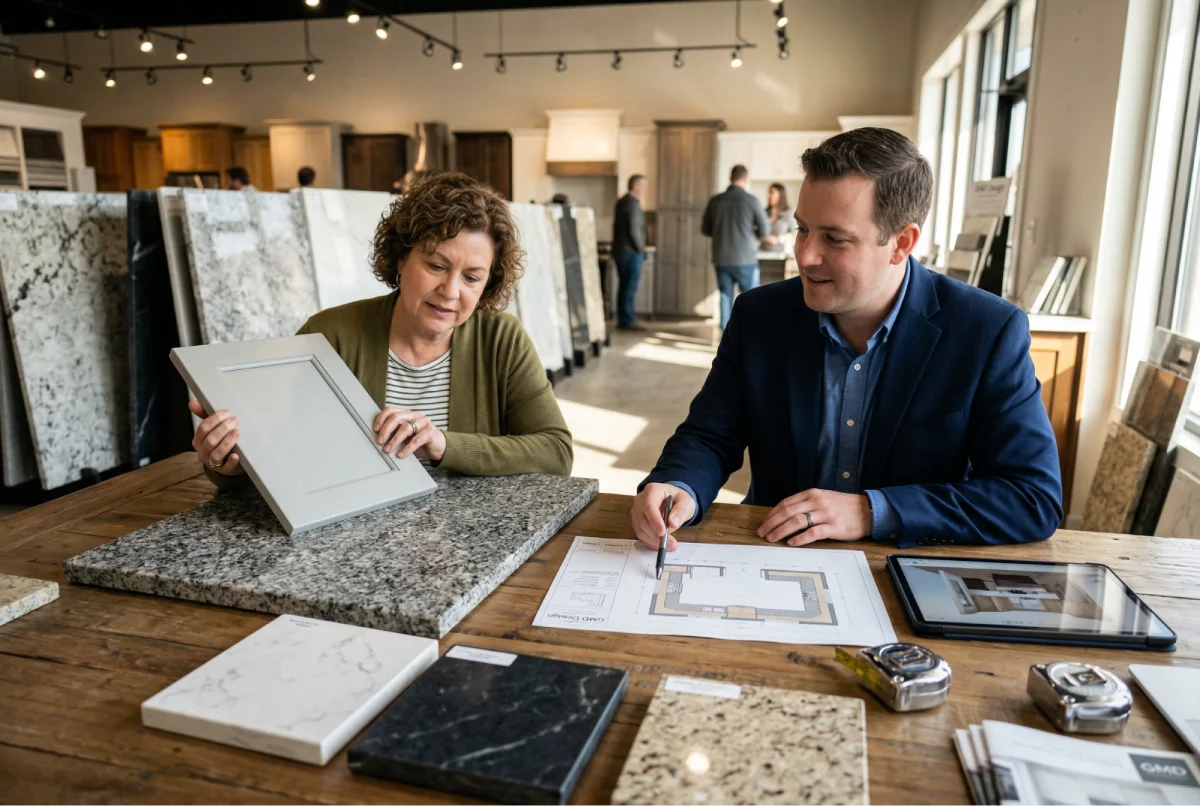
A standard Denver kitchen countertop remodel takes two to three weeks from initial consultation to completed installation. The biggest variable is fabrication time — typically 5 to 10 business days — which depends on material type, project complexity, and current shop volume. Most homeowners are surprised by how little of that time involves actual disruption to their kitchen.
The timeline concern is the one GMD hears most often during consultations: “How long will I be without a kitchen?” The honest answer is usually just one day — installation day itself. Everything else happens at the fabrication shop, not in your home.
Here’s how the StoneDoneRight™ timeline breaks down:
Week 1: Consultation and Material Selection
You visit the showroom, select your stone, choose your edge profile, confirm your sink and cooktop selections, and schedule the template appointment. This visit takes about 45 minutes to an hour. Some homeowners know exactly what they want and wrap up in one visit. Others come back for a second look — and that’s perfectly normal when you’re choosing a surface you’ll live with for decades.
Week 1–2: Template Appointment
A technician visits your home and captures exact measurements with a digital laser templating system. The template appointment takes 30 to 60 minutes. Your old countertops stay in place during this phase — no disruption to your kitchen.
Week 2–3: Fabrication
Your slab is cut, shaped, polished, and quality-inspected at GMD’s Pecos Street fabrication facility. This phase takes 5 to 10 business days. You use your kitchen normally during this time.
Week 3: Installation Day
The installation crew removes your old countertops, sets the new stone, levels and seams everything, installs your undermount sink, reconnects plumbing, and applies sealant. A standard kitchen takes 2 to 4 hours. Larger projects or multi-room remodels may take a full day. By dinnertime, your new countertops are in.
| Phase | What Happens | Duration | Kitchen Disruption |
| Consultation | Material selection, edge choice, project scoping | 45–60 minutes | None |
| Template | Digital laser measurement at your home | 30–60 minutes | Minimal (counters must be cleared) |
| Fabrication | CNC cutting, profiling, polishing at shop | 5–10 business days | None |
| Installation | Demolition, placement, leveling, seaming, sealing | 2–4 hours (standard kitchen) | 1 day |
| Post-Install | Curing period, walkthrough, care instructions | 24–48 hours | Minimal (light use only) |
The total kitchen downtime? Roughly one day. That’s it. The common fear of “weeks without a kitchen” almost never happens with a countertop-only remodel. It’s when countertops are part of a larger renovation — cabinets, plumbing relocation, flooring — that timelines extend into weeks or months.
Key Takeaways
- Takeaway 1: Replace countertops when you see structural damage, deep embedded stains, outdated materials, or when you’re already renovating the room — don’t wait until the damage forces an emergency replacement.
- Takeaway 2: Coordinate your new countertop with existing cabinets, flooring, and backsplash by bringing samples to your showroom visit and viewing full slabs under similar lighting.
- Takeaway 3: Plan your backsplash replacement at the same time as your countertop remodel — old backsplash often comes off during demolition anyway.
- Takeaway 4: A standard Denver kitchen countertop remodel takes 2 to 3 weeks total, with only one day of actual kitchen disruption during installation.
- Takeaway 5: Bathroom countertop remodels follow the same process as kitchens but involve additional moisture protection, sink style considerations, and height requirements.
- Takeaway 6: Working with a single company that handles design consultation, fabrication, and installation eliminates coordination headaches between multiple contractors.
What’s Different About Bathroom Countertop Remodels Compared to Kitchens?
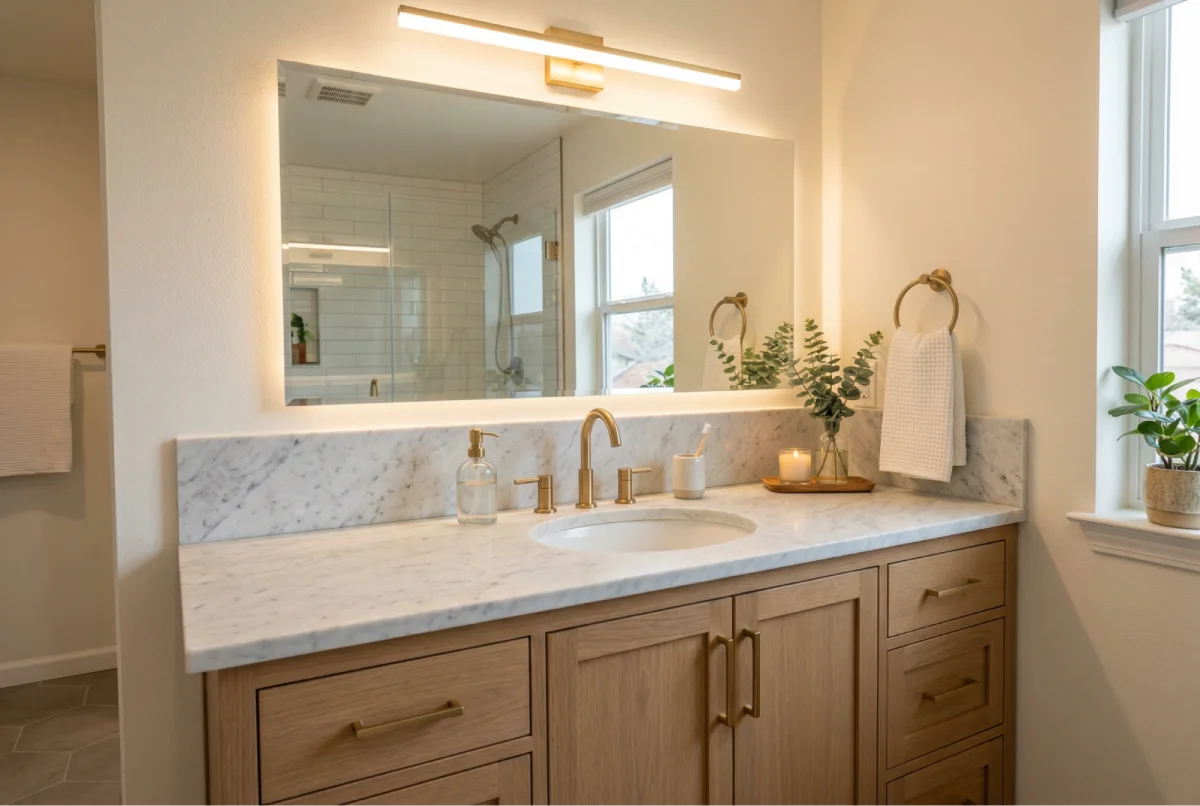
Bathroom countertop remodels share the same fabrication and installation process as kitchens, but differ in three key areas: moisture exposure demands more careful material selection and sealing, sink configurations vary more widely (undermount, vessel, integrated), and vanity heights may need ADA compliance for accessible bathrooms.
Bathrooms present unique challenges that kitchens don’t. Daily exposure to water, steam, and humidity means your material choice and sealing protocol need to account for a wetter environment. Here’s what changes:
Material Selection for Moisture
Quartz and porcelain are inherently non-porous, making them excellent bathroom choices with zero moisture penetration. Granite works well in bathrooms when sealed properly, though it needs more attention in a wet environment than in a kitchen. Marble is a popular bathroom choice for its luxurious appearance — and since bathrooms don’t see the same acidic food exposure as kitchens, the etching concern is significantly reduced. Honed marble vanities are one of the most requested bathroom countertop upgrades at GMD.
Sink Configuration Differences
Kitchen sinks are almost always undermount for stone countertops. Bathrooms offer more variety: undermount ovals, undermount rectangles, vessel sinks (which sit on top of the countertop), and semi-recessed options. Each style requires a different cutout shape and edge treatment during fabrication. Vessel sinks need a smaller drain hole and a finished edge around the entire countertop perimeter. Undermount bath sinks need polished cutout edges that are visible from below.
Vanity Height and ADA Considerations
Standard bathroom vanity height is 32 to 34 inches. Comfort-height vanities run 36 inches — matching kitchen counter height. ADA-compliant vanities in commercial or accessible residential bathrooms require specific knee clearance dimensions and maximum height restrictions. GMD’s 1,650+ commercial projects include extensive ADA-compliant bathroom installations.
Steam and Ventilation
A bathroom without proper ventilation exposes stone countertops to repeated steam saturation. Over time, this can cause sealer breakdown in natural stone and promote mildew around seams if not properly maintained. GMD recommends ensuring your bathroom has adequate ventilation before installing natural stone — it’s a detail that protects your investment long-term.
Conclusion
A countertop remodel — kitchen, bathroom, or both — is one of the fastest ways to transform a Denver home without the cost and disruption of a full renovation. The key is planning: choosing materials that work with your existing space, understanding the timeline so there are no surprises, and working with a single company that handles everything from design through installation under one roof.
Ready to start planning your countertop remodel? Contact Granite & Marble Designs for a free design consultation. Bring your cabinet samples, your flooring swatch, and your questions — and walk away with a clear plan, timeline, and material recommendation tailored to your Denver home.
Frequently Asked Questions
How long does a kitchen countertop remodel take in Denver?
A standard kitchen countertop remodel takes 2 to 3 weeks from consultation to completed installation. Only one day involves actual kitchen disruption — installation day itself.
Can I replace my countertops without replacing cabinets?
Yes. Most countertop remodels don’t require new cabinets. As long as your existing cabinets are structurally sound and level, new stone countertops can be installed on top of them.
What’s the best countertop material for a Denver bathroom remodel?
Quartz is the most popular for its zero-maintenance and non-porous surface. Honed marble is the most requested luxury option. Granite works well when sealed properly for moisture environments.
Do I need to replace my backsplash when I replace countertops?
Usually, yes. Old backsplash is typically removed during countertop demolition, and the new countertop height may differ from the old one. Coordinating both at once creates a cleaner result.
How much kitchen downtime should I plan for during a countertop remodel?
Plan for one full day of kitchen unavailability on installation day. You can use your kitchen normally during the template and fabrication phases.
Can I keep using my old sink with new countertops?
Often yes, depending on the sink type and condition. Undermount sinks may need replacement if the new stone thickness differs from the original. GMD confirms sink compatibility during the template appointment.
What if my cabinets aren’t perfectly level?
The installation crew shims and levels the countertop during installation to accommodate minor cabinet irregularities. Significant leveling issues are identified during the template appointment.
Should I remodel my kitchen and bathroom countertops at the same time?
If budget allows, yes. Multi-room projects save on template visits, and fabricating from the same stone lot ensures color consistency. GMD coordinates multi-room projects with a single timeline.
How do I protect my new countertops during the rest of a renovation?
Cover stone surfaces with moving blankets during adjacent work (painting, cabinet hardware, tile). Avoid setting heavy tools directly on the surface and keep adhesive tape off polished stone.
Can I see what my new countertops will look like before they’re installed?
At GMD’s showroom, you can view full slabs and work with a design consultant to visualize how the stone will look with your cabinet and flooring samples. Some projects also include digital layout visualization before fabrication.