
How Do Quartz and Granite Differ in the Fabrication Shop for Denver Homes?
In the fabrication shop, quartz and granite share the same stages, but they behave differently at almost every one. Granite is a natural igneous stone that varies from slab to slab, so layout, seams and polishing follow the individual slab. Engineered quartz is manufactured, so stone countertop fabrication with it is more uniform, with tighter limits on heat and finish.
In this guide, you’ll learn what changes operation by operation: slab inspection, layout, cutting, cutouts, edge work, finishes, seaming and handling. It covers shop work only and does not rank the two materials for a kitchen remodel or a bathroom vanity in a Denver home.
Key Takeaways
- Same stages, different behavior: Quartz and granite both go through layout, cutting, cutouts, edge work, polishing and seaming, but each responds differently at every stage.
- Granite is read slab by slab: Granite is a natural igneous stone, so the fabricator plans around the pattern and fissures of one specific slab.
- Quartz is engineered and uniform: Engineered quartz is made from quartz aggregate and resin binders, so its pattern is consistent and its face finish is set before it reaches the shop.
- Heat matters more on quartz: The resin in engineered quartz reacts to heat, so cutting and polishing are kept wet and controlled.
- Seams are planned differently: A granite seam is blended by matching the pattern, while a plain quartz seam relies on tight alignment and color-matched adhesive.
What Is the Difference Between Quartz and Granite in Stone Countertop Fabrication?
The difference is the material itself: granite is a natural stone cut from a quarried block, and quartz is an engineered surface made in a factory.
Granite is an igneous rock with visible mineral crystals that give each slab its own pattern. It belongs to the family of dimension stone, the trade term for natural rock quarried and cut to size for building use. Granite countertops are planned one slab at a time.
Quartz, as a countertop material, means engineered quartz. It is a type of engineered stone, a manufactured slab of crushed quartz aggregate held together with resin binders and pigments. It is not a natural stone, although most of its content is a natural mineral. Its pattern is designed, so quartz countertops from one production run closely match each other.
Both materials are hard, heavy and rigid, and both are shaped with diamond tooling and water. The differences sit in the details: how the slab is inspected, how much heat it tolerates, how its edges polish and how its seams are joined. Marble, quartzite, soapstone and travertine have their own shop behavior and sit outside this comparison.
How Do Quartz and Granite Compare at Each Fabrication Step?
Quartz and granite pass through the same shop operations, and the table below shows what changes for the stone fabricator at each one.
| Shop operation | Granite (natural stone) | Engineered quartz |
|---|---|---|
| Slab inspection | Checked for fissures, pits and pattern movement across the slab | Checked for surface defects and color consistency between slabs |
| Slab layout | Pieces are placed to suit the pattern of one slab | Pieces are placed for fit and seam position, unless the design has veining |
| Cutting | Cut wet, with natural weak points kept out of narrow sections | Cut wet, with heat controlled because of the resin |
| Cutouts | Narrow strips near sinks and cooktops are supported, often reinforced | Inside corners are rounded and kept cool to limit stress |
| Edge work | Polished in stages to bring up the color of the crystals | Polished wet at controlled speed to match the factory face |
| Finish options | Polished, honed and leathered faces are possible on many granites | The face finish is set by the manufacturer |
| Seaming | Adhesive is tinted, and the pattern is aligned across the joint | Adhesive is color matched, and plain colors need a tight, level joint |
| Chips and handling | Fissures and large crystals can chip | No fissures, but sharp square edges can chip |
The same differences apply to kitchen and bathroom countertops, a kitchen island, a fireplace surround or a stone backsplash used in place of tile.
How Does Slab Layout Change Between Granite and Quartz?
Granite layout follows the pattern of one specific slab, while quartz layout is driven mostly by piece sizes and seam position.
Slab layout is the step where each countertop piece is positioned on the slab before cutting. It starts from the template, the recorded shape of the cabinets, walls and corners where the stone will sit. With granite, the fabricator studies the whole face first. Veining, the pattern of lines and streaks running through the stone, may flow in one direction. A fissure, which is a natural hairline feature in the stone, may cross the area where a sink cutout would otherwise go.
The slab you choose is the slab that gets cut, so many fabricators show the planned layout on the slab before any cutting.
A solid or fine-grained quartz color looks the same across the slab, so the layout can focus on fitting the pieces and placing seams where they interrupt the surface least. Quartz designs with bold veining are the exception, because their veins need the same attention as natural stone wherever they are meant to meet at a seam.
Stone selection is simpler at full size. In the Denver showroom, you can pick out a slab in person and see pattern movement that a small sample cannot show.
How Are Quartz and Granite Cut and Given Cutouts?
Both materials are cut wet with diamond tooling, often on CNC equipment, but quartz needs closer heat control and granite needs closer attention to natural weak points.
CNC fabrication is cutting and shaping stone with a computer-controlled machine that follows a programmed path drawn from the template.
A fabricator may shift a granite cut, or turn a piece on the slab, so a fissure does not end up in a narrow strip of stone. The strips in front of and behind a sink or cooktop cutout are the weakest parts of any countertop piece, and in granite they are often reinforced before the piece is moved.
Engineered quartz has no fissures, so its strength is more even from one area to the next. The resin binders can discolor or scorch if a blade runs too hot, so feed rate, water flow and tooling condition are watched closely. In both materials, inside corners of cutouts are rounded, since a sharp inside corner concentrates stress.
How Do Edge Work and Polishing Differ Between the Two Materials?
Granite edges are polished to bring out the natural crystals, while quartz edges are polished carefully so they match the manufactured face.
An edge profile is the shape given to the exposed edge of a countertop, such as an eased edge, a bullnose or a mitered edge. Experienced stone fabricators shape the profile first, then polish it in stages with finer and finer abrasives. Hand finishing at this stage is where craftsmanship shows in both materials.
On granite, polishing brings up the color and shine of the minerals, and the result depends on the stone. Dense, fine-grained granites tend to take an even polish, while granites with large crystals can leave small pits along an edge. That is one of the honest limits of natural stone: some edges can’t be polished to the same level on every slab.
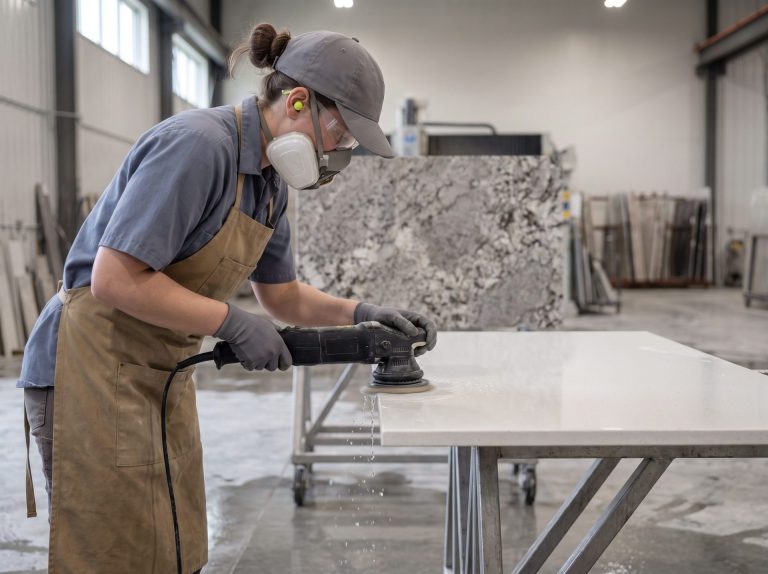
On engineered quartz, the goal is to match the edge to the face that left the factory. The resin makes the surface sensitive to heat from polishing pads, so the work is done wet and at controlled speed. An overheated edge can turn cloudy or lighter than the face.
A polished finish is glossy and reflective, and a honed finish is smooth and matte. Ask to see a finished edge sample in the material you are considering.
Which Finish Options Can a Shop Produce on Quartz and Granite?
Granite can carry a polished, honed or leathered face, while the face finish of engineered quartz is fixed by the manufacturer before fabrication.
Most granite slabs arrive polished, and many granites can also be honed or leathered. A leathered finish is a textured, low-sheen surface made by brushing the stone so the softer minerals recede slightly. Not every granite responds well to every finish.
Engineered quartz arrives with its face finish already made, whether polished or matte. The shop’s job is to cut and edge the slab without changing that face, then bring the edges to the same sheen. If you want a different finish in quartz, the practical route is to choose a slab made with that finish.
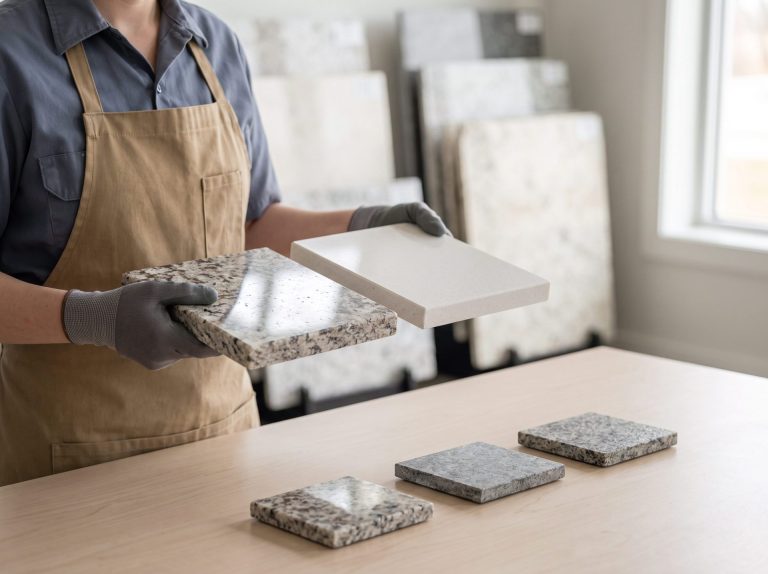
How Are Seams Made in Granite and Quartz Countertops?
Seams in both materials are joined with color-matched adhesive, but granite relies on pattern matching and plain quartz relies on a tight, level joint.
A seam is the joint where two countertop pieces meet on a long or L-shaped run. Its position is decided at slab layout, not on installation day. In the shop, the two meeting edges are cut straight and true so the installer can draw them together closely.
With granite, the pattern does part of the work. The fabricator cuts the two pieces from neighboring areas of the slab so color and movement carry across the joint, and the adhesive is tinted to blend with the stone.
With engineered quartz, the color is consistent, so matching the adhesive is more direct. The trade-off is that a plain white or solid color has no pattern to draw the eye away from the joint, so the seam depends on flat, level, closely fitted edges.
No seam in either material disappears completely. A fair expectation is a joint that is tight, level and close in color, placed where it interrupts the surface least.
How Do Chips, Fissures and Handling Differ in the Shop?
Granite carries natural fissures that need inspection, while quartz is uniform but can still chip at sharp edges, and both are moved on edge.
Granite is inspected before layout and again after cutting. Fissures and small pits are part of natural stone and are not defects by themselves, but some stones fracture easily, and a fissure in the wrong place can become a crack under stress. Fabricators support narrow sections with that in mind.
Engineered quartz does not have natural fissures. Its edges can still chip, most often at a sharp square corner or at the rim of a cutout, which is one reason slightly eased edges are common on both materials.
Handling is nearly the same for both. Finished pieces are heavy and rigid, so they are stored and carried upright on edge and secured to a frame for transport.
Actionable Tip
Before you approve fabrication, ask for three things in writing for your specific material. Ask where each seam will fall, which edge profile and finish the shop recommends for that slab, and how the edges will be matched to the face. For granite, ask to see the layout on your actual slab. For quartz, confirm the slabs share one production run.
How Does Granite and Marble Designs Approach Granite and Quartz Fabrication in Denver?
Granite and Marble Designs places fabrication as the third step of its StoneDoneRight™ process, after the design consultation and the slab layout.
Granite and Marble Designs is a natural stone supplier and countertop contractor in Denver that has served the Denver metro and the wider Colorado region since 2007. Co-founded by Michael Clifton and Jack Wilt, the company follows a full-service model that covers design, fabrication and installation, taking projects from start to finish for homeowners, commercial builders, and contractor and designer partners.
The StoneDoneRight™ process runs through five documented steps: a personalized design consultation, engineering and slab layout, precision CNC fabrication, professional demolition, and installation with high-quality sealing and near-imperceptible seams.
Granite countertop fabrication in Denver and quartz countertop fabrication in Denver pass through the same five steps at the company. What changes is the shop detail described above. That detail is also worth raising with any granite fabricators in Denver you speak with.
Granite and Marble Designs has worked on projects for 1,354+ homeowners, 1,650+ commercial projects and 1,400+ contractor projects, and it has earned eight Parade of Homes awards between 2008 and 2020.
Frequently Asked Questions
Is quartz fabricated the same way as granite?
The stages are the same, but the handling is not. Both are templated, laid out, cut wet, edged and polished. Granite is planned around the pattern and fissures of one natural slab. Engineered quartz is uniform, so the focus moves to heat control and to matching the edges with the factory finish.
Are quartz countertops natural or man-made?
Quartz countertops are man-made. Engineered quartz is a manufactured slab of crushed quartz aggregate bound with resin and pigments, so it is not a natural stone, even though quartz itself is a natural mineral. Granite is a natural igneous rock cut from a quarried block. That is why granite varies from slab to slab.
Is quartz or granite harder to cut in the shop?
Each has its own difficulty. Both are cut wet with diamond tooling. Granite asks the fabricator to work around fissures, pits and mineral changes in one slab. Engineered quartz is consistent, but its resin reacts to heat, so cutting speed and water flow are controlled closely. The settings are adjusted for each material.
Can the finish on a quartz countertop be changed in the shop?
Usually not across the whole face. Engineered quartz arrives with its polished or matte face already produced by the manufacturer, and the shop matches the edges to it. Refinishing the full surface is not routine. If you want a specific finish in quartz, choose a slab made with that finish.
Which shows seams more, quartz or granite?
It depends on the color and pattern more than the material. A speckled granite can blend a well-made seam into its pattern, while long veining makes any break in the flow visible. A plain quartz has no pattern to distract the eye, so the joint depends on level, closely fitted edges.
Do quartz and granite both need sealing after fabrication?
Granite needs periodic sealing, and sealing is not optional for it, because natural stone can absorb liquids. Engineered quartz does not absorb liquids the way natural stone does, so it is not sealed in the same way, but it still needs routine care. No countertop surface is stain-proof. Ask your fabricator about care for your material.
Can quartz and granite have the same edge profile?
Most common edge profiles, such as an eased edge, a bullnose or a mitered edge, can be made in both materials. A granite edge shows the stone’s crystals and can pit slightly on some slabs. A quartz edge has to match the sheen of the factory face, so ask to see a sample.
What should I ask a fabricator before choosing between quartz and granite?
Ask how your chosen material changes the layout, the seam positions, the edge profile and the finish. For granite, ask to see the planned layout on your actual slab and where any fissures sit. For quartz, ask how the edges will be matched to the face and whether the slabs come from one production run.
Same Shop, Different Rules for Quartz and Granite in Your Denver Home
Stone countertop fabrication treats quartz and granite as two different materials that happen to share one set of machines. Granite is read one slab at a time, and engineered quartz is worked with close control of heat and sheen. For new stone countertops in a Denver home, knowing which rules apply to your material helps you ask sharper questions before the slab is cut.
Call (303) 529-1932 to compare how a granite slab and a quartz slab would each be worked for your Denver kitchen or bath, or send a message through the contact page naming both materials.