
Custom Stone Fabrication for Specialty Projects in Denver
Custom stone fabrication extends far beyond countertops. Fireplace surrounds, tub decks, shower walls, stair treads, reception desks, outdoor kitchens, and architectural features all require specialty fabrication techniques — curved cuts, bookmatching, oversized slab handling, multi-piece assembly, and complex geometry that pushes CNC equipment and artisan skills to their highest level.
Most people associate stone fabrication with kitchen countertops. That’s the bread and butter. But the projects that really showcase what a fabrication shop can do? Those are the specialty pieces. A floor-to-ceiling bookmatched marble fireplace surround. Granite stair treads that wrap around a curved staircase. A reception desk carved from a single exotic slab. These are the projects where the line between fabrication and art gets blurry — and where the difference between an adequate shop and an exceptional one becomes obvious. Granite & Marble Designs’ stone fabrication services handle the full spectrum of custom stone fabrication — from straightforward countertops to the most complex specialty projects in Denver — using the same CNC precision and artisan craftsmanship that’s driven 4,400+ completed projects since 2007.
This guide explores the specialty fabrication projects that homeowners, designers, architects, and commercial clients bring to GMD — what’s possible, what’s involved, and why these projects demand a fabricator with both advanced equipment and deep experience.
What Types of Specialty Stone Fabrication Projects Are Most Common?
The most common specialty fabrication projects include fireplace surrounds and mantels, tub decks and shower walls, stone stair treads and risers, commercial reception desks, outdoor kitchen surfaces, wine bar and entertainment area tops, and architectural accent walls. Each project type presents unique fabrication challenges around geometry, weight, structural support, and installation logistics.
Specialty stone fabrication isn’t a niche offering — it’s a growing part of residential and commercial design in Denver. As homeowners and architects discover what CNC technology and skilled fabricators can do with natural stone, the requests get more creative and more ambitious. Here’s what GMD fabricates most frequently beyond countertops:
Fireplace Surrounds and Mantels
The single most impactful specialty stone project for residential interiors. A stone fireplace surround transforms a wall into a focal point — especially when the stone is bookmatched (cut from the same slab and mirrored to create a symmetrical vein pattern). Fireplace fabrication involves large vertical panels, precise cutouts for the firebox opening, floating stone mantel shelves, and hearth pieces that must be level and structurally supported.
Tub Decks and Shower Walls
Full stone tub decks wrap the bathtub in matching stone, creating a spa-like enclosure. Shower walls fabricated from large stone panels replace tile entirely, eliminating grout lines and creating a monolithic, easy-to-clean surface. Both applications demand waterproof seam engineering and material selection that handles constant moisture exposure.
Stone Stair Treads and Risers
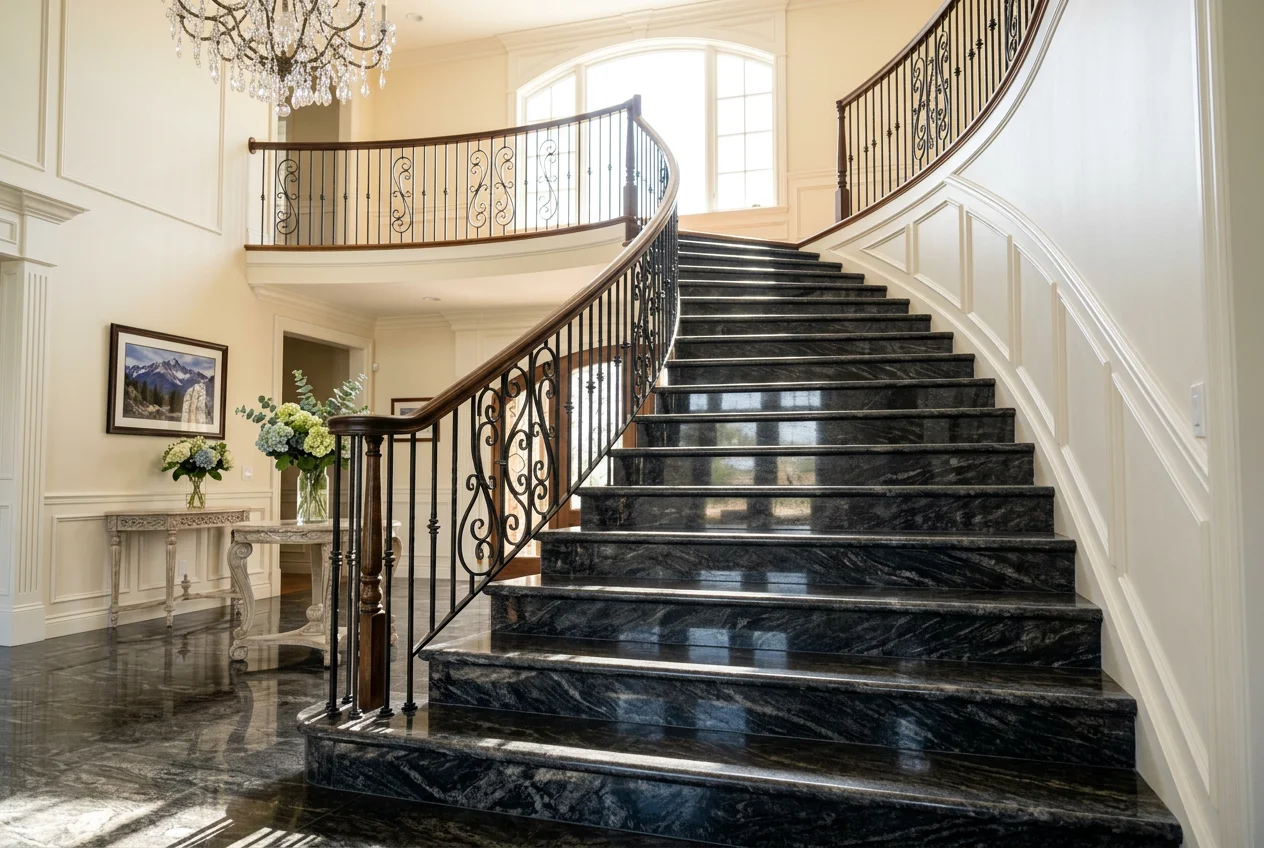
Granite and quartzite stair treads are durable, dramatic, and slip-resistant (especially in leathered or honed finishes). Each tread is fabricated to the exact dimensions of each step — and in older homes, no two steps are the same width or depth. Curved staircases require curved stone treads, which push CNC cutting capabilities to their limits.
Commercial Reception Desks
A stone-topped reception desk makes a first-impression statement. These projects often involve curved or angular geometries, waterfall edges that flow from the desk surface down the front panel, and oversized pieces that require careful transport and multi-person installation. Design firms and architects frequently spec custom stone reception desks for Denver offices, hotels, and medical practices.
Outdoor Kitchen Surfaces
Denver’s climate makes outdoor living a priority for many homeowners. Outdoor kitchen countertops must withstand UV exposure, freeze-thaw cycling, hail impacts, and wide temperature swings. Material selection is critical — granite and porcelain handle outdoor Denver conditions; quartz and marble do not.
| Project Type | Common Materials | Key Fabrication Challenge | Typical Lead Time |
| Fireplace surround | Marble, quartzite, granite | Bookmatching, large vertical panels | 3–5 weeks |
| Tub deck | Marble, quartz, granite | Waterproof seams, moisture resistance | 2–4 weeks |
| Shower walls | Porcelain, marble, granite | Large panel handling, waterproof install | 3–5 weeks |
| Stair treads | Granite, quartzite | Curved geometry, consistent profiling | 3–6 weeks |
| Reception desk | Exotic granite, quartz | Curved cuts, oversized pieces | 4–8 weeks |
| Outdoor kitchen | Granite, porcelain | UV + freeze-thaw resistance | 3–5 weeks |
What Advanced Fabrication Techniques Make Specialty Projects Possible?
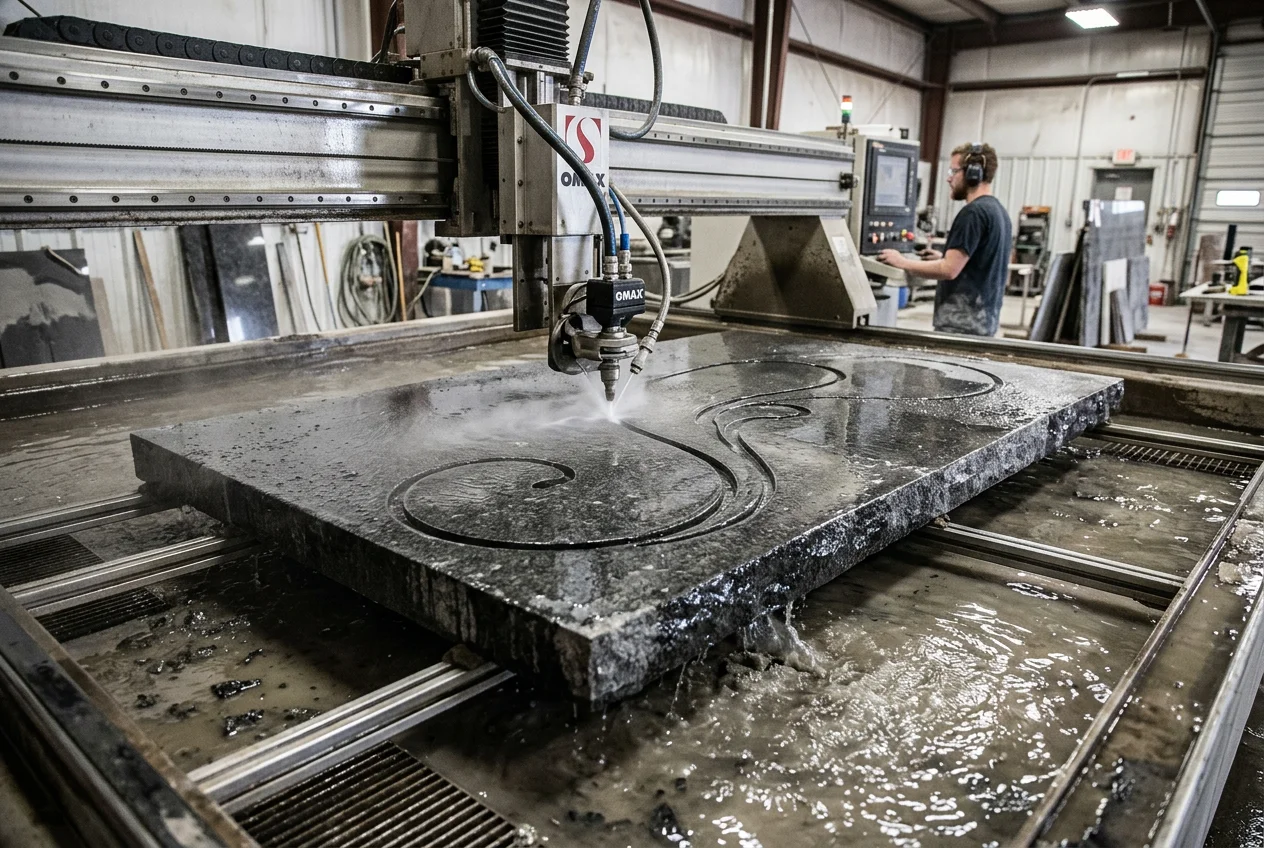
Specialty stone projects rely on advanced fabrication techniques that standard countertop work rarely requires: bookmatching for symmetrical vein patterns, waterjet cutting for curves and intricate shapes, mitered construction for seamless corners, lamination for thicker visual profiles, and multi-piece assembly engineering for projects that span entire walls or staircases.
These techniques separate a countertop shop from a full-service fabrication facility. Each one requires specific equipment, operator expertise, and planning time that goes beyond standard template-cut-install workflows.
Bookmatching
Two adjacent slices from the same stone block are opened like a book, creating a mirror-image vein pattern. When installed side by side — on a fireplace surround, shower wall, or large island — the result is a symmetrical pattern that’s visually stunning and unmistakably intentional. Bookmatching requires sourcing consecutive slabs from the same block, planning the layout before purchase, and fabricating with precision alignment so the mirror point is seamless.
Waterjet Cutting
While CNC bridge saws cut straight lines and basic curves, waterjets use ultra-high-pressure water mixed with abrasive garnet to cut any shape — curves, circles, inlays, and complex geometries. Waterjet cutting is essential for curved reception desks, circular table tops, and decorative stone inlays. The cut edge is clean and requires minimal finishing.
Mitered Construction
Mitered joints create the illusion of a solid stone mass at corners — the stone appears to wrap around a corner without any visible edge. This technique is essential for waterfall islands, fireplace mantels, and reception desk panels. The miter is cut at exactly 45 degrees, bonded with reinforced adhesive, and polished flush. A well-executed miter is invisible.
Lamination
Two pieces of stone are bonded together to create a thicker profile. A 3cm countertop with a laminated edge looks like 6cm — creating a substantial, heavy visual impression without the weight and cost of solid thick stone. Lamination is common on fireplace mantels, bar tops, and commercial reception surfaces where visual weight conveys quality.
Multi-Piece Assembly
Large projects — full-wall fireplace surrounds, wrap-around tub decks, multi-panel shower walls — are fabricated as multiple pieces that are dry-fitted in the shop, numbered, and then assembled on-site. The shop fit verifies that every piece aligns perfectly before transport. On-site assembly follows the numbered sequence with seams bonded and finished to disappear.
| Technique | What It Does | Equipment Required | Skill Level |
| Bookmatching | Creates mirror-image vein symmetry | Standard CNC + layout planning | Advanced layout engineering |
| Waterjet cutting | Cuts any shape including curves | Waterjet cutter (high-pressure) | Specialized operator |
| Mitered joints | Seamless corners and wraps | CNC with miter capability | Advanced bonding skills |
| Lamination | Creates thicker visual profiles | Bonding equipment, clamps | Moderate |
| Multi-piece assembly | Large projects spanning walls/stairs | Full shop dry-fit space | Advanced project management |
How Does GMD Approach Complex Custom Fabrication Projects?
GMD’s approach to custom specialty fabrication starts with a design consultation that includes the architect or designer, follows with site measurement and structural assessment, moves through layout engineering with client approval, and executes fabrication with the same StoneDoneRight™ six-stage quality process used for countertops — adapted for the specific demands of each specialty project.
Complex custom projects don’t follow the same template-fabricate-install pipeline as a standard kitchen. They require collaboration between the fabricator, the designer or architect, and often the structural engineer or general contractor. Here’s how GMD structures specialty work:
Design Collaboration
Every custom project starts with a conversation about the vision. What does the designer want the stone to accomplish? What’s the aesthetic goal? What are the structural constraints? GMD’s team brings fabrication expertise to these conversations — advising on what’s possible, what material best achieves the design intent, and where the practical limits of stone fabrication apply.
For example, a designer may envision a curved marble wall, but marble’s hardness and fissure patterns may make granite or quartzite a better choice for that specific geometry. Or an architect may spec a floating stone shelf that requires internal steel reinforcement the client doesn’t see. GMD identifies these considerations early so the design evolves with fabrication reality, not against it.
Site Assessment
Specialty projects often involve spaces that standard template technicians don’t encounter — curved walls, sloped floors, non-standard ceiling heights, structural support questions. GMD’s team assesses the installation site for structural capacity (can the wall hold a 500-pound stone surround?), access logistics (can we get a 10-foot slab through the front door?), and environmental factors (will the outdoor kitchen surface face south and get full sun exposure?).
Fabrication With Built-In Complexity
Once the design is approved and the site is measured, fabrication follows GMD’s six-stage process with additional complexity steps:
- Slab inspection with design-specific criteria (vein direction for bookmatching, structural integrity for large spans)
- Layout engineering with designer/architect approval
- CNC cutting with specialty operations (waterjet for curves, miter cuts for wraps)
- Multi-stage finishing matched to the design specification
- In-shop dry-fit assembly for multi-piece projects
- Quality inspection against both fabrication standards and design intent
Key Takeaways
- Takeaway 1: Custom stone fabrication extends far beyond countertops — fireplaces, tub decks, stair treads, reception desks, and architectural features all require specialty techniques and experience.
- Takeaway 2: Advanced techniques like bookmatching, waterjet cutting, mitered construction, and multi-piece assembly make ambitious stone designs possible that standard countertop shops can’t execute.
- Takeaway 3: Specialty projects require design collaboration between the fabricator, architect or designer, and often the structural engineer — not just a template-and-cut workflow.
- Takeaway 4: Site assessment for specialty projects evaluates structural capacity, access logistics, and environmental factors that standard countertop templating doesn’t address.
- Takeaway 5: Material selection for specialty applications depends on the specific demands of the project — not every stone that works as a countertop works as a fireplace surround or stair tread.
- Takeaway 6: In-shop dry-fit assembly before on-site installation ensures every piece of a multi-component project aligns perfectly and follows the approved design.
Who Benefits Most From Custom Stone Fabrication Services?
Homeowners building custom or luxury homes, interior designers executing high-end residential projects, architects specifying stone for commercial spaces, general contractors needing a reliable specialty stone sub, and commercial property owners investing in statement-making lobby or reception areas all benefit from a fabricator with custom specialty capabilities.
Custom stone fabrication isn’t just for mansions. A single bookmatched fireplace surround in a 1,500-square-foot Denver bungalow can be the design element that makes the whole home feel intentional. A local restaurant with a custom granite bar top creates an atmosphere that laminate never will. The scale of the project doesn’t determine whether custom stone fabrication is worth exploring — the design ambition does.
For Homeowners
If you have a design vision that goes beyond standard countertops — a stone fireplace, a spa bathroom with matching stone surfaces, an outdoor kitchen that extends your living space — a custom fabrication conversation is the first step. GMD’s design consultants help translate vision into fabrication reality, advising on material selection, structural requirements, and realistic budgets.
For Designers and Architects
GMD collaborates with Denver-area designers and architects as a fabrication partner who brings technical expertise to the creative process. The team can advise on material feasibility, structural support requirements, seam placement for aesthetic continuity, and fabrication timelines that align with project schedules.
For General Contractors
Specialty stone fabrication projects — especially commercial ones like lobby feature walls and reception desks — require a sub who understands construction coordination, phased installation, and the documentation requirements of commercial projects. GMD’s 1,400+ contractor partnerships demonstrate their ability to function as a reliable specialty trade partner.
Conclusion
Custom stone fabrication is where craftsmanship, technology, and design ambition converge. Whether it’s a bookmatched marble fireplace, curved granite stair treads, or a statement reception desk, specialty projects demand a fabricator with advanced CNC equipment, deep material knowledge, and the artisan skill to execute complex geometries and finishes. The projects that transform spaces from ordinary to extraordinary almost always involve stone — and a fabricator who knows how to push the material to its full potential.
Have a specialty stone project in mind? Contact Granite & Marble Designs for a design consultation. Bring your sketches, your inspiration photos, and your questions — GMD’s team will help you understand what’s possible, what material fits the vision, and how to bring your custom stone project to life in Denver.
Frequently Asked Questions
What specialty stone projects does GMD fabricate?
Fireplace surrounds, tub decks, shower walls, stair treads, reception desks, outdoor kitchen surfaces, bar tops, accent walls, wine cellars, and architectural stone features.
How long do specialty fabrication projects take?
Timelines range from 2 to 8 weeks depending on complexity. Fireplace surrounds typically take 3 to 5 weeks. Large commercial reception desks may take 4 to 8 weeks from design approval to installation.
Can stone be cut into curved shapes?
Yes. Waterjet cutting technology uses high-pressure water and abrasive garnet to cut any shape including curves, circles, and complex geometries in virtually any stone type.
What is bookmatching in stone fabrication?
Bookmatching opens two consecutive slabs from the same stone block like a book, creating a symmetrical mirror-image vein pattern. It’s most popular for fireplace surrounds and feature walls.
Can my existing fireplace be refaced with stone?
In most cases, yes — as long as the existing structure can support the stone’s weight. GMD assesses structural capacity during the site visit and recommends reinforcement if needed.
What stone works best for outdoor kitchens in Denver?
Granite with outdoor-grade sealing and porcelain slab materials handle Denver’s UV, freeze-thaw, and temperature extremes. Quartz and marble should not be used outdoors.
How are large stone pieces transported and installed?
Specialty pieces are fabricated, dry-fit, and numbered at the shop. Transport uses padded A-frame trucks. Installation uses suction lifters, multi-person crews, and engineered support brackets as needed.
Can stone stair treads be fabricated for curved staircases?
Yes. Each curved tread is individually templated and CNC-cut to match the specific radius and dimensions of each step — no two pieces are identical in a curved staircase.
Do I need an architect for a custom stone project?
Not always. Simple projects like a fireplace surround or tub deck can be designed collaboratively with GMD’s team. Large-scale or structural projects benefit from architectural involvement.
What’s the difference between custom fabrication and standard countertop work?
Custom fabrication involves advanced techniques — bookmatching, waterjet curves, mitered construction, multi-piece assembly — that go beyond the template-cut-install pipeline of standard countertop projects.