
Custom Granite Countertop Fabrication in Denver CO
Custom granite countertop fabrication transforms a raw granite slab into a precision-cut, finished surface tailored to your exact kitchen layout, edge profile preference, sink configuration, and finish type. It requires slab-level material expertise, CNC cutting precision, and finishing skills that only come from years of hands-on granite fabrication experience.
Granite has been the backbone of stone countertop fabrication for decades — and for good reason. No two slabs are identical. The mineral formations that create granite’s colors and patterns happened millions of years ago, deep underground, and the result is a surface that can’t be replicated by any factory process. But here’s the thing most homeowners don’t realize: the slab you pick is only half the equation. How it’s fabricated — cut, profiled, polished, and prepared — determines whether that stone becomes a showpiece or a letdown. Granite & Marble Designs’ stone fabrication services have specialized in granite fabrication for over 17 years, with 100+ years of combined artisan experience across their team and 4,400+ completed projects in Denver.
This guide covers everything about custom granite fabrication: how slabs are selected and inspected, what CNC cutting does for precision, the difference between finish types, edge profile options, and how to evaluate a granite countertop fabricator who’ll do your slab justice.
How Does Custom Granite Slab Selection Work?
Granite slab selection starts at the showroom or slab yard where you view full slabs — not samples — under proper lighting. You’re choosing a specific piece of stone, not ordering a color from a catalog. Every slab’s veining, mineral inclusions, color variation, and structural integrity must be evaluated in person because what you see is exactly what you get — there’s no reorder if you don’t like it after it’s cut.
This is where granite fundamentally differs from engineered quartz. With quartz, you pick a color swatch and the manufacturer ships a consistent product. With granite, you’re selecting a unique piece of the earth. The slab you choose is the slab you live with. That’s both the appeal and the responsibility.
What to Look For During Slab Selection
At GMD’s Denver showroom on Pecos Street, clients walk through racks of full-size granite slabs and evaluate each one based on several factors:
- Vein pattern and movement. Granite ranges from tight, uniform speckle patterns (like Uba Tuba or Baltic Brown) to dramatic, flowing river-like veining (like Blue Dunes or Magma Gold). The pattern you prefer depends on your kitchen’s size, cabinet color, and design style. Busy patterns work better on smaller surfaces; dramatic movement shines on large islands.
- Color consistency across the slab. Granite is natural, so color can shift across a single slab. One end might be darker, the other lighter. A good stone fabricator helps you identify where the color shifts fall and plans the layout so the most consistent sections land on the most visible surfaces.
- Structural integrity. Not all sections of a slab are equally sound. Natural fissures — hairline separations in the mineral structure — are normal in granite but need to be identified before cutting. A fissure that falls across a sink cutout or near an edge can become a crack during fabrication. GMD’s team inspects every slab for structural soundness before layout engineering begins.
- Thickness. Standard granite countertop thickness is 3cm (about 1.25 inches). Some applications use 2cm granite with plywood backing for lighter weight. Your edge profile and installation method may require one thickness over the other.
Granite Grades and Exotic Varieties
Granite is loosely categorized into commercial grades — typically simpler patterns with more uniform coloring — and exotic varieties with dramatic veining, rare mineral inclusions, and higher slab costs. Denver homeowners have access to hundreds of varieties through local distributors, and GMD maintains relationships with multiple suppliers to offer the widest selection.
| Granite Category | Pattern Character | Common Varieties | Best For |
| Commercial grade | Uniform speckle, subtle movement | Uba Tuba, Baltic Brown, Giallo Ornamental | Budget-friendly kitchens, rentals |
| Mid-range | Moderate veining, color depth | Santa Cecilia, New Venetian Gold, Tan Brown | Most residential kitchens |
| Premium | Dramatic veining, bold color | Blue Pearl, Bianco Antico, Typhoon Bordeaux | Design-focused spaces |
| Exotic | Rare minerals, extreme movement | Blue Dunes, Magma Gold, Patagonia, Azul Bahia | Statement islands, showpiece kitchens |
What Granite Finishes Are Available and How Do They Affect the Stone?
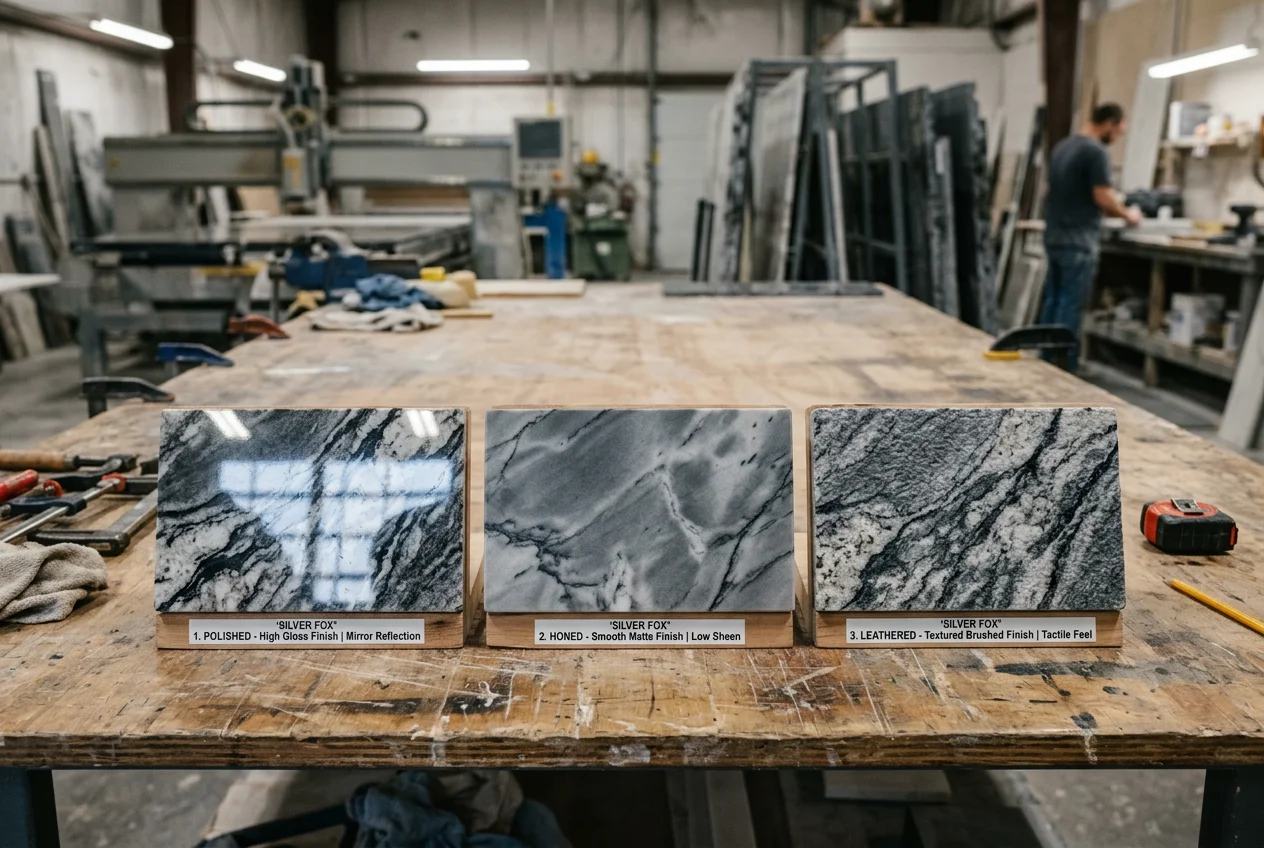
Granite can be finished in three primary ways: polished (mirror-like reflective surface), honed (smooth matte with no reflection), and leathered (textured, dimpled surface that retains color depth). Each finish changes the stone’s appearance, tactile feel, and maintenance requirements — and not every granite variety looks good in every finish.
Most people picture polished granite when they think of stone countertops — the glossy, reflective surface that shows off every vein and mineral crystal. But polished isn’t the only option, and it’s not always the best one. The finish you choose changes how the granite looks, feels, and performs in daily use.
Polished Finish
The classic choice. Diamond polishing pads bring the granite surface to a high-gloss mirror finish that reflects light and maximizes color saturation. Polished granite shows the full depth of the stone’s mineral patterns. It’s smooth to the touch, easy to clean, and the most stain-resistant of the three finishes because the polishing process closes the stone’s surface pores. The tradeoff: fingerprints and water spots show more easily on dark polished granite.
Honed Finish
A honed finish is polished partway — the surface is smooth but flat, with no reflective sheen. It gives granite a more understated, contemporary look. Honed finishes are popular in modern and transitional kitchen designs where a matte surface creates a softer aesthetic. The catch: honed granite is slightly more porous than polished because the surface pores aren’t fully closed. It needs more frequent sealing and is somewhat more susceptible to staining.
Leathered Finish
The newest and most distinctive finish option. Leathered granite has a subtle texture — dimpled and brushed — that retains the stone’s color depth without the reflective quality of polished or the flat plainness of honed. It hides fingerprints, water spots, and minor scratches better than either alternative. The texture comes from running diamond-tipped brushes across the surface in a specific pattern. Not every granite variety takes a leathered finish well — stones with large mineral crystals and pronounced texture work best.
| Finish Type | Appearance | Maintenance | Stain Resistance | Best Granite Types |
| Polished | High-gloss, reflective | Low (annual seal) | Highest | All varieties |
| Honed | Matte, smooth, no sheen | Moderate (seal 2x/year) | Moderate | Light colors, subtle patterns |
| Leathered | Textured, dimpled, color-rich | Low–Moderate | Good (texture masks spots) | Bold patterns, large crystal structure |
The finish decision should happen at the showroom, where you can see and touch all three options on actual granite samples. At GMD, the team keeps finish samples for popular granite varieties so you can compare polished, honed, and leathered side by side before committing.
What Edge Profile Options Are Available for Granite Countertops?
Granite supports the widest range of edge profiles of any countertop material — from simple eased and beveled edges to decorative ogee, bullnose, and waterfall miters. The edge profile affects the countertop’s visual weight, design style, and maintenance. Simpler profiles cost less to fabricate and collect less grime; ornate profiles add architectural detail but require more cleaning.
The edge of your countertop is what you see at eye level when you’re standing in the kitchen. It’s a design detail that most homeowners underestimate until they see the options side by side. And because granite is hard enough to hold fine detail without chipping, it supports more intricate profiles than softer stones like marble.
Simple Profiles
- Eased edge: A flat, squared-off edge with slightly softened corners. The most popular choice for modern and contemporary kitchens. Clean, minimal, and the least expensive to fabricate.
- Beveled edge: A flat edge with a 45-degree chamfer cut along the top. Adds a subtle shadow line that gives the countertop more visual definition than a plain eased edge.
- Half bullnose: The top edge is rounded while the bottom remains square. Softer than eased but still understated. A popular compromise between modern and traditional.
Decorative Profiles
- Full bullnose: Both top and bottom edges are rounded, creating a completely smooth half-circle edge. Classic, timeless, and comfortable to lean against. Works well in traditional and transitional kitchens.
- Ogee: An S-curve profile that creates an elegant, layered look. The most ornate standard profile. Pairs with raised-panel cabinets and traditional design. Takes longer to fabricate and requires more polishing passes.
- Dupont: A stepped profile with a flat upper section and a curved lower section. Creates architectural depth without the full curve of an ogee.
Specialty Profiles
- Waterfall miter: The countertop continues vertically down the side of an island or cabinet end. Requires a 45-degree miter cut and precision bonding. The most dramatic profile option — and the most fabrication-intensive.
- Laminated edge: Two pieces of granite are bonded together to create a thicker appearance. A 3cm slab with a laminated edge looks like 6cm — giving the countertop a substantial, luxury weight.
| Edge Profile | Style | Fabrication Complexity | Cleaning Ease | Best Kitchen Style |
| Eased | Modern/minimal | Simple | Easiest | Contemporary, modern |
| Beveled | Modern with detail | Simple | Easy | Transitional |
| Half Bullnose | Subtle curve | Moderate | Easy | Transitional |
| Full Bullnose | Classic curve | Moderate | Moderate | Traditional |
| Ogee | Ornate S-curve | Complex | Requires attention | Traditional, formal |
| Waterfall Miter | Dramatic vertical flow | Most complex | Easy (flat surface) | Modern luxury |
Key Takeaways
- Takeaway 1: Granite slab selection requires viewing full slabs in person — not samples — because each slab’s veining, color, and structural integrity are unique and irreplaceable.
- Takeaway 2: Three finish options — polished, honed, and leathered — each change the granite’s appearance, maintenance needs, and stain resistance, and not every variety suits every finish.
- Takeaway 3: Granite supports the widest range of edge profiles of any countertop material, from simple eased edges to complex ogee and waterfall miters.
- Takeaway 4: Structural inspection before cutting prevents fabrication failures — fissures and soft spots must be identified and avoided during layout engineering.
- Takeaway 5: Exotic granite varieties deliver one-of-a-kind visual drama but require experienced fabricators who understand how rare mineral structures affect cutting and finishing.
- Takeaway 6: The fabricator’s experience with granite specifically — not just stone in general — determines the quality of your cut, finish, and seam work.
How Do You Choose the Right Granite Fabricator in Denver?
Evaluate a granite fabricator based on their CNC equipment, in-house fabrication capability, granite-specific experience, willingness to show you their shop, and their approach to slab inspection and layout engineering. A fabricator who lets you participate in slab selection and layout approval gives you more control over the finished product than one who just takes your order and sends a crew.
Not every stone fabricator in Denver has equal granite experience. Granite fabrication requires specific knowledge that doesn’t automatically transfer from working with quartz or porcelain. The mineral structure of granite varies dramatically between varieties — some cut clean, others chip if the blade speed is wrong. Some take a leathered finish beautifully; others turn muddy. These are details that come from years of working with specific stone types.
Here’s what separates a granite specialist from a general countertop shop:
Granite-Specific Expertise
Ask how many granite projects the fabricator completes per month and what percentage of their work is natural stone versus engineered quartz. A shop that does 80% quartz and 20% granite has different skill sets than one that works with natural stone daily. GMD’s fabrication team works with granite, marble, quartzite, and other natural stone every day — it’s their core business, not a sideline.
Slab Inspection Process
A qualified granite countertop fabricator inspects every slab before cutting for fissures, soft spots, color inconsistencies, and structural weaknesses. They show you what they find and adjust the layout to avoid problem areas. A shop that doesn’t inspect — or doesn’t share findings with the client — is gambling with your stone.
Layout Participation
The best granite fabricators involve clients in the layout engineering process. You should see where the seams will fall, how the vein pattern will flow across your kitchen, and which sections of the slab will become your most visible surfaces. At GMD, clients approve the layout before any cutting begins. That’s standard in their StoneDoneRight™ process — not an add-on.
Remnant Program
A fabrication shop that manages its remnants well provides value to clients with smaller projects. Granite remnants — leftover pieces from larger slab cuts — are perfect for bathroom vanities, laundry room counters, bar tops, and small kitchen projects at a fraction of full-slab cost. GMD maintains a live remnant inventory that clients can browse at their Denver showroom.
Granite & Marble Designs has fabricated granite countertops for over 4,400 projects across Denver — residential kitchens, commercial restaurants, contractor builds, and custom homes. Their Pecos Street facility runs current-generation CNC equipment, and every project follows the StoneDoneRight™ fabrication process from slab inspection through final quality check.
Conclusion
Granite countertop fabrication is where the raw potential of natural stone meets precision engineering. The slab you select, the finish you choose, the edge profile you pick, and the fabricator you trust all determine whether your countertop becomes the centerpiece your kitchen deserves. Custom granite fabrication isn’t a commodity — it’s a craft that rewards experience, equipment investment, and attention to every detail from the first slab inspection to the final quality check.
Want to see the granite fabrication process firsthand? Contact Granite & Marble Designs for a free consultation that includes slab viewing at their Denver showroom and a fabrication shop tour. Bring your cabinet samples, your design ideas, and your questions — and work with a team that’s been fabricating granite in Denver since 2007.
Frequently Asked Questions
How long does custom granite fabrication take?
Granite fabrication typically takes 5 to 10 business days after the digital template is completed. Exotic varieties or complex layouts with multiple pieces may require additional time.
Can I choose my specific granite slab?
Yes. At GMD’s Denver showroom, you view and select your specific slab. The stone you choose is the stone that gets fabricated — no surprises or substitutions.
What’s the difference between granite grades?
Commercial-grade granite has simpler patterns and lower cost. Exotic granite features rare mineral inclusions, dramatic veining, and higher slab prices. The fabrication process is the same for both.
Is leathered granite harder to maintain than polished?
Leathered granite actually hides fingerprints and water spots better than polished. It needs similar sealing frequency and is easier to keep looking clean in daily use.
Can granite be fabricated with a waterfall edge?
Yes. Waterfall edges on granite require precision miter cuts and bonding. The vein pattern must be matched across the horizontal and vertical surfaces for a seamless look.
How thick should my granite countertop be?
Standard thickness is 3cm (about 1.25 inches). Some applications use 2cm granite with plywood reinforcement for lighter weight. Your edge profile and sink type may influence the choice.
What happens to leftover granite from my slab?
Usable remnant pieces are inventoried and made available for smaller projects like bathroom vanities and bar tops. Clients can access GMD’s remnant inventory at their showroom.
Does the type of granite affect fabrication difficulty?
Yes. Harder varieties with dense mineral structures require slower cutting speeds and specialized blade selection. Stones with large quartz crystal inclusions can chip during edge profiling if not handled properly.
Can granite be repaired if it chips after installation?
Small chips can be filled with color-matched epoxy and polished to blend with the surrounding surface. Larger damage may require professional fabrication repair. GMD offers repair services for existing granite countertops.
How do I know if a fabricator has real granite experience?
Ask about their natural stone project volume, request to see granite work in progress at their shop, and ask which granite varieties they’ve worked with recently. Experience with exotic and challenging varieties indicates deeper expertise.