
Book Matching Stone Slabs: Creating Symmetrical Beauty in Your Countertops
Book matching stone slabs is a fabrication technique that places two adjacent slabs cut sequentially from the same quarry block side by side so their patterns mirror each other. The result is a dramatic symmetrical effect that reads like an open book, most striking on veined stones like Calacatta marble, dramatic quartzites, and figured granites.
Book matching is one of the highest-craft techniques in stone fabrication and produces some of the most dramatic countertop and feature-wall installations in Denver homes. When a homeowner walks into a kitchen with a bookmatched island or feature wall, the symmetry stops them mid-conversation. Getting that result requires specific slabs, specific fabrication technique, and specific design intent from the start.
After 18 years of Denver stone work, bookmatched projects are among the most satisfying because they push every part of the craft: slab selection, layout, cutting, seam bonding, and install. They also cost more, take longer, and require more careful sourcing than standard fabrication. Understanding what bookmatching is and where it works helps homeowners direct the technique to the projects that deserve it.
What Book Matching Actually Is
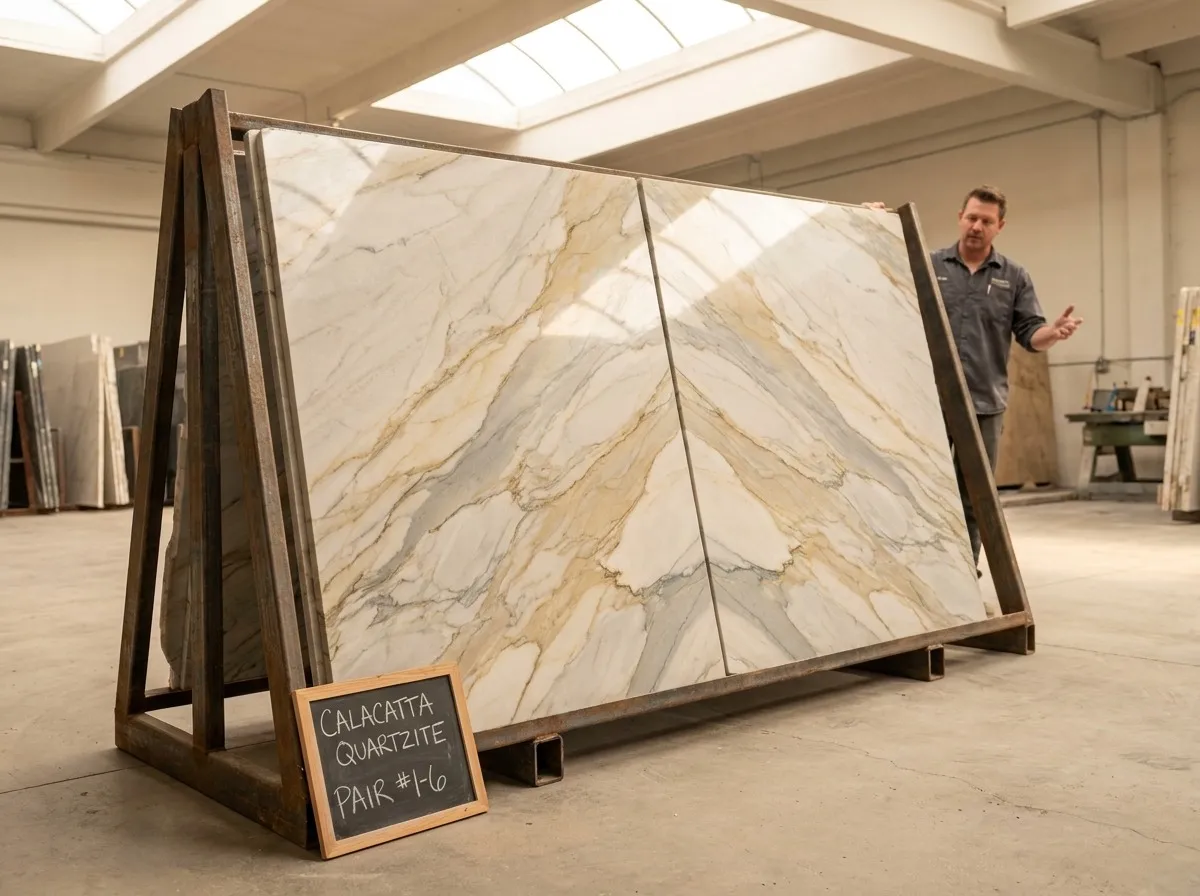
Book matching is a woodworking and stonework technique that pairs two adjacent pieces cut sequentially from the same source so that opening them reveals a mirrored pattern. The name comes from opening a book to two facing pages, where the pattern flows across the center seam as if it were continuous.
In stone fabrication, bookmatching requires two adjacent slabs cut from the same quarry block. Modern stone quarrying produces slabs by cutting the block into thin sheets with wire saws, and adjacent slabs share nearly identical patterns because they are only a few millimeters apart in the original block. When those two slabs get polished and installed side by side with the matching faces together, the pattern flips across the center line to create the bookmatched effect.
The technique works best with strongly veined stones where the pattern is visible enough to reward the mirror treatment. Calacatta marble, dramatic quartzites (Fusion Cristallo, Bianco Antico, Fantasy Brown), figured granites (Typhoon Bordeaux, Verde Marinace), and dramatic onyx all bookmatch beautifully. Solid-color stones and tight-pattern stones do not benefit from bookmatching because the mirror effect is not visible enough to justify the cost.
Common Bookmatched Applications in Denver Homes
Bookmatching shows up in several specific applications where the visual impact justifies the technique. The most common Denver applications:
- Feature walls and fireplace surrounds. Vertical installations where the bookmatched pattern becomes the room’s defining visual element. Great rooms with floor-to-ceiling bookmatched fireplace surrounds are among the most photographed features in luxury home tours.
- Kitchen islands. A bookmatched island top creates a dramatic centerpiece for open-concept kitchens. The mirror pattern reads clearly from any angle in the room.
- Bar tops and butler’s pantries. Long bar tops with bookmatched slabs deliver dramatic hospitality-grade impact.
- Bathroom vanity feature walls. Behind vanities in primary bathrooms, bookmatched walls create spa-like drama.
- Reception desks and commercial features. Hotels, restaurants, and premium office spaces use bookmatched stone for signature surfaces.
For any of these applications, the design conversation starts with the space and works backward to the stone selection. Not every space justifies bookmatching, and not every stone bookmatches well.
The Slab Selection Reality
Bookmatching requires two specific adjacent slabs from the same quarry block. This changes the slab selection process in several important ways:
- Sequential slabs must be reserved together. A single bookmatch requires two slabs; feature walls sometimes require four or six sequential slabs. All the needed slabs must be identified and reserved before any get cut.
- Not every yard has bookmatch pairs. Denver stone yards typically carry some bookmatched pairs but not all varieties are available at all times. Sourcing may take 4 to 12 weeks for premium bookmatch pairs.
- Yield is lower. A bookmatched island might consume 3 or 4 slabs when a non-bookmatched version would consume 2. The waste is inherent to the technique.
- Prices reflect the sourcing complexity. Bookmatch pairs typically carry a 15 to 30 percent premium over the same variety purchased as single slabs.
- Slab selection happens in person. Photos of bookmatch pairs never convey the effect the way seeing them together does. Visiting the stone slab inventory with the fabricator produces better decisions than remote selection.
The reserved-together requirement means the homeowner commits to the pair before fabrication begins. Once cut, the slabs cannot be un-committed.
Fabrication Technique for Bookmatched Projects
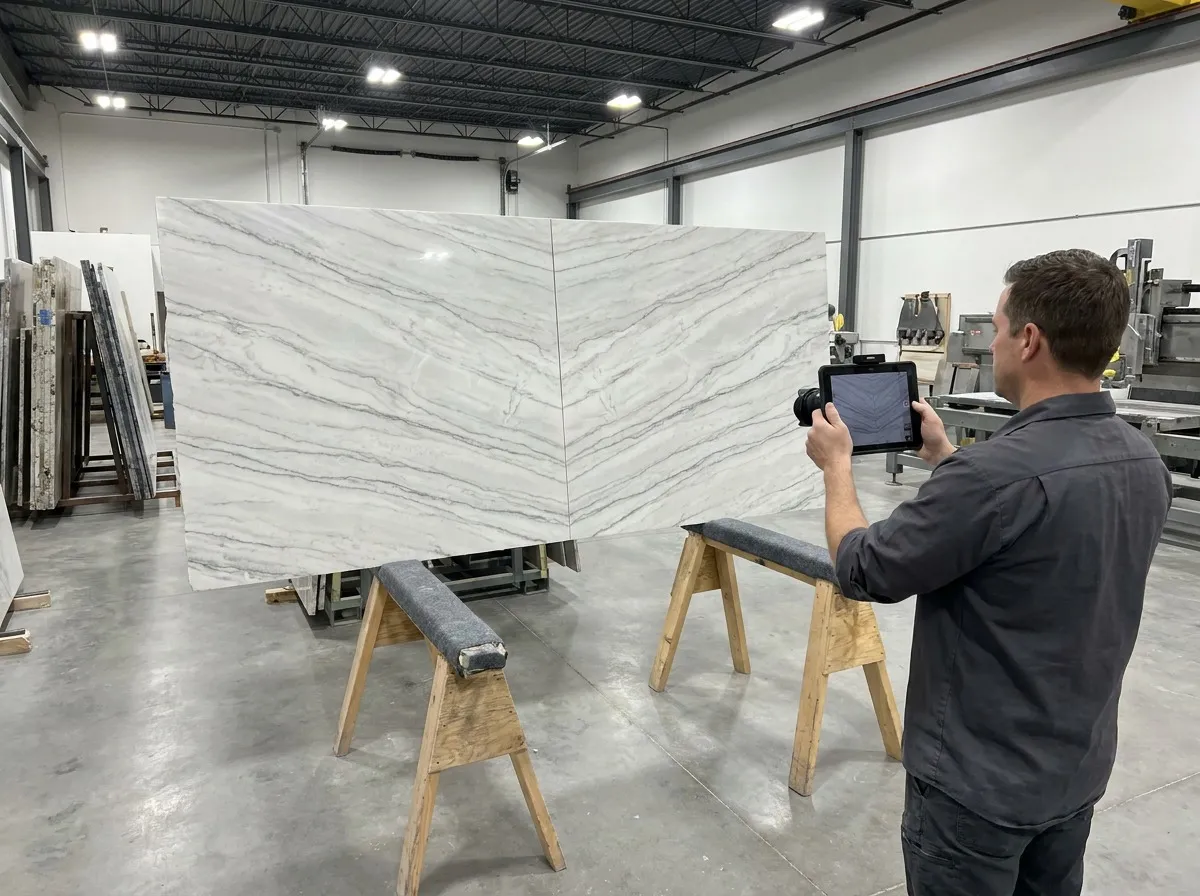
Once the bookmatch pair is selected and reserved, stone fabrication services shift into a more careful mode than standard countertop work. Several specific fabrication considerations apply:
The dry-fit stage is essential on bookmatched projects. After the CNC cuts the pieces to shape, the fabricator physically assembles them in the shop on padded sawhorses to verify the pattern flows across the seam as expected. Small adjustments to piece orientation can meaningfully improve or degrade the visual effect. The customer typically reviews the dry-fit before final polishing and install.
Seam epoxy color-matching is critical. On a bookmatched project, the seam between the two mirrored pieces is the visual centerline of the whole installation. Any color difference between the epoxy and the stone base color pulls the eye directly to the seam and undermines the mirror effect. Custom-mixed epoxy that matches the specific slab tone eliminates this issue.
Transport and install handling requires care. Both bookmatch pieces must arrive at install undamaged. A chipped edge or scratched surface on one piece cannot be replaced without sourcing another bookmatch pair, which may not be possible. Transport uses A-frame racks with padding, and install crews handle pieces with vacuum lifters.
The install sequence places the pieces adjacent to each other first, then verifies the mirror alignment before final bonding. If the pieces are off by even a fraction of an inch, the mirror effect breaks. Adjustment happens on-site, sometimes taking additional install time.
Cost Considerations for Bookmatched Projects
Bookmatched projects carry cost premiums at multiple stages. Understanding where the costs land helps homeowners budget accurately:
Slab material typically runs 15 to 30 percent higher for bookmatch pairs because the sourcing requires specific sequential slabs from a single block. Suppliers reserve bookmatch pairs when they receive shipments, and demand exceeds supply for premium varieties.
Fabrication labor adds 20 to 40 percent above standard project labor because of the additional layout review, mandatory dry-fit, careful seam preparation, and coordinated install. A standard island might have 15 hours of fabrication labor; a bookmatched island might have 25 hours.
Total project cost premium usually lands at 30 to 60 percent above the same project without bookmatching. A $10,000 island in dramatic quartzite might run $14,000 to $16,000 as a bookmatched island. A $30,000 fireplace surround with a bookmatched feature wall might run $45,000 to $50,000.
For homeowners for whom the visual impact justifies the cost, the premium is worth it. For homeowners on tighter budgets, non-bookmatched fabrication of the same stone delivers 80 percent of the visual impact at 60 to 70 percent of the cost.
When Bookmatching Delivers Its Best Results
Bookmatching earns its cost premium when specific conditions align. Situations where bookmatched projects consistently produce delighted homeowners:
- The stone has strong visible veining. Dramatic patterns reward the mirror treatment; subtle patterns do not justify it.
- The application is visible from multiple angles. Feature walls seen from across a great room, islands seen from adjoining rooms, bar tops seen during entertaining all showcase the effect.
- The design intent is signature architectural stone. Kitchens meant to be magazine-photographed, luxury homes where the stone is the design feature, commercial spaces where signature surfaces matter.
- The budget supports the premium. Bookmatching is not the place to economize; do it right or skip it.
- The stone yard has appropriate pairs available. Sometimes the timing means waiting 8 to 12 weeks for the right pair to arrive.
Bookmatching is not right for every kitchen. A workhorse family kitchen with heavy daily use may not justify the premium. A subtle transitional design may not benefit from the dramatic effect. Solid-color stones and tight-pattern stones do not bookmatch meaningfully.
Alternatives to Full Bookmatching
Homeowners who love the bookmatched aesthetic but need to work within a tighter budget have several alternatives that deliver similar visual impact at lower cost:
Slip matching uses the same face of the slab repeated across the seam so the pattern flows in one direction rather than mirroring. Slip matching costs about the same as standard fabrication (no premium) and works well for long perimeter runs where continuous pattern flow matters more than mirror symmetry.
Single-slab bookmatching uses one dramatic slab positioned so its veining flows across the primary sightline. The whole island top comes from a single slab, and the bookmatching effect happens naturally within the slab pattern rather than across a seam. Cost is similar to a standard island.
Partial bookmatching applies the technique only to the most visible feature (the island top or the fireplace surround face) while using non-matched fabrication for the perimeter counters. This concentrates the premium spend where it matters most.
Feature-wall bookmatching applies bookmatching to a single accent wall rather than a full kitchen. A single bookmatched wall behind a range or in an entryway delivers dramatic impact with a smaller total investment.
Key Takeaways
- Book matching pairs two adjacent slabs cut from the same quarry block so their patterns mirror across the seam.
- The technique works best on strongly veined stones (Calacatta marble, dramatic quartzites, figured granites, dramatic onyx).
- Common Denver applications include fireplace surrounds, kitchen islands, bar tops, bathroom feature walls, and commercial reception desks.
- Slab selection requires sequential adjacent slabs reserved together before fabrication begins; sourcing may take 4 to 12 weeks.
- Cost premium typically runs 30 to 60 percent above the same project without bookmatching.
- Alternatives include slip matching, single-slab dramatic layouts, partial bookmatching, and feature-wall-only bookmatching for tighter budgets.
Frequently Asked Questions
How much more does a bookmatched project cost compared to standard fabrication?
Typically 30 to 60 percent more than the same project without bookmatching. The premium comes from higher slab material cost (15 to 30 percent for bookmatch pairs), additional fabrication labor (20 to 40 percent above standard), and mandatory dry-fit and careful install handling. A $10,000 island in standard fabrication might run $14,000 to $16,000 as a bookmatched island.
Can every stone be bookmatched?
Technically yes, but not every stone benefits visually. Bookmatching works dramatically on strongly veined stones (Calacatta marble, dramatic quartzites, figured granites, onyx) where the mirror effect is clearly visible. Solid-color stones (Absolute Black granite, plain white marble) and tight-pattern stones do not show the bookmatch effect meaningfully, so paying the premium for them does not deliver the visual return.
How long does bookmatch slab sourcing take in Denver?
Sourcing typically runs 4 to 12 weeks depending on the specific variety and current supplier inventory. Common bookmatch pairs (Calacatta marble, popular quartzites) may be available at Denver yards immediately. Rare or exotic bookmatch pairs may require import from Italy, Brazil, or India with lead times of 8 to 16 weeks.
Should bookmatching be done on an island or a feature wall?
Both work, and choice depends on the design intent. Islands are seen from multiple angles in the kitchen and read as the design centerpiece; feature walls dominate the room they are in. For open-concept great rooms with fireplaces, the fireplace surround is often the higher-impact bookmatch. For entertaining kitchens with prominent islands, the island can be the right feature.
Is bookmatching the same as slip matching?
No. Bookmatching mirrors the pattern across the seam (symmetric, like an open book). Slip matching continues the pattern in the same direction (asymmetric, like a continuous flow). Bookmatching creates dramatic symmetry; slip matching creates natural continuous flow. Both are legitimate techniques for different design intents.
Can bookmatched slabs be repaired if damaged after install?
Difficult, sometimes impossible. Because bookmatching requires specific adjacent slabs from a single quarry block, replacing a damaged piece requires either sourcing another bookmatch pair (which may not be available in matching color) or accepting that the replacement will not perfectly match the original. Extreme care during transport and install is essential.
Does a bookmatched project require a specific type of fabricator?
Yes. Fabricators experienced with bookmatching understand the layout considerations, dry-fit requirements, seam epoxy color matching, and install handling that make bookmatched projects succeed. A fabricator new to bookmatching may execute the fabrication but miss the details that separate a good bookmatch from a great one.
What is the difference between a two-slab bookmatch and a four-slab bookmatch?
A two-slab bookmatch pairs two adjacent slabs. A four-slab bookmatch pairs four sequential slabs, sometimes arranged in a 2×2 grid or a horizontal row, creating multiple mirror lines. Four-slab configurations are used on large feature walls or grand island installations. Cost scales with slab count and complexity.
Can engineered quartz be bookmatched?
Not in the traditional sense. Engineered quartz patterns are printed and applied consistently across every slab, so any two slabs of the same pattern look similar but do not mirror. Some manufacturers produce specific bookmatch-look engineered quartz where the print itself is designed to mirror, but the natural bookmatch effect that comes from adjacent quarry slabs is unique to natural stone.
How do I know if a stone yard has appropriate bookmatch pairs?
Visit the yard with the fabricator during the design phase. The yard staff can walk through current bookmatch inventory (typically stored specifically as pairs with tags identifying them). Photos of the pairs get taken during the visit for later comparison. If the yard does not have appropriate pairs, the fabricator can help identify other Denver yards or arrange import sourcing with longer lead times.
Next Step
Bookmatched projects start with a stone yard visit where the design intent meets the physical slabs available. The right pair produces decades of dramatic visual impact.
Author
Elliot Nunes Lead Design Consultant and Senior Stone Specialist Granite and Marble Designs, Denver, CO 80221
Elliot Nunes has designed and fabricated bookmatched projects across Denver ranging from single-slab kitchen islands to floor-to-ceiling fireplace surrounds. His approach starts with the space and works backward to slab selection, so the bookmatch investment lands where its visual impact justifies the premium.