
Quartz Countertop Fabrication Services in Denver CO
Quartz countertop fabrication is the process of cutting, shaping, profiling, and polishing engineered quartz slabs into ready-to-install countertop surfaces. While quartz is often marketed as “easy to work with,” it actually requires brand-specific fabrication knowledge, precise thermal management during cutting, and specialized seam techniques — because the resin binders in engineered quartz behave differently than natural stone under CNC equipment.
Quartz has become one of the most popular countertop materials in Denver — and for good reason. It’s non-porous, never needs sealing, comes in consistent colors and patterns, and handles daily kitchen and bathroom use without fuss. But popularity doesn’t mean simplicity when it comes to fabrication. Every quartz brand uses a different resin formula, different pigment composition, and different slab thickness. Those differences affect how the material cuts, how seams are color-matched, and how edge profiles hold up during routing. Granite & Marble Designs’ stone fabrication services fabricate all major quartz brands — Caesarstone, Cambria, Silestone, MSI, and others — using CNC technology calibrated to each material’s specific requirements.
This guide covers what makes quartz countertop fabrication different from natural stone, how CNC equipment handles engineered quartz, what brand-specific considerations matter, and why the fabricator you choose affects the quality of your finished quartz countertop.
How Is Quartz Fabrication Different From Natural Stone Fabrication?
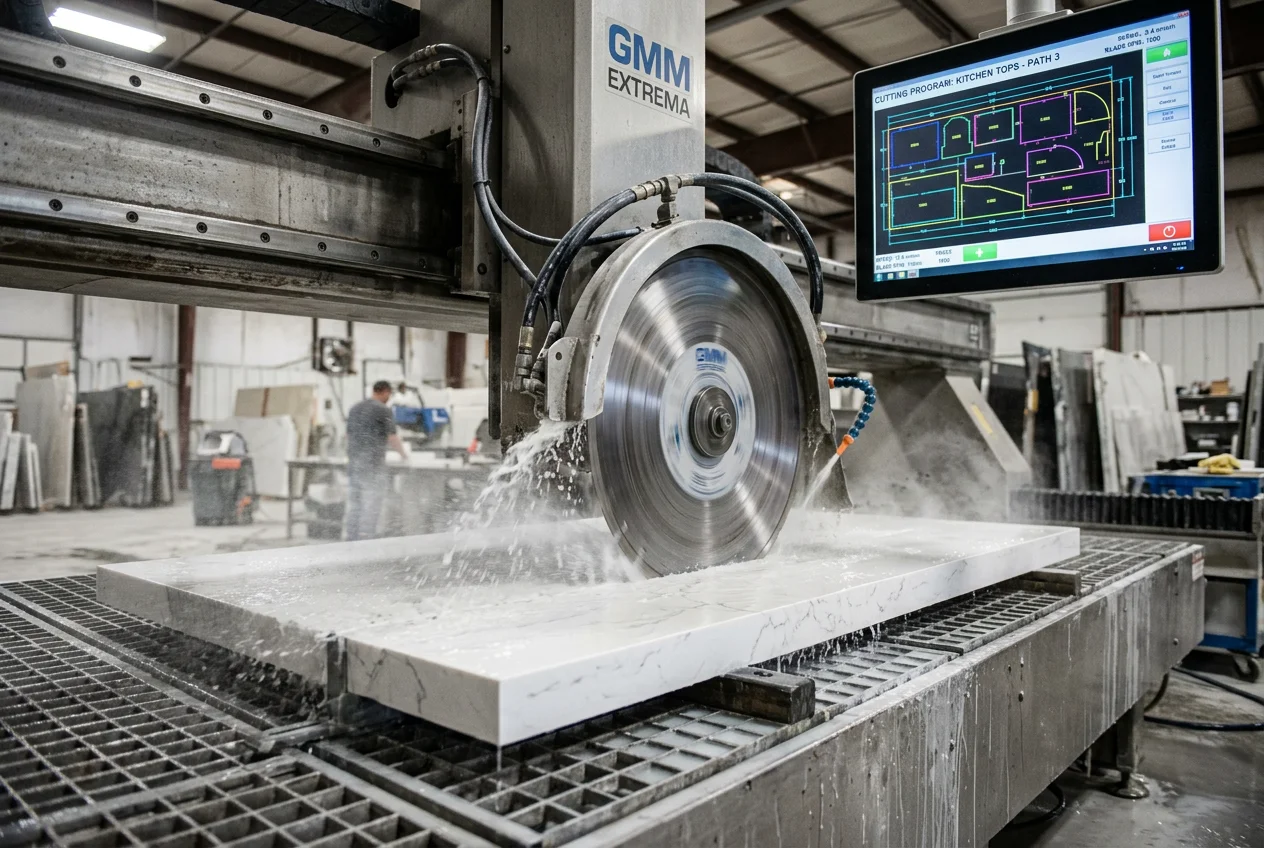
Quartz fabrication requires different cutting speeds, blade cooling, dust management, and seam techniques than natural stone because quartz is an engineered composite — roughly 90-94% crushed quartz bound with polymer resins. The resin component generates more heat during cutting, produces finer dust particles, creates different seam-matching challenges, and can discolor if thermal management isn’t precise.
Most homeowners assume that a fabricator who cuts granite well will automatically cut quartz well. That’s partly true — the CNC equipment is similar — but the material behavior is different enough that the operator needs to adjust their approach.
Cutting Differences
Natural stone is entirely mineral. When a diamond blade cuts through granite, it’s cutting through crystalline structures that fracture cleanly. Quartz countertops are mineral plus resin, and that resin heats up during cutting. If the blade moves too fast or the water cooling is insufficient, the resin can scorch at the cut edge, leaving discoloration that’s visible on lighter-colored quartz. Professional quartz fabrication services calibrate blade speed and water flow specifically for each quartz brand’s resin formula.
Dust Management
Quartz fabrication generates fine silica dust — a known respiratory hazard. Professional fabrication shops use wet-cutting processes (water suppresses dust during cutting) and enclosed work areas with air filtration systems. This isn’t just a quality issue; it’s a worker safety requirement. A shop that dry-cuts quartz is cutting corners on both quality and safety.
Seam Behavior
Natural stone seams use color-matched epoxy that bonds to the mineral surface. Quartz seams bond to the resin matrix, which means the adhesive chemistry is different. Additionally, quartz patterns — especially those mimicking marble veining — need careful seam placement because the printed or embedded pattern doesn’t always flow naturally across a joint the way natural stone veining does. Matching a Calacatta-pattern quartz seam requires the fabricator to plan pattern continuity during layout engineering.
Edge Profiling
Quartz edges profile cleanly with CNC routers, but the resin can chip or pull out of the edge surface if the routing bit is worn or the feed rate is too aggressive. Fresh diamond tooling and proper feed rates produce smooth, consistent edges. A shop that doesn’t maintain their tooling produces quartz edges with micro-chips that catch light and feel rough.
| Fabrication Factor | Natural Stone (Granite) | Engineered Quartz |
| Cutting speed | Moderate to fast | Slower (heat management) |
| Water cooling | Standard | Critical (prevents resin scorch) |
| Dust type | Mineral particles | Fine silica + resin particles |
| Seam adhesive | Stone-bonding epoxy | Resin-compatible adhesive |
| Pattern matching at seams | Natural vein alignment | Printed/embedded pattern alignment |
| Edge chipping risk | Low (mineral structure) | Moderate (resin pullout possible) |
| Tooling wear | Normal | Faster (resin accelerates wear) |
What Should You Know About Major Quartz Brands and Fabrication?
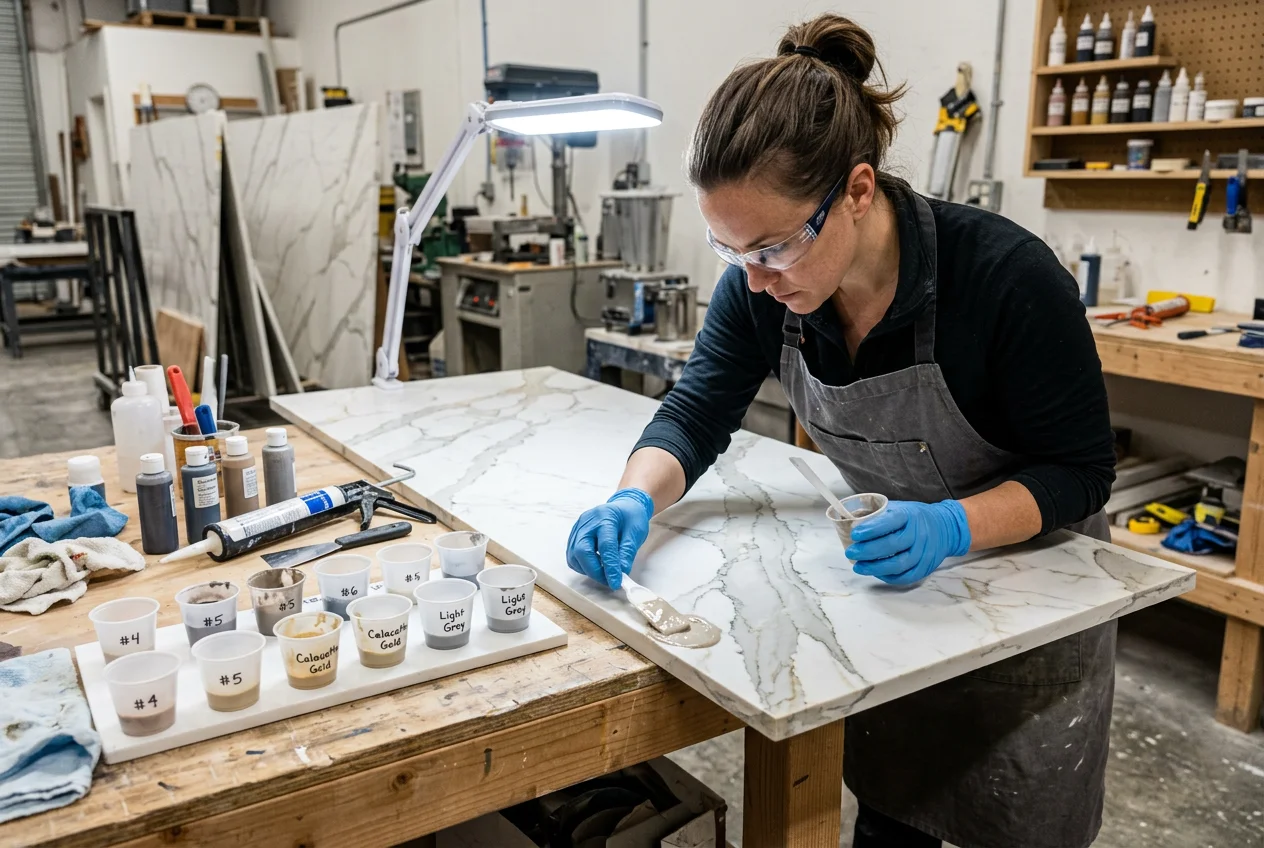
Each quartz brand — Caesarstone, Cambria, Silestone, MSI, and others — uses proprietary resin formulas, different slab thicknesses, and unique pattern technologies that affect fabrication parameters. A fabricator experienced with multiple brands knows how each one cuts, seams, and finishes differently — and adjusts their CNC programming accordingly rather than using one-size-fits-all settings.
Not all quartz is created equal. The brand determines the resin percentage, the pattern depth, the color consistency between slabs, and even the available edge profile options. Here’s what distinguishes the major brands from a fabrication perspective:
Caesarstone
One of the original engineered quartz manufacturers. Caesarstone slabs use a consistent resin formula that fabricates predictably. Their newer collections include veined patterns that mimic natural marble — these require careful seam planning because the veining is surface-applied and doesn’t penetrate the full slab thickness. Cut edges show the underlying quartz aggregate, not the surface pattern.
Cambria
An American-made quartz brand known for thick 3cm slabs and deep pattern penetration. Cambria’s proprietary manufacturing process creates patterns that extend deeper into the slab than most competitors, which means cut edges show more pattern consistency. This makes Cambria easier to seam with less visible pattern disruption. Their hardness tends to run slightly higher than average quartz, requiring adjusted blade speeds.
Silestone
Silestone includes a proprietary antimicrobial treatment (N-Boost) in their quartz. From a fabrication perspective, Silestone slabs cut and profile similarly to other premium brands. Their “Loft” and “Ethereal” collections use larger pattern formats that need careful layout planning to maintain visual flow across seams.
MSI Q Quartz and Budget Brands
MSI and similar value-tier quartz brands offer lower-cost alternatives with simpler patterns. They fabricate well with standard quartz settings but may have slightly more color variation between slabs than premium brands. For multi-piece kitchens, order all material from the same production lot.
| Brand | Slab Thickness | Pattern Depth | Seam Visibility | Fabrication Notes |
| Caesarstone | 2cm, 3cm | Surface to moderate | Moderate (surface pattern) | Consistent resin, predictable cutting |
| Cambria | 3cm standard | Deep penetration | Lower (pattern at edges) | Slightly harder, adjust blade speed |
| Silestone | 2cm, 3cm | Moderate | Moderate | N-Boost antimicrobial, standard cutting |
| MSI Q Quartz | 2cm, 3cm | Surface level | Higher on veined patterns | Check lot consistency for multi-piece |
| LG Viatera | 2cm, 3cm | Moderate | Moderate | Standard fabrication parameters |
What Edge Profiles and Design Options Work Best With Quartz?
Quartz supports all standard edge profiles — eased, beveled, bullnose, ogee, and waterfall miters — but its resin composition makes some profiles more forgiving than others. Simple profiles (eased, beveled) show the cleanest results because there’s less edge surface exposed to potential micro-chipping. Complex profiles (ogee, dupont) require slower routing speeds and fresh diamond tooling to prevent resin pullout along the curves.
Edge profile selection for quartz follows the same aesthetic logic as natural stone — eased for modern, bullnose for transitional, ogee for traditional. But the fabrication considerations are slightly different because of how the resin behaves during routing.
Best-Performing Quartz Edge Profiles
- Eased edge: The most popular quartz edge by far. A flat squared edge with softened corners. Clean, modern, and the most forgiving to fabricate. The short edge surface area minimizes any risk of chipping or resin pullout.
- Beveled edge: A flat edge with a 45-degree chamfer. Adds subtle detail with minimal fabrication complexity. The beveled cut creates a shadow line that works well with quartz patterns that mimic natural stone.
- Half bullnose: The top edge is rounded while the bottom stays square. A good transitional option that fabricates cleanly on quartz. The curved surface needs proper diamond pad polishing to match the face finish.
Profiles That Require Extra Care on Quartz
- Full bullnose: Both top and bottom edges are rounded. More edge surface exposed, more polishing required. Works well but requires fresh tooling to avoid micro-texture inconsistencies.
- Ogee: The S-curve creates the most edge surface and the most routing passes. On quartz, ogee profiles need slower feed rates and sharp tooling to prevent the resin from pulling out of the concave sections. A well-executed ogee on quartz looks stunning — but it requires a fabricator who knows the material’s limits.
- Waterfall miter: The mitered joint on a waterfall quartz island is one of the most demanding fabrication tasks. The miter cut must be precisely 45 degrees, the pattern must align across the joint, and the bonding adhesive must be color-matched to the quartz surface — not just the base color. GMD’s CNC equipment cuts miters with sub-millimeter accuracy for tight, nearly invisible waterfall joints.
Quartz-Specific Design Considerations
Quartz patterns have evolved dramatically. Early quartz was solid colors or simple speckle. Today’s premium quartz mimics Calacatta marble, concrete, soapstone, and even quartzite — complete with vein patterns that need to be oriented correctly during fabrication. If you’re choosing a veined quartz pattern, discuss vein direction with your fabricator during the layout phase. Running veins lengthwise along a kitchen run creates a different visual effect than running them across the width.
Key Takeaways
- Takeaway 1: Quartz fabrication requires different cutting speeds, dust management, and seam techniques than natural stone because the polymer resin binders behave differently under CNC equipment.
- Takeaway 2: Each quartz brand uses proprietary resin formulas and pattern technologies that affect how the material cuts, seams, and finishes — experienced fabricators adjust their approach per brand.
- Takeaway 3: Quartz seam visibility depends on both the pattern type and the fabricator’s color-matching skill — veined patterns require more layout planning than solid colors.
- Takeaway 4: Simple edge profiles (eased, beveled) deliver the cleanest results on quartz; complex profiles (ogee, waterfall) need slower routing speeds and fresh tooling.
- Takeaway 5: Wet cutting is non-negotiable for quartz fabrication — it prevents resin scorching and suppresses the fine silica dust that’s a serious worker safety hazard.
- Takeaway 6: Quartz can’t be used outdoors — UV exposure degrades the resin binders over time, causing discoloration and structural weakening.
Why Does Your Choice of Quartz Fabricator Matter?
Your quartz fabricator determines seam quality, edge finish, pattern alignment, and whether the material’s non-porous integrity is maintained through cutting and installation. A fabricator who treats quartz like granite — same speeds, same tooling, same adhesives — produces lower-quality results because the materials demand fundamentally different techniques.
Quartz is often positioned as the “easy” countertop material. And for homeowners, it is — no sealing, no fussing, just wipe and go. But for fabricators, quartz is not easier than natural stone. It’s different. And those differences require specific knowledge and equipment calibration.
What to Ask a Quartz Fabricator
- “Which quartz brands have you fabricated?” A shop experienced with Caesarstone, Cambria, and Silestone understands brand-to-brand differences. A shop that only works with one brand may not know how to adjust for a different resin formula.
- “How do you manage seam visibility on veined quartz?” The answer should involve layout engineering, pattern alignment during dry-fit, and brand-specific color-matched adhesive. If the answer is “we just use clear epoxy,” that fabricator isn’t optimizing for quartz.
- “Do you wet-cut all quartz fabrication?” The only acceptable answer is yes. Dry-cutting quartz creates silica dust hazards and risks resin scorching at the cut edge.
- “What edge profiles do you recommend for quartz?” A knowledgeable fabricator will mention that complex profiles require adjusted feed rates on quartz and may suggest alternatives if your preferred profile is prone to chipping on your specific brand.
GMD’s fabrication team works with every major quartz brand and calibrates their CNC equipment to each material’s specifications. Their StoneDoneRight™ process applies the same six-stage quality pipeline to quartz as natural stone — slab inspection, digital templating, layout engineering, CNC cutting, edge profiling, and final quality inspection — with quartz-specific adjustments at every stage.
Conclusion
Quartz countertop fabrication sits at the intersection of engineering precision and material science. The consistency that makes quartz appealing to homeowners — uniform color, predictable performance, zero maintenance — requires a fabricator who understands that consistency comes from manufacturing, not nature, and adjusts their techniques accordingly. Brand-specific knowledge, proper thermal management, and specialized seam work separate a quartz countertop you’re proud of from one where the seams catch your eye every morning.
Ready for expert quartz fabrication? Contact Granite & Marble Designs for a free consultation. Their team fabricates all major quartz brands with CNC precision and brand-specific expertise — backed by over 4,400 completed projects in Denver.
Frequently Asked Questions
Is quartz harder to fabricate than granite?
Not harder, but different. Quartz requires slower cutting speeds, better thermal management, and specialized seam techniques due to its resin binders. A fabricator experienced with both materials adjusts their approach accordingly.
Can any stone fabricator work with quartz?
Technically, any shop with CNC equipment can cut quartz. But the quality depends on whether they calibrate for quartz-specific requirements. Ask about their quartz brand experience and seam techniques.
Does the quartz brand affect fabrication quality?
Yes. Each brand uses different resin formulas, pattern depths, and slab characteristics. A fabricator experienced with multiple brands delivers better results because they adjust techniques per material.
What edge profile works best on quartz?
Eased and beveled edges produce the cleanest results. Bullnose and ogee are possible but require slower routing and fresh tooling. Discuss options with your fabricator based on your specific quartz brand.
How are quartz seams color-matched?
The fabricator mixes custom-colored adhesive to match the specific quartz slab’s color and pattern. For veined patterns, seam placement is planned during layout engineering to minimize visual disruption.
Can quartz countertops be fabricated for outdoor use?
No. Quartz resin degrades under UV exposure, causing discoloration and weakening. For outdoor countertops in Denver, choose granite, quartzite, or porcelain instead.
How long does quartz fabrication take?
Quartz fabrication follows the same 5 to 10 business day timeline as natural stone after templating. The process includes slab inspection, CNC cutting, edge profiling, and quality inspection.
Is quartz fabrication dusty?
All quartz fabrication at GMD uses wet-cutting processes that suppress dust during cutting. This is both a quality requirement (prevents resin scorching) and a worker safety standard.
Can quartz be fabricated with a waterfall edge?
Yes. Waterfall miters on quartz require precise 45-degree cuts and pattern-aligned bonding. The adhesive must color-match both the surface pattern and the base color for an invisible joint.
What’s the difference between quartz and quartzite fabrication?
Quartz is engineered (resin + crushed stone) and requires resin-specific techniques. Quartzite is natural stone (metamorphic) and is fabricated like granite but is significantly harder, requiring specialized diamond tooling.