
How to Choose the Best Countertop Company in Denver
The best countertop company for your project is one that fabricates in-house, uses CNC equipment, lets you tour their shop, provides transparent itemized quotes, and has a verifiable track record of completed projects in Denver. Price should be the last thing you compare — not the first — because the cheapest quote almost always cuts corners somewhere you won’t see until it’s too late.
Hiring a countertop company in Denver is one of those decisions where the stakes feel higher than they should. You’re spending thousands of dollars on a surface you’ll use every day for the next decade or two, and you’re trusting someone to cut a one-of-a-kind stone slab that can’t be re-ordered if they mess up. Sound stressful? It doesn’t have to be — if you know what to look for and what to ask. As a natural stone supplier and fabricator serving Denver since 2007, Granite & Marble Designs has seen what separates great countertop companies from ones that leave homeowners frustrated, and this guide shares that knowledge honestly.
This guide walks you through how to evaluate stone companies in Denver, what red flags to avoid, which questions cut through the sales pitch, and how to compare quotes so you’re actually comparing the same thing.
What Should You Look for in a Denver Countertop Company?

Look for in-house fabrication with CNC equipment, a physical showroom where you can view full slabs, a verifiable history of completed projects in your area, transparent quotes that itemize every cost, and a willingness to let you tour their fabrication facility. A company that checks all five boxes is confident in their process — and that confidence shows up in the finished product.
Most homeowners start their search on Google, read a few reviews, and call whoever’s closest or cheapest. That approach works for ordering a pizza. It doesn’t work for a multi-thousand-dollar stone countertop project. Here’s what actually matters:
In-House Fabrication
This is the single biggest factor. A company that fabricates in their own shop — with their own equipment and their own team — controls every step from template to finished piece. A company that outsources fabrication sends your project to a third-party shop where they have no direct oversight. That handoff creates opportunities for miscommunication, quality variation, and accountability gaps.
Ask directly: “Do you fabricate in your own facility, or do you outsource fabrication?” If the answer involves a third-party shop, you’re not hiring a fabricator — you’re hiring a middleman.
CNC Equipment
CNC (Computer Numerical Control) machines cut and profile stone with precision that hand tools can’t match. A shop running CNC bridge saws and routers produces tighter cuts, more consistent edge profiles, and more precise cutouts than one relying on handheld grinders and circular saws. Ask what equipment they use and when it was last upgraded.
Physical Showroom with Full Slabs
A company with a showroom where you can view full-size stone slabs is invested in the customer experience. Browsing 4-inch samples at a home improvement store doesn’t tell you how a stone will look across an 8-foot island. At GMD’s Denver showroom on Pecos Street, clients walk through racks of full slabs and select the exact stone for their project.
Verifiable Track Record
Ask for project numbers, not vague claims. “We’ve done hundreds of kitchens” is marketing. “We’ve completed 4,400+ projects including 1,354 residential kitchens since 2007” is accountable. Check Google Reviews, BBB ratings, and ask for recent project photos or references. A custom stone company with a real track record is happy to share it.
Transparent Quoting
The quote should itemize every cost: material, fabrication, installation, demolition, plumbing coordination, sink mounting, sealing, and any backsplash work. A single lump-sum number hides what you’re paying for and makes it impossible to compare quotes from different companies fairly.
| What to Evaluate | Green Flag | Red Flag |
| Fabrication | In-house with own equipment | Outsourced to third-party shop |
| Equipment | CNC bridge saw and router | Handheld grinders only |
| Showroom | Full slab viewing available | Samples only, no slab access |
| Track record | Specific project numbers, verifiable reviews | Vague claims, few or no reviews |
| Quoting | Itemized breakdown of every cost | Lump-sum with no detail |
| Shop tour | Welcomed and encouraged | Refused or avoided |
What Questions Should You Ask Before Hiring a Countertop Company?
Ask these seven questions: Do you fabricate in-house? What CNC equipment do you use? Can I tour your facility? How many projects have you completed in my area? What’s included in your quote? What warranty do you offer? And who is personally responsible if something goes wrong? The answers tell you more than any website or advertisement ever will.
Questions cut through the sales pitch. Any company can say they’re “the best” on their website. But specific, pointed questions force concrete answers that reveal whether the operation matches the marketing.
The Seven Questions That Matter
1. “Do you fabricate in your own shop, or outsource?” This separates fabricators from brokers. If they outsource, ask who does the fabrication and whether you can visit that shop instead.
2. “What cutting and profiling equipment do you use?” You’re listening for CNC bridge saws and CNC routers. If the answer is “our experienced craftsmen use hand tools,” that’s a polite way of saying they don’t have precision machinery.
3. “Can I tour your fabrication facility?” A confident shop says yes. A shop that avoids the question or makes excuses has something they’d rather you not see — outdated equipment, disorganized workflow, or a space that doesn’t match their marketing.
4. “How many projects have you completed in Denver?” Listen for specifics. How many residential? How many commercial? How many years have they been operating? Vague answers like “a lot” or “too many to count” are non-answers.
5. “What exactly is included in this quote?” Go line by line. Material cost. Fabrication. Installation. Demolition of old countertops. Plumbing disconnect and reconnect. Sink mounting hardware. Sealant application. Standard backsplash. If any of those items are missing, ask why — and get the additional cost in writing before you sign.
6. “What does your warranty cover and for how long?” Ask what specifically is covered — fabrication defects? Seam separation? Cracking? Staining? And ask what’s excluded. A warranty that covers “materials and workmanship” but excludes “normal wear” and “natural stone characteristics” may not cover much at all.
7. “If something goes wrong, who do I call?” You want a single point of accountability. If the answer involves calling one company for installation issues and another for fabrication problems, the accountability is already fractured.
| Question | What a Good Answer Sounds Like | What a Bad Answer Sounds Like |
| In-house fabrication? | “Yes, at our facility on [address]” | “We work with trusted partners” |
| CNC equipment? | “We run [specific brand] CNC bridge saw and router” | “Our team is very experienced with tools” |
| Shop tour? | “Absolutely, when would you like to come?” | “We don’t usually do that” or “Our shop is off-site” |
| Project count? | “4,400+ including 1,354 residential” | “We’ve been doing this a long time” |
| Quote details? | Itemized line-by-line breakdown | Single lump-sum number |
| Warranty? | Specific terms, duration, and coverage | “We stand behind our work” |
| Accountability? | “Call me directly, here’s my number” | “Contact customer service” |
How Do You Compare Countertop Quotes Without Getting Burned?
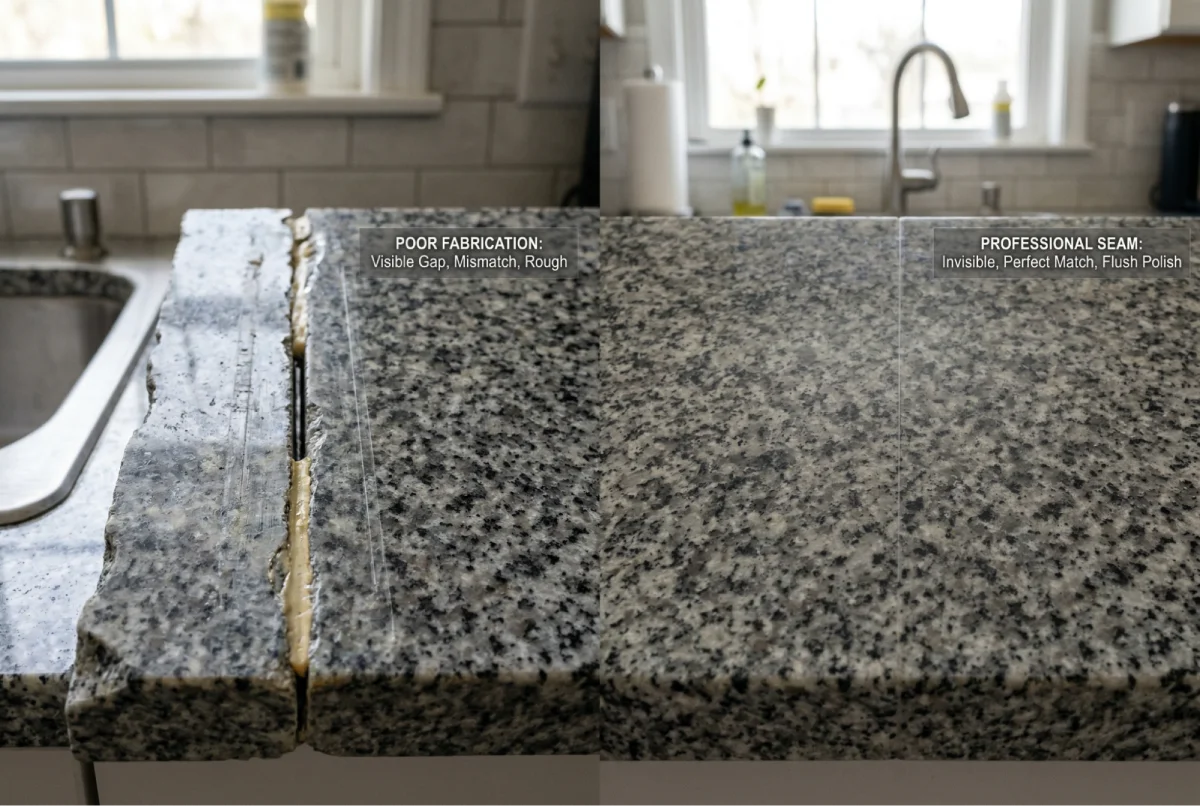
Compare quotes by creating a line-item checklist of every service — material, fabrication, template, demolition, installation, plumbing, sink mounting, backsplash, and sealant — and checking which items each quote includes. The lowest total price often excludes services the other quotes include, making it appear cheaper while costing more once you add the missing pieces.
Here’s the thing about countertop quotes: they’re only comparable when they include the same scope. A $3,500 quote that covers everything from demolition through sealing is actually cheaper than a $2,800 quote that excludes demolition, plumbing, and backsplash — once you add those items separately, the “cheap” quote ends up costing more.
The Apples-to-Apples Comparison Method
Create a simple spreadsheet with these line items and fill in what each quote covers:
- Material cost (stone slab, per square foot or per slab)
- Fabrication (cutting, profiling, polishing)
- Template (digital laser or hand measurement)
- Demolition (removal and disposal of old countertops)
- Installation (placement, leveling, seaming)
- Plumbing (disconnect and reconnect)
- Sink mounting (clips, adhesive, installation)
- Standard backsplash (4-inch stone backsplash)
- Sealant (initial sealing application)
- Warranty (what’s covered, how long)
When you put three quotes side by side with this framework, the differences become obvious. One company might include everything in a single price. Another might quote material and fabrication only, with installation, plumbing, and demolition as separate charges. A third might include installation but not sink mounting or sealing.
Hidden Cost Traps
Watch for these common traps in countertop quotes:
- “Per square foot” pricing without edge profile costs. Simple edges are usually included. Ogee, waterfall, or laminated edges often carry additional fabrication charges that aren’t in the base square-foot price.
- Sink cutout charges. Some companies include undermount sink cutouts in the fabrication price. Others charge per cutout — $150 to $300 each — which adds up fast in a multi-sink bathroom project.
- Travel or delivery fees. If the fabrication shop is outside the Denver metro area, delivery charges may apply. Ask what service area is included in the standard quote.
- Seam surcharges. Complex seam work — especially waterfall miters and pattern-matched joints — requires more fabrication time. Some companies charge extra per seam.
| Quote Line Item | Company A | Company B | Company C |
| Material | ✓ Included | ✓ Included | ✓ Included |
| Fabrication | ✓ Included | ✓ Included | ✓ Included |
| Template | ✓ Included | ✓ Included | $ Separate charge |
| Demolition | ✓ Included | $ Separate charge | $ Separate charge |
| Installation | ✓ Included | ✓ Included | ✓ Included |
| Plumbing | ✓ Included | $ Separate plumber | $ Not included |
| Sink mounting | ✓ Included | ✓ Included | $ Per cutout charge |
| Backsplash | ✓ 4″ included | $ Add-on | $ Add-on |
| Sealant | ✓ Included | ✓ Included | $ Separate charge |
| Apparent Price | $$$ | $$ | $ |
| True Total | $$$ | $$$+ | $$$$ |
The company with the highest sticker price often delivers the best value when everything is included. GMD’s quotes are fully itemized with no hidden charges — what you see on paper is what you pay.
Key Takeaways
- Takeaway 1: In-house fabrication with CNC equipment is the single most important factor when choosing a countertop company — it gives the company direct control over quality and accountability.
- Takeaway 2: Seven specific questions — about fabrication, equipment, shop tours, project volume, quote details, warranty, and accountability — reveal more than any website or advertisement.
- Takeaway 3: Compare quotes using a line-item checklist, not total price alone — the cheapest quote often excludes services that other quotes include as standard.
- Takeaway 4: A company that refuses shop tours, gives vague project numbers, or provides lump-sum quotes without itemization is showing you who they are — believe them.
- Takeaway 5: Warranty specifics matter more than warranty length — a 10-year warranty with broad exclusions protects you less than a 5-year warranty with clear, specific coverage.
- Takeaway 6: The best countertop companies welcome scrutiny — they’re confident in their process, transparent about their pricing, and accountable when problems arise.
What Red Flags Should Make You Walk Away From a Countertop Company?
Walk away if a company won’t let you tour their shop, can’t give you specific project numbers, provides a lump-sum quote with no itemization, pressures you to sign immediately with “today-only” pricing, claims they fabricate in-house but can’t show you the equipment, or has a pattern of unresolved complaints on Google Reviews or the BBB.
Not every countertop company that looks professional online is professional in practice. Some warning signs are obvious. Others are subtle enough that you might miss them if you’re not looking.
Immediate Red Flags
- “We don’t do shop tours.” A fabrication shop is not a secret facility. If they won’t show you where your countertop is being made, ask yourself why.
- Pressure to commit. “This price is only good today” or “we’ve only got one slab left in this color” are high-pressure tactics. A legitimate company gives you time to make a considered decision. Stone slabs don’t expire.
- No physical location. A company operating out of a truck or a PO box has no overhead — which also means no showroom, no dedicated fabrication space, and nowhere to find them if something goes wrong.
- Can’t name their equipment. If you ask what CNC machines they run and the answer is vague or evasive, they likely don’t have any. “We use the latest technology” is not an answer.
- Subcontracts everything. Some companies market themselves as full-service fabricators but actually outsource fabrication, installation, and even templating to different subcontractors. You’re paying a markup for project management, not craftsmanship.
Subtler Warning Signs
- Only positive reviews with generic language. Real reviews mention specific details — the type of stone, the installer’s name, the timeline. Fake reviews say things like “Great company, very professional!” without any substance.
- No photos of their own work. Stock photos on a countertop company’s website or social media are a red flag. A company that does quality work has hundreds of real project photos.
- Quote doesn’t mention demolition or plumbing. If significant line items are missing from the quote, they’re either not included (and you’ll pay extra later) or the company hasn’t thought through the full project scope.
Granite & Marble Designs has operated from their Pecos Street facility since 2007, welcomes shop tours, maintains a 4,400+ project track record with real customer reviews, and provides fully itemized quotes with every scope item clearly defined. That’s the standard — and any best natural stone supplier in Denver should meet it.
Conclusion
Choosing a countertop company is a hiring decision, not a shopping decision. You’re not buying a product off a shelf — you’re entrusting someone to cut an irreplaceable stone slab, fabricate it to millimeter precision, and install it in the room where you spend the most time. The seven questions, the quote comparison framework, and the red flag checklist in this guide give you the tools to evaluate any stone companies in Denver on substance rather than marketing.
Ready to see what a confident countertop company looks like from the inside? Contact Granite & Marble Designs for a free consultation that includes a fabrication shop tour, full slab viewing, and a transparent, itemized quote — no pressure, no gimmicks, no surprises.
Frequently Asked Questions
How many countertop companies should I get quotes from?
Three quotes is the standard recommendation. It gives you enough comparison data without becoming overwhelming. Use the line-item comparison method to evaluate them fairly.
Is the cheapest countertop quote always the worst?
Not always, but frequently. Cheap quotes often exclude services like demolition, plumbing, and sealing that more expensive all-inclusive quotes cover. Compare scope, not just price.
How do I verify a countertop company’s track record?
Check Google Reviews for volume and recency. Look at the BBB for complaint history. Ask the company for specific project numbers and recent reference photos. Visit their shop.
Should I hire a big box store or a local fabricator?
Big box stores typically outsource fabrication and installation to local subcontractors. Hiring a local fabricator directly eliminates the middleman markup and gives you a direct relationship with the people doing the work.
What warranty should I expect from a countertop company?
Look for a warranty that specifically covers fabrication defects, seam integrity, and installation workmanship. Ask what’s excluded. Duration matters less than what’s actually covered.
Can I negotiate countertop company pricing?
You can ask about available promotions or remnant options for cost savings, but negotiating below a company’s fair pricing usually means they’ll cut corners to make the math work. Focus on value, not discounts.
How important are online reviews for countertop companies?
Very important — but read them critically. Look for specific details about the project, not generic praise. A company with 200+ reviews averaging 4.5+ stars with substantive feedback is more trustworthy than one with 15 perfect five-star reviews.
What’s the difference between a countertop fabricator and a countertop retailer?
A fabricator cuts, profiles, and polishes the stone in their own shop. A retailer takes your order and hires a separate fabricator and installer. Working directly with a fabricator gives you better quality control and usually better pricing.
Should I visit the fabrication shop before hiring?
Absolutely. The shop condition, equipment quality, work-in-progress, and team professionalism tell you everything about the company that their website can’t. Any company that welcomes a visit is worth considering.
How long should the countertop company have been in business?
Experience matters, but it’s not the only factor. A company operating 10+ years with consistent reviews demonstrates staying power. A newer company with CNC equipment and in-house fabrication can also deliver excellent work.