
Stone Countertop Fabrication Process: From Slab to Surface
Stone countertop fabrication is the process of transforming a raw stone slab into a precision-cut, polished, ready-to-install countertop surface. It involves digital templating, CNC cutting, edge profiling, sink cutout engineering, seam fabrication, and multi-stage polishing — each step requiring specialized equipment and experienced operators to get right.
Most homeowners never think about what happens between “I picked my stone” and “it’s installed in my kitchen.” That in-between — stone countertop fabrication — is where the quality of your countertop is actually determined. A gorgeous slab of granite or quartzite can become a stunning kitchen centerpiece or a disappointing mess, and the difference comes down entirely to how it’s fabricated. Granite & Marble Designs’ stone fabrication services have turned raw slabs into finished surfaces for over 4,400 projects in Denver since 2007, using state-of-the-art CNC technology and 100+ years of combined artisan experience.
This guide pulls back the curtain on stone fabrication — every phase, every machine, every quality checkpoint. Whether you’re a homeowner trying to understand what you’re paying for, a contractor evaluating fabrication partners, or just curious about how countertops are actually made, this is the process from start to finish.
What Are the Main Stages of Stone Countertop Fabrication?
Stone countertop fabrication follows six core stages: slab selection and inspection, digital templating, layout engineering, CNC cutting and shaping, edge profiling and polishing, and final quality inspection. Each stage builds on the last, and errors at any point compound through the remaining stages — which is why fabrication quality matters more than most people realize.
Think of fabrication as a chain. The template feeds the layout. The layout programs the CNC. The CNC cut determines the edge profile quality. And the quality inspection catches anything the machines and operators missed. Break one link, and you feel it in the finished product.
Here’s how Granite & Marble Designs runs their StoneDoneRight™ fabrication process at their Pecos Street facility:
Stage 1: Slab Selection and Inspection
Before anything gets cut, the selected slab is inspected for structural integrity. Fabricators look for natural fissures, soft spots, color inconsistencies, and hidden cracks that could cause problems during cutting. Not every part of a slab is usable. A stone fabricator who skips this step risks discovering flaws mid-cut — after the expensive part has already started.
Stage 2: Digital Templating
A technician visits the installation site and captures exact measurements using a digital laser templating system. This creates a point-cloud-style digital map of the countertop layout — every wall angle, cabinet dimension, appliance position, sink location, and overhang measurement. That data transfers directly to fabrication software with no manual re-entry.
Stage 3: Layout Engineering
This is where artistry meets engineering. The fabrication team maps the template onto the slab, deciding where each piece comes from within the stone. They plan vein direction, seam locations, pattern continuity, and material yield. A skilled layout engineer maximizes the usable stone while positioning seams where they’ll be least visible. At GMD, clients can approve the layout plan before any cutting begins.
Stage 4: CNC Cutting and Shaping
The programmed layout feeds into a CNC bridge saw — a computer-controlled cutting machine that uses diamond blades to cut stone with sub-millimeter accuracy. Water jets cool the blade and suppress dust during cutting. Sink cutouts, cooktop openings, and faucet holes are all cut during this phase, each positioned exactly where the digital template specified.
Stage 5: Edge Profiling and Polishing
After cutting, the countertop edges are shaped using CNC routers equipped with diamond profiling bits. Whether you chose a simple eased edge, a rounded bullnose, or a decorative ogee, the router follows a programmed path to create a consistent profile along the entire edge. Multi-stage diamond polishing pads then bring the edge to the same finish level as the slab surface — polished, honed, or leathered.
Stage 6: Quality Inspection
Every finished piece goes through a final inspection: dimensional accuracy against the template, surface finish consistency, edge profile uniformity, seam fit verification, and visual inspection for chips or defects. Pieces that don’t pass get re-fabricated. This is the quality gate that separates professional fabrication from assembly-line output.
| Fabrication Stage | Equipment Used | What’s Checked | Time Required |
| Slab Inspection | Visual + structural testing | Fissures, cracks, color consistency | 15–30 minutes |
| Digital Templating | Laser templating system | Dimensional accuracy to millimeters | 30–60 minutes (on-site) |
| Layout Engineering | CAD/CAM software | Vein flow, seam placement, yield optimization | 1–2 hours |
| CNC Cutting | Bridge saw, waterjet | Cut accuracy, cutout positions | 1–3 hours per slab |
| Edge Profiling | CNC router, diamond pads | Profile consistency, finish quality | 30–60 minutes per piece |
| Quality Inspection | Straight edge, visual check | Dimensions, finish, defects | 15–30 minutes per piece |
Why Does CNC Fabrication Technology Matter for Your Countertop?
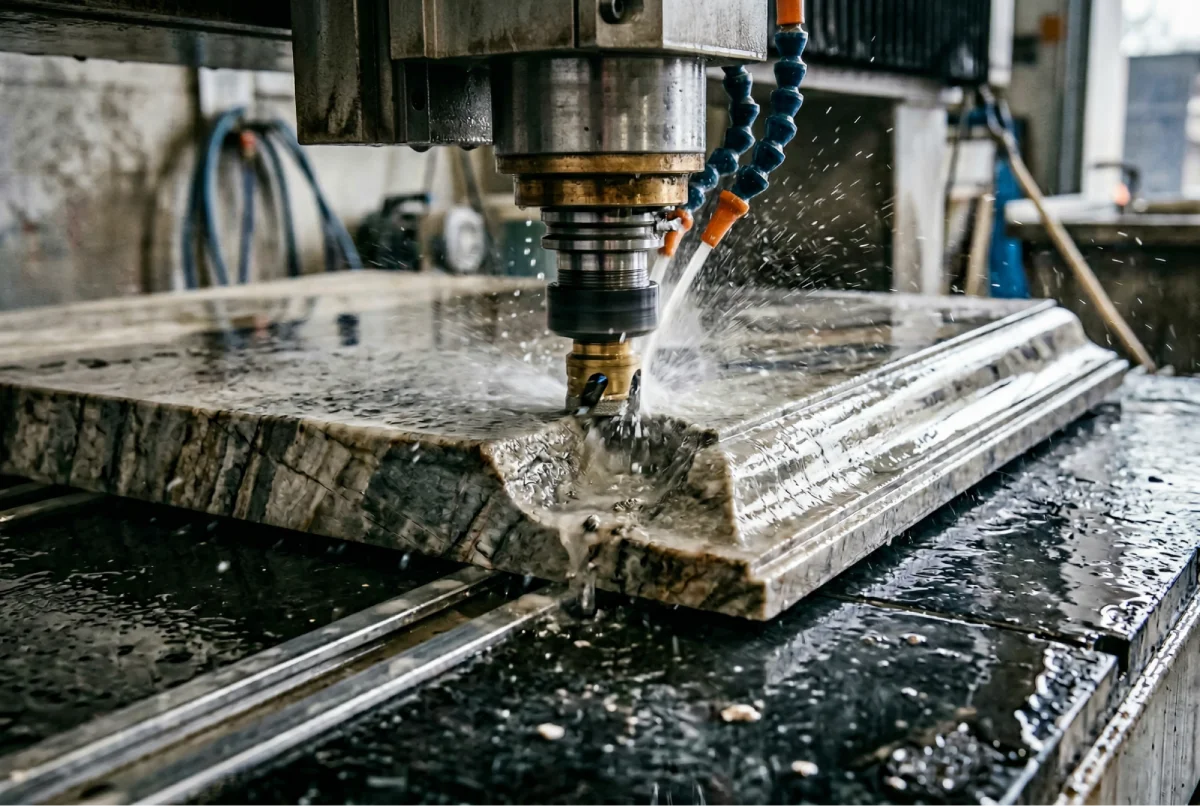
CNC (Computer Numerical Control) fabrication eliminates the dimensional errors, inconsistent edges, and rough cutouts that plague hand-fabricated countertops. A CNC bridge saw cuts stone to within fractions of a millimeter, and a CNC router produces edge profiles that are perfectly uniform across the entire countertop length — something no human hand can consistently replicate.
Not every fabrication shop runs the same equipment. Some shops still hand-cut with circular saws and shape edges with handheld grinders. Others have invested in CNC technology that automates the most precision-critical operations. The difference shows up in three places:
- Cut accuracy. A CNC bridge saw follows a programmed cutting path with positional accuracy measured in tenths of a millimeter. Hand cutting with a circular saw introduces operator variability — slight wobbles, drift, and inconsistency that add up across a 10-foot countertop run.
- Edge consistency. A CNC router creates the same edge profile from start to finish because the machine follows a programmed tool path. Hand-profiled edges often show subtle variations — a thicker bullnose here, a slightly uneven ogee there — that become visible in raking light.
- Cutout precision. Sink cutouts, cooktop openings, and faucet holes cut by CNC match the digital template exactly. Hand-cut openings rely on traced lines and operator skill, leaving more room for misalignment that becomes apparent during installation.
Does this mean hand fabrication is always bad? No. Some finishing work — color-matching seam epoxy, polishing hard-to-reach areas, final fit adjustments on site — still requires skilled hands. But the primary cutting, shaping, and profiling should be machine-controlled for consistency.
GMD invested in latest-generation CNC bridge saws and routers specifically because the results are verifiable. Every cut can be measured against the digital template. That level of accountability doesn’t exist with hand fabrication.
| Fabrication Method | Cut Accuracy | Edge Consistency | Cutout Precision | Speed |
| CNC Bridge Saw | ±0.5mm | Machine-uniform | Template-exact | Faster |
| Hand Circular Saw | ±2-5mm | Operator-variable | Traced-line approximate | Slower |
| CNC Router (edge) | Programmed path | Identical start-to-finish | N/A | Consistent |
| Handheld Grinder (edge) | Manual control | Variable by section | N/A | Inconsistent |
How Does Seam Engineering Work in Stone Fabrication?
Seam engineering is the process of planning where countertop pieces join together, then cutting, color-matching, and bonding those joints so they’re structurally sound and nearly invisible. It’s the most skill-intensive part of fabrication — and the part homeowners notice most if it’s done poorly.
Every countertop project that spans more than a single slab requires at least one seam. L-shaped kitchens, large islands, and countertops longer than the slab’s natural dimensions all involve joints. The question isn’t whether you’ll have seams — it’s whether you’ll see them.
Here’s the thing: a well-engineered seam isn’t just glued together. It’s a multi-step process that starts during layout and finishes during installation.
During Layout: The fabricator plans seam locations based on three priorities — structural strength, visual concealment, and vein continuity. Seams placed at natural break points (inside corners, behind sinks) are less visible. Seams that interrupt a dramatic vein pattern stick out. At GMD, clients are involved in seam placement decisions during the layout engineering phase.
During Fabrication: The mating edges of each seam are cut with matching profiles — usually a slight bevel or flat-edge joint — and dry-fitted in the shop to verify alignment. Any gaps are corrected before the pieces leave the facility.
During Installation: The seam is bonded with color-matched epoxy that’s custom-mixed to match the specific stone’s coloring and pattern. The epoxy is applied, the pieces are drawn together with suction cups or clamps, and the joint is leveled and polished flush with the surface.
The result, when done right: a joint you can feel with your fingertip but can’t see from two feet away. That’s the standard professional stone fabrication services should deliver.
- Seam placement matters. Inside corners, behind cooktops, and along natural color transitions are ideal locations. Mid-island seams across a clean surface are the hardest to hide.
- Vein direction must flow. If the stone has prominent veining, the fabricator aligns the vein pattern across the seam during layout engineering. This requires pre-planning that starts before the first cut.
- Color-matched epoxy is non-negotiable. Generic adhesive creates a visible line. Custom-mixed epoxy that matches the stone’s base color and pattern makes the seam virtually disappear.
Key Takeaways
- Takeaway 1: Stone countertop fabrication involves six precision stages — each building on the last — and errors at any stage compound through the remaining steps.
- Takeaway 2: CNC technology delivers sub-millimeter cutting accuracy and uniform edge profiles that hand fabrication can’t consistently match.
- Takeaway 3: Layout engineering is where artistry meets precision — planning vein direction, seam placement, and material yield before a single cut is made.
- Takeaway 4: Seam engineering combines strategic placement, dry-fit verification, and color-matched epoxy bonding to create joints that are structurally sound and nearly invisible.
- Takeaway 5: Quality inspection at every stage — not just at the end — is what separates professional fabrication from assembly-line output.
- Takeaway 6: In-house fabrication with CNC equipment gives your fabricator full control over accuracy, timeline, and quality accountability.
How Do You Evaluate a Stone Fabricator’s Quality?
Visit the fabrication shop. Look at the equipment condition, the organization of the workspace, the quality of work-in-progress, and whether the team uses digital templating and CNC cutting. A fabricator who won’t let you tour their facility likely has something to hide — and a fabricator who welcomes the visit is confident in their process.
Choosing a stone fabricator near me in Denver comes down to more than price per square foot. The cheapest quote often means older equipment, less experienced operators, and corners cut during quality inspection. Here’s what to evaluate:
Equipment Investment
Ask what CNC equipment they use and how old it is. A shop running a 15-year-old bridge saw produces different results than one with current-generation machines. You don’t need to understand the technical specs — just ask, “When was your main cutting equipment last upgraded?” Shops that invest in equipment invest in quality.
In-House vs. Subcontracted
Some companies that call themselves fabricators actually outsource the cutting and shaping to another shop. That means they have no direct control over fabrication quality. A natural stone fabricator who fabricates 100% in-house at their own facility — like GMD does at their Pecos Street shop — controls every step from template to finished piece.
Quality Checkpoints
Ask how many quality inspections happen during their process. If the answer is “we check it when it’s done,” that’s a single-point-of-failure approach. Professional stone fabrication includes inspection at slab intake, post-cutting, post-profiling, and final assembly.
Seam Work Samples
Ask to see examples of their seam work on completed countertops. Better yet, ask to see a seam in-progress in their shop. The quality of seam fabrication tells you more about a shop’s skill level than any other single indicator.
Fabrication Timeline Transparency
A professional shop gives you a firm fabrication timeline at consultation, not a vague “a few weeks.” GMD’s StoneDoneRight™ process includes a specific timeline commitment backed by 17+ years of scheduling data. If a fabricator can’t tell you when your countertop will be ready, they likely don’t have the production management systems to track it.
Granite & Marble Designs welcomes shop tours and encourages homeowners and contractors to see their fabrication process firsthand. With over 4,400 completed projects — 1,354 residential, 1,650 commercial, and 1,400+ contractor partnerships — the work speaks for itself.
Conclusion
Every countertop starts as a raw slab. What happens between that slab and your kitchen determines whether you end up with a surface you’re proud of or one that reminds you of corners that were cut. Stone countertop fabrication is a precision trade that combines digital technology, engineering, and artisan skill — and the fabricator you choose matters as much as the stone you select.
Want to see the process firsthand? Contact Granite and Marble Designs to schedule a free consultation that includes a fabrication shop tour at their Denver facility. See the CNC equipment, meet the team, and understand exactly how your countertop will be made.
Frequently Asked Questions
How long does stone countertop fabrication take?
Fabrication typically takes 5 to 10 business days after the digital template is completed. Complex projects with multiple pieces, unusual layouts, or exotic materials may take longer.
What’s the difference between fabrication and installation?
Fabrication is the cutting, shaping, and polishing of the stone at the shop. Installation is the placement, leveling, seaming, and sealing of the finished pieces in your home. They’re separate phases.
Does the type of stone affect fabrication difficulty?
Yes. Harder materials like quartzite and porcelain require specialized diamond tooling and slower cutting speeds. Softer materials like marble need careful handling to prevent chipping during edge profiling.
What is CNC stone fabrication?
CNC (Computer Numerical Control) fabrication uses computer-programmed machines to cut, shape, and profile stone with sub-millimeter accuracy. It replaces manual cutting and grinding for more consistent, precise results.
Can I visit the fabrication shop to see my countertop being made?
GMD welcomes shop visits and encourages clients to see their countertop during fabrication. Not all fabricators offer this — if a shop won’t let you visit, ask why.
How are sink cutouts made in stone countertops?
Sink cutouts are programmed from the digital template and cut by CNC bridge saw or waterjet. The cutout position matches the exact plumbing location captured during templating.
What makes a seam invisible in stone fabrication?
Strategic placement along natural break points, precise edge matching during dry-fit, and color-matched epoxy bonded under pressure. The joint is then polished flush with the surface.
What happens if a fabrication mistake is made?
In most cases, a new piece must be fabricated. This is why quality checkpoints at every stage matter — catching an error after cutting is far more costly than catching it during layout engineering.
Is in-house fabrication better than outsourced?
In-house fabrication gives the company direct control over quality, timeline, and accountability. Outsourced fabrication introduces handoff points where communication gaps and quality variation can occur.
How do I know if a fabricator uses real CNC equipment?
Visit the shop. CNC bridge saws and routers are large, industrial machines — they’re impossible to miss. If a shop claims CNC capability but you only see handheld grinders and circular saws, the claim doesn’t hold up.