
Does One Denver Stone Company Serve Homeowners, Commercial Clients and Contractors?
Yes, one Denver stone company can serve homeowners, commercial clients and contractors when it supplies, fabricates and installs the stone itself. The stone and the shop work stay the same for all three. What changes is who makes the decisions, how the work is documented and how installation fits the schedule of the wider project.
In this guide, you’ll learn how a stone supplier for homeowners and contractors is set up and what each kind of client needs from it. You’ll also see where commercial stone supplier work differs, and how Granite and Marble Designs serves all three from one Denver shop and showroom.
Key Takeaways
- One shop, three kinds of client: A company that supplies, fabricates and installs stone can work for homeowners, commercial clients and contractor and designer partners from the same inventory.
- The stone work doesn’t change: Templating, slab layout, fabrication and installation follow the same order on a kitchen, a hotel vanity run or a builder’s project.
- The decision maker changes: A homeowner decides for one home, a commercial team decides from drawings and specifications, and a contractor decides on behalf of a client.
- Scheduling is the real difference: Residential work fits a household, while commercial and trade work has to fit a construction schedule shared with other trades.
- Slab choice still happens in person: Homeowners and the clients of contractors and designers get the most reliable result when they see the full slab at a showroom.
- Limits apply to everyone: Natural stone varies from slab to slab, granite and marble need periodic sealing, and every stone can stain and needs routine care.
What Is a Stone Supplier for Homeowners and Contractors?
A stone supplier for homeowners and contractors is a company that sells stone to the public and to the building trade from the same inventory.
The phrase covers more than one kind of business. A landscape or masonry stone yard sells stone products such as pavers, flagstone, stone veneer, boulders and wall stone for a patio, a walkway or a retaining wall. A countertop stone supplier sells slabs of natural stone, such as granite, marble, quartzite and limestone, along with engineered quartz, and usually cuts them into finished pieces. This guide is about the second kind.
Natural stone slabs are a form of dimension stone, which is stone that has been quarried and cut to specific sizes and shapes. A countertop is the most common finished product. The same slabs also become bathroom vanities, a stone fireplace surround, bar tops, reception counters and surfaces for outdoor spaces.
Some suppliers sell only to the trade, and some fabricators work only for homeowners. A company that serves both has two jobs. It guides a first-time buyer through unfamiliar choices, and it gives a contractor or builder accurate pieces when the job is ready for them.
How Do Homeowner, Commercial and Contractor Stone Projects Compare?
Homeowner, commercial and contractor stone projects use the same fabrication steps but differ in who decides, what paperwork exists and how installation is scheduled.
| Question | Homeowner project | Commercial project | Contractor or designer project |
|---|---|---|---|
| Who decides? | The homeowner | An owner’s team, an architect or a designer | The contractor or designer, with their client |
| What do they bring? | Photos, ideas and a cabinet plan | Drawings and written specifications | Drawings, a schedule and a client’s selections |
| What do they need most? | Guidance through each choice | Consistent pieces delivered to a schedule | A dependable long-term fabrication partner |
| How is the stone chosen? | In person, slab by slab | By specification, then confirmed against slabs | By the client, often at the showroom |
| How is installation timed? | Around the household and the cabinets | Around other trades on the job site | Around the contractor’s construction sequence |
| Typical spaces | Kitchen countertops, a bathroom, a fireplace | Hotels, restaurants and sports venues | Renovation and new residential and commercial projects |
Each kind of project asks the stone company for a different kind of communication.
What Do Denver Homeowners Need From a Stone Company?
Denver homeowners need guidance more than anything else, because most are choosing stone for the first time and will live with the result every day.
A residential project usually starts with a design consultation, where the space, the way it’s used and the stone options are talked through. At Granite and Marble Designs, stone design consulting covers the selection of stone, recommendations based on what the space needs, and project management. The company guides the choice, and the homeowner makes it.
The next decision is the slab itself. Every slab of natural stone is different, and two slabs sold under the same name can vary in color and veining, which is the pattern of lines and streaks running through the stone. Visiting a showroom in Denver lets you see the whole slab instead of a small sample.
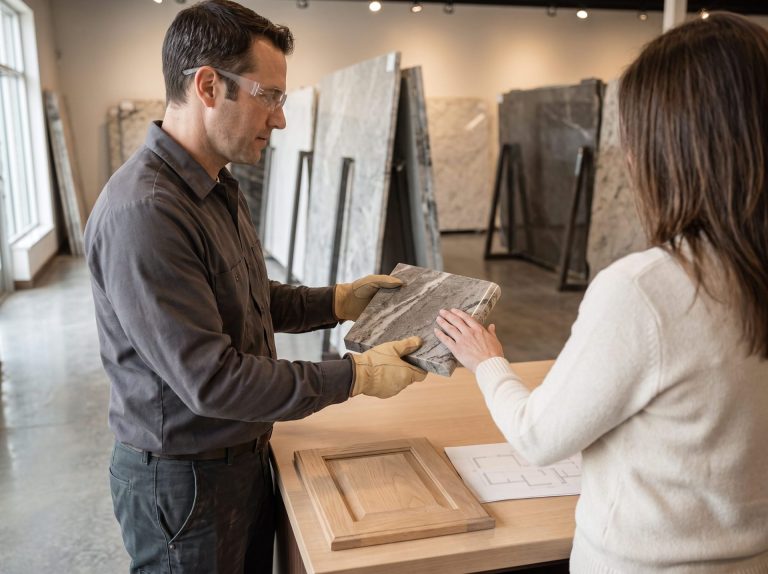
Homeowners also choose the finish and the edge profile, which is the shape cut into the exposed edge of the countertop. A polished finish is glossy and reflective, while a honed finish is smooth and matte. These choices are settled before the stone is cut.
A homeowner should expect honest answers about care as well. Granite and marble both need periodic sealing, which is a protective treatment that slows how quickly stone absorbs liquids. Marble also etches from acids such as lemon juice. Durability depends on the stone you choose and on how it’s looked after.
What Does a Commercial Stone Supplier Do for Hotels, Restaurants and Sports Venues in Colorado?
A commercial stone supplier provides and fabricates stone for business spaces, where the work has to fit a construction schedule set by many other trades.
A commercial stone project is stone work in a commercial property, meaning a building used for business rather than as a home. Hotels, restaurants and sports venues are common examples. In these spaces the stone is chosen by an owner’s team, an architect or an interior designer, and it’s described in drawings and written specifications before a slab is selected.
Three things set commercial work apart from a single kitchen.
- Repetition: A hotel may need the same vanity top made many times, so each piece has to match the drawing and the pieces before it.
- Coordination: A general contractor runs the job site, and the stone has to arrive after the cabinets or bases are ready and before the finishing trades need the space.
- Heavy use: A bar top or a reception counter is touched by far more people than a home countertop, so the material, the finish and the edge are chosen with wear in mind.
Because natural stone varies, a commercial team should ask how slabs will be selected so that pieces placed side by side look consistent. Engineered quartz is manufactured and more uniform from slab to slab, which is one reason it’s often specified for repeated pieces. It is not a natural stone, and it still needs routine care.
The stone company’s role on a commercial project is to turn the drawings into accurate pieces and to keep the builder informed. Granite and Marble Designs documents its commercial work as schedule-sensitive projects such as hotels, restaurants and sports venues.
How Do Contractors and Designers Work With a Stone Supplier on Denver Metro Projects?
Contractors and designers in the Denver metro work with a stone supplier as trade partners, sending repeat projects to one company that knows how they build.
A contractor partner is a builder, remodeler, architect or designer who relies on the same stone company across many jobs. The contractor brings the drawings and the construction schedule. The contractor’s client usually picks the slab, often during a showroom visit, and the stone company fabricates and installs to the contractor’s sequence.
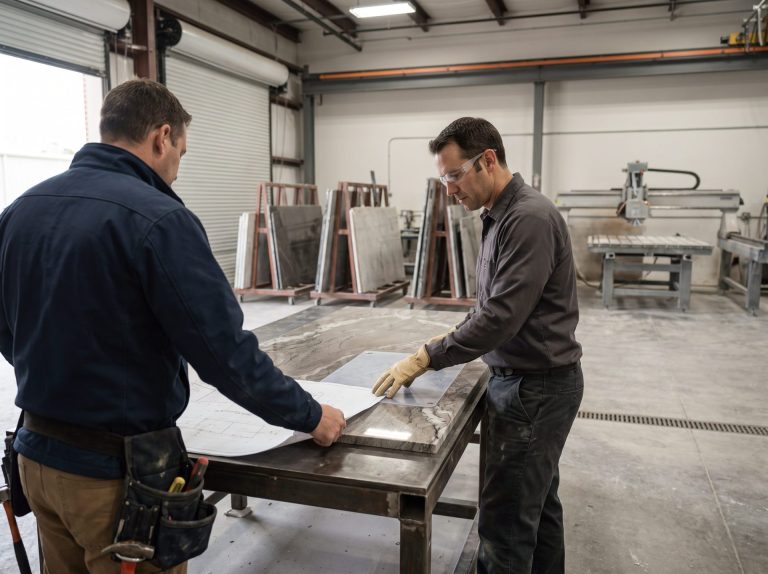
Each kind of trade partner uses the relationship a little differently.
- General contractors and builders: A builder needs templating, fabrication and installation to land in the right order after the cabinets are set, on a renovation or a new build.
- Kitchen and bath remodelers: A remodeler often needs the old countertop removed as part of the same plan, so the cabinets are protected and the new measurements stay valid.
- Interior designers and architects: A designer or architect specifies the stone, the finish and the edge, and needs the fabricated result to match the design intent.
A stone contractor relationship works when both sides share information early. Before the first job together, a contractor should ask who takes the template, how a change to a cabinet or a fixture is communicated, and who the single contact is. A mason or a landscaper buying loose stone has different needs, but a countertop project depends on measurements taken from the finished space.
Granite and Marble Designs describes contractors and designers as clients who rely on it as a long-term fabrication partner. It works as both a wholesaler and a retailer, so the same slabs are available to the trade and to the public.
Which Steps Stay the Same for Every Client?
Four steps stay the same for every client: templating, slab layout, fabrication and installation, in that order, whatever the size of the project.
- Laser templating: Laser templating measures the finished space with a laser device before the slab is cut, and the template becomes the pattern for every piece.
- Slab layout: Slab layout places each piece on the slab so cutouts, veining and seams fall where they should. A seam is the joint where two pieces of stone meet.
- CNC fabrication: CNC fabrication is computer-controlled cutting that follows a programmed path from the template, including sink and cooktop cutouts.
- Installation: Installers set the pieces, join the seams so they are near-imperceptible, and seal the stone that needs it.
A stone installation company that also fabricates the stone works from one set of measurements from start to finish.
What Are the Limits of One Company Serving Three Audiences?
The limits are practical ones: natural stone varies, some shapes can’t be made in some stones, and a shared shop has to schedule every kind of work.
Some edges can’t be polished on certain materials, and some stones fracture easily when they’re cut into narrow or unsupported shapes. A good supplier says so before the slab is ordered, for a homeowner and for an architect alike.
Variation is a limit too. On a large commercial run, pieces cut from different slabs of natural stone won’t be identical, so matching has to be planned at slab selection.
Scheduling deserves a direct question. A company that serves homes, commercial sites and trade partners plans all of them through one shop, so ask how your project is scheduled and who will tell you if something changes.
Actionable Tip
Before your first conversation with a stone company, write down three things: who makes the final decision on the stone, who is responsible for the cabinets or the base the stone will sit on, and who needs to be on site for templating. Share that list at the start, so the company knows which kind of project it is planning.
How Does Granite and Marble Designs Serve Homeowners, Commercial Clients and Contractors in Denver?
Granite and Marble Designs serves homeowners, commercial builders, and contractor and designer partners through one full-service model that covers design, fabrication and installation.
Granite and Marble Designs is a natural stone supplier in Denver and a countertop contractor that has served the Denver metro area and the wider Colorado region since 2007. It was co-founded by Michael Clifton and Jack Wilt. Its work for each audience is counted separately: projects for 1,354+ homeowners, 1,650+ commercial projects and 1,400+ contractor projects.
Every project runs through the company’s StoneDoneRight™ process. The five steps are a personalized design consultation, expert engineering and slab layout, precision CNC fabrication, professional demolition, and meticulous installation with high-quality sealing and near-imperceptible seams. The steps are the same for a family kitchen and for a restaurant bar.
The company has also earned eight Parade of Homes awards between 2008 and 2020. The same craftsmanship standard applies to every audience.
Frequently Asked Questions
Can a homeowner buy from a stone supplier that also works with contractors?
Yes. A stone supplier that serves both the public and the trade sells from the same slab inventory to each. A homeowner can visit the showroom, choose a slab in person and have it fabricated and installed without hiring a contractor first. At Granite and Marble Designs, residential projects start with a design consultation, and the company handles templating, fabrication and installation from there.
What is a commercial stone supplier?
A commercial stone supplier is a company that provides and fabricates stone for business spaces instead of private homes. The work is driven by drawings and written specifications, and it has to fit a construction schedule shared with other trades. Granite and Marble Designs documents commercial stone work for schedule-sensitive projects such as hotels, restaurants and sports venues in the Denver metro and the wider Colorado region.
Do contractors and designers choose the slab, or does their client?
It depends on the project. On residential jobs, the contractor’s or designer’s client usually chooses the slab, often at the showroom, because natural stone varies and the client lives with the result. On commercial jobs, the stone is normally named in the specification first, and slabs are then confirmed against it. In both cases the contractor or designer stays the main contact for the stone company.
What if you don’t have a contractor for your stone project?
You don’t need one for the stone itself when the company supplies, fabricates and installs it. A full-service stone company measures the space, cuts the stone and sets it. Other work, such as plumbing connections or new cabinets, may still need its own trade. Ask at the design consultation which parts of your project the stone company covers and which parts it doesn’t.
Is the fabrication process different for commercial and residential stone?
No, the fabrication steps are the same. The space is templated, each piece is laid out on the slab, the stone is cut and finished, and installers set it. What differs is the volume, the paperwork and the scheduling. A commercial project may repeat one piece many times and must follow a builder’s sequence, while a residential project follows one household’s plans.
What should a contractor ask a stone supplier before the first project together?
Ask who takes the template and when, how changes to cabinets or fixtures are communicated, who the single contact is, and how installation is scheduled around other trades. It also helps to ask how your clients choose their slabs and whether removal of an old countertop can be part of the same plan. Getting these answers before the first job prevents confusion on later ones.
Does natural stone look the same across a large commercial project?
Not exactly. Natural stone varies in color and veining from slab to slab, so pieces cut from different slabs won’t be identical. A commercial team should ask how slabs will be selected and laid out so neighboring pieces look consistent. If close uniformity matters, engineered quartz is manufactured and more consistent, although it is not a natural stone and still needs routine care.
Which stone materials suit both homes and commercial spaces?
Granite, marble, quartzite, limestone and engineered quartz are all used in homes and in commercial spaces. The right choice depends on how the surface is used, how much wear it takes and how much care the owner is prepared to give it. Granite and marble need periodic sealing, and marble etches from acids, so a busy bar top and a quiet powder room may call for different stones.
One Denver Stone Company, Three Kinds of Projects
One company can be a stone supplier for homeowners and contractors and a commercial stone supplier at once. The stone work is the same, and only the communication changes. A homeowner needs guidance and a slab chosen in person. A commercial team needs pieces that match the drawings and arrive in sequence. A contractor or designer needs a partner who builds the way they do. If you know which of the three you are, a Denver stone company can tell you plainly how your project would run.
Call (303) 529-1932 and say which kind of project you have, a home, a commercial space or a trade job, or send a message through the contact page with your drawings or a short description of the space.