
What Does Stone Fabrication Mean for a Countertop in Denver, CO?
Stone fabrication means turning a raw slab of granite, marble, quartzite or engineered quartz into finished countertop pieces that fit one specific space. For a Denver kitchen or bathroom, it covers slab layout, cutting, cutouts, edge shaping and finishing, all done in the shop after the space is measured and before installation.
In this guide, you’ll learn what stone fabrication includes, how it differs from slab supply and installation, which decisions it asks of you, and where its limits sit. It’s written for Denver homeowners planning custom countertops and for the contractors and designers who coordinate the work.
Key Takeaways
- Fabrication is shop work: Stone fabrication is the stage that turns a slab into countertop pieces sized, shaped and finished for one space.
- It is one of three jobs: Slab supply, fabrication and installation are separate jobs, and one company or several businesses may handle them.
- Every stage asks something of you: The slab, the layout, the sink and cooktop models, the edge profile and the finish are your decisions.
- Measurement comes first: The space is templated before any cutting, so cabinets and fixture choices need to be settled early.
- Cut stone is permanent: Once a slab is cut, the layout, cutouts and seams can’t be moved, which is why approvals happen before the first cut.
- Stone has real limits: Some edges can’t be polished, some stones fracture more easily than others, and no natural stone is stain-proof.
What Does Stone Fabrication Mean?
Stone fabrication means the shop work of measuring, laying out, cutting, shaping and finishing a stone slab into custom pieces built for one countertop or surface.
The raw material is dimension stone, the trade term for natural rock that is quarried and cut to size for building use. Granite, marble and quartzite arrive at a fabrication shop as large slabs with a polished or honed face. Engineered quartz arrives the same way, although it is made from quartz aggregate bound with resin, so it is not a natural stone.
A slab on its own is not a countertop, because it has no sink opening, no shaped edge and no relationship to your cabinets. The finished pieces leave the shop ready to be set in place, whether the project is a kitchen countertop, a bathroom vanity top, a fireplace surround, a shower wall or a stone panel for a feature wall.
People also use the word fabricator for the business or the craftsman who does this work. A stone fabricator reads the slab, plans the cuts and finishes each piece, and the quality of that work, and the attention to detail behind it, shows up in how well the countertop fits, how the edges look and where the seams fall. The fabrication, along with the slab and the finish, is what makes a stone countertop premium.
How Is Stone Fabrication Different From Slab Supply and Installation?
Stone fabrication sits between slab supply and installation: a supplier provides the slab, a fabricator cuts and finishes it, and installers set it in place.
| Job | What it covers | Where it happens | What it decides |
|---|---|---|---|
| Slab supply | Stocking natural stone and engineered quartz slabs for selection | Showroom or slab yard | Which stone and which specific slab |
| Stone fabrication | Template results, slab layout, cutting, cutouts, edges and finishes | Fabrication shop | How the slab becomes pieces that fit your space |
| Installation | Setting, securing and seaming the finished pieces, then sealing stone that needs it | Your kitchen or bathroom | How the pieces meet your cabinets, walls and fixtures |
Some businesses specialize in one job, while a full-service company handles all three, so the slab selection, the layout and the final installation stay integrated in one process. If separate businesses are involved, ask who owns the measurement, because the template is the hand-off point between fabrication and installation.
What Happens to a Slab During Stone Fabrication?
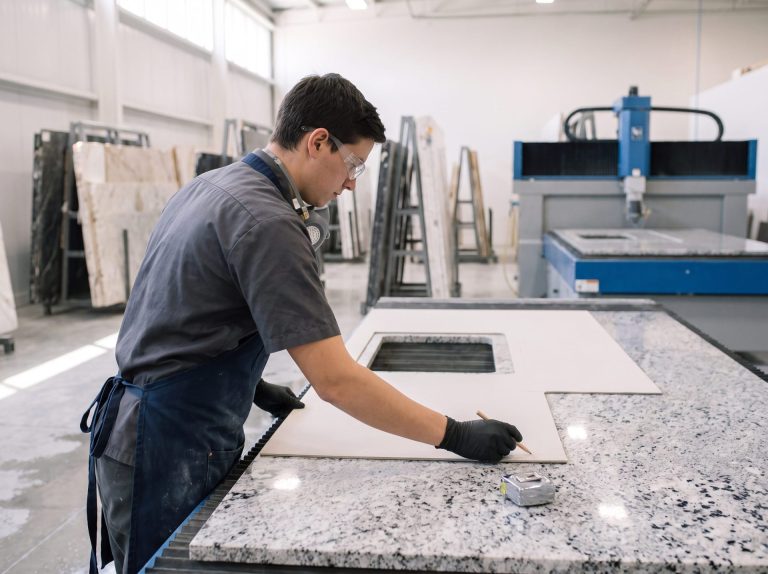
During stone fabrication, a slab is matched to a measured template, laid out, cut to shape, opened for fixtures, edged and finished before it leaves the shop.
- Templating: Templating is the process of recording the exact shape of the cabinets, walls and corners where the stone will sit. The template becomes the pattern every piece is cut from.
- Slab layout: Slab layout places each countertop piece on the slab so cutouts, seams and veining land where they should. Veining is the pattern of lines and streaks that runs through natural stone.
- Cutting: Pieces are cut from the slab with a stone saw or a CNC machine. CNC fabrication uses computer-controlled cutting technology that follows a programmed path drawn from the template.
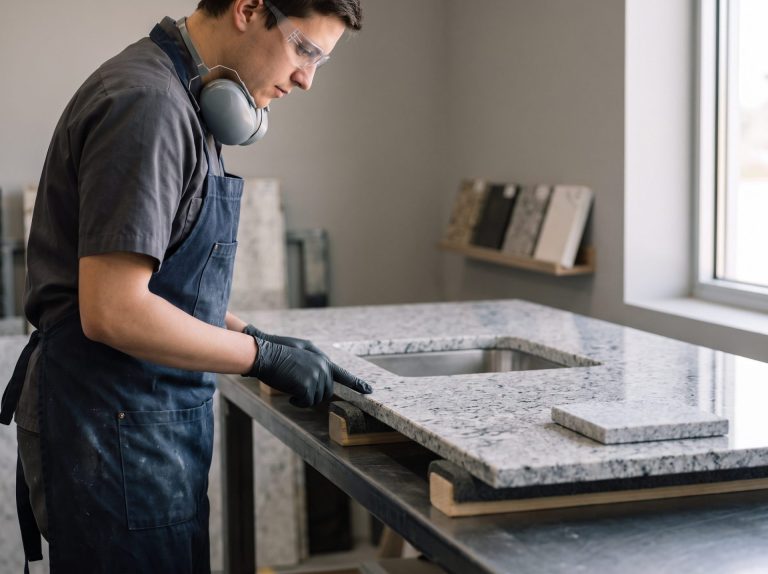
- Cutouts: Openings for an undermount sink, a cooktop and faucet holes are cut to the exact fixture models you choose.
- Edges and finish: The exposed edge is shaped to a chosen edge profile and polished or honed to match the surface.
- Inspection: Each finished piece is checked for fit, edge detail and surface finish before it is released to the installer.
Seams are part of layout, not an afterthought. A seam is the joint where two pieces of stone meet, and on a long run or an L-shaped kitchen a seam is often unavoidable because slabs come in limited sizes. The goal is a near-imperceptible seam placed where the veining and the light work in its favor.
Which Custom Stone Fabrication Decisions Belong to You?
Your decisions in stone fabrication are the slab, the layout, the fixtures, the edge and the finish, and each one is settled before cutting begins.
A fabricator guides these choices during a design consultation, but the customer makes them.
| Fabrication stage | Decision it asks of you | Why it has to come first |
|---|---|---|
| Slab selection | The specific slab, not only the stone name | Natural stone varies from slab to slab in color and pattern |
| Templating | Cabinets installed and secured; sink, faucet and cooktop models chosen | The template records the final space and fixture sizes |
| Slab layout | Approval of where pieces, seams and veining fall | Layout is permanent once the first cut is made |
| Cutouts | Exact undermount sink and cooktop specifications | Openings are cut to fit those models |
| Edge profile | The shape of the exposed edge | Some profiles suit some stones better than others |
| Finish | Polished, honed, leathered or tumbled | The finish changes how the surface looks and feels |
A polished finish is glossy and reflective, while a honed finish is smooth and matte.
Bring photos of your cabinets, flooring and tile when you see slabs in person at the showroom. Ask the fabricator to show you the planned layout on your slab, especially on a kitchen island where the full face of the stone is on display. If you want a matching stone backsplash from the same slab, say so before layout.
Which Stone Edge and Slab Terms Should Denver Homeowners Know?
Denver homeowners should know a short list of stone edge and slab terms, because each one names a decision or a limit they will meet during the project.
- Template: The recorded shape of the space, used as the cutting pattern for every piece.
- CNC fabrication: Cutting and shaping stone with a computer-controlled machine that follows a programmed path.
- Veining: The natural lines and streaks in stone such as marble and many granites and quartzites.
- Seam: The joint where two stone pieces meet on a long or L-shaped run.
- Cutout: An opening cut into the stone for a sink, cooktop or faucet.
- Edge profile: The shape of the exposed edge, such as an eased edge, a bullnose or a mitered edge.
- Polished vs honed: A glossy, reflective surface versus a smooth, matte one.
- Bookmatching: Laying two adjacent slab faces side by side so their veining mirrors across a seam.
A mitered edge joins two pieces at an angle so the edge looks thicker than the slab. A waterfall edge carries the stone down the side of a cabinet or island to the floor. Both are fabrication decisions, because they change how many pieces are cut and how the slab is laid out.
What Does a Stone Fabricator Do Differently With Granite, Marble, Quartzite and Quartz?
A stone fabricator follows the same stages for every material, but each stone behaves differently under the saw, at the edge and in daily care.
Granite is an igneous rock with visible crystals, and it is a common countertop stone because it is dense and hard. Quartzite is a natural metamorphic rock that is harder than granite, which makes it demanding to cut and shape. Marble is softer, often shows strong veining and etches from acids such as lemon juice, so layout and care conversations matter more.
Engineered quartz is a manufactured surface of quartz aggregate and resin, and its color and pattern are more consistent from slab to slab. It doesn’t absorb liquids the way natural stone does, but it still needs care, and it is not a natural stone. Porcelain slabs are another surface some shops fabricate, with their own handling needs.
What Can Stone Fabrication Not Do for a Natural Stone Project?
Stone fabrication can’t correct a wrong measurement after cutting on any natural stone project, remove a slab’s natural character or make any natural stone stain-proof.
Some edges can’t be polished on certain stones, and some stones fracture more easily than others, especially around thin sections beside a sink cutout. A careful fabricator will tell you when a profile or a layout is risky for your stone instead of promising it will work.
If a cabinet moves or a sink changes after templating, the space usually has to be measured again before anything is cut. A piece cut to an old measurement may mean a new countertop piece cut from new stone.
Natural stone also keeps its veining and color movement, and fabrication works with them rather than erasing them. Granite and marble both need periodic sealing, and sealing is not optional for those materials. No natural stone is stain-proof, and every surface needs routine care.
Actionable Tip
Before your space is templated, make one written list for the fabricator: the slab you chose, the exact sink, faucet and cooktop model numbers, the edge profile, the finish, and where you would accept a seam. Ask the fabricator to confirm each item back to you in writing and to show you the planned layout on your slab before any cutting begins.
How Does Granite and Marble Designs Approach Stone Fabrication in Denver?
Granite and Marble Designs approaches stone fabrication in Denver as one part of its StoneDoneRight™ process, between slab layout and installation.
Granite and Marble Designs is a natural stone supplier in Denver and countertop contractor that has served the Denver metro and the wider Colorado region since 2007. The company was co-founded by Michael Clifton and Jack Wilt. Its full-service model covers design, fabrication and installation for homeowners, commercial builders, and contractor and designer partners.
The StoneDoneRight™ process runs through five documented steps: a personalized design consultation, engineering and slab layout, precision CNC fabrication, professional demolition, and meticulous installation with high-quality sealing and near-imperceptible seams. Its countertop fabrication service covers slab layout, CNC fabrication, edges, cutouts and finishes in granite, quartz, marble and other stone for residential and commercial projects.
Commercial work includes schedule-sensitive hotels, restaurants and sports venues, and the company has earned eight Parade of Homes awards between 2008 and 2020. For a Denver homeowner, that means the slab picked at the showroom, the layout on that slab and the finished pieces all stay inside one company’s process.
Frequently Asked Questions
What does stone fabrication mean?
Stone fabrication means turning a raw stone slab into finished pieces for one specific countertop or surface. The work covers recording the shape of the space, laying out the pieces on the slab, cutting them to shape, cutting openings for the sink and cooktop, shaping the edges and finishing the surface. It happens in a fabrication shop after the space is templated and before the pieces are installed.
What does a stone fabricator do?
A stone fabricator reads a slab, plans where each countertop piece will come from, and cuts and finishes those pieces to match the template of your space. That includes cutouts for sinks and cooktops, edge profiles and polishing or honing. A fabricator also flags risks before the slab is cut, such as an edge that won’t polish well on a certain stone or a thin section that could fracture.
Is stone fabrication the same as countertop installation?
No. Fabrication happens in the shop and turns the slab into finished pieces. Installation happens in your kitchen or bathroom, where the installation team sets those pieces on the cabinets, join the seams, mount an undermount sink and seal stone that needs it. One full-service company can handle both, or separate businesses can share the work, with the template acting as the hand-off point between them.
Can I supply my own stone for fabrication?
Some fabricators accept a slab the customer bought elsewhere and some do not, so ask before you buy. If it is allowed, the fabricator will want to inspect the slab first for cracks, fissures and size, because a slab that is too small or flawed for your layout can’t be fixed in the shop. Buying the slab and the fabrication from one company keeps that responsibility in one place.
How much does stone fabrication cost?
The cost of a stone fabrication service depends on the material, the size and number of pieces, the number of cutouts, the edge profile, the finish and how complex the layout is. A large island with a mitered or waterfall edge takes more shop work than a simple straight run. Ask for an itemized breakdown so you can see what fabrication covers and what installation, demolition or sealing add to the project.
Does the space need to be measured before fabrication?
Yes. Fabrication starts from a template, which records the exact shape of the cabinets, walls and corners. The base cabinets should be installed and secured, and the sink, faucet and cooktop models should be chosen, because the cutouts are cut to those fixtures. If anything changes after templating, the space usually has to be measured again before the slab is cut.
Can a countertop be changed after the stone is cut?
Only in small ways. An installer can make minor adjustments while they install the stone, but a piece cut too short, a cutout in the wrong place or a seam on the wrong side of a run usually means cutting a new piece from new stone. That is why slab layout, fixture choices and edge profiles are approved before the first cut, when changes are still simple to make.
Is engineered quartz fabricated the same way as granite?
The stages are the same: templating, layout, cutting, cutouts, edges and finishing. The materials differ. Engineered quartz is a manufactured surface of quartz aggregate and resin with a more consistent pattern, while granite is a natural igneous stone that varies from slab to slab and needs periodic sealing. Ask how your chosen material affects edge options, cutout support and care before you commit.
Turning a Slab Into a Countertop That Fits Your Denver Space
Stone fabrication is where a slab stops being raw material and becomes your countertop. For a Denver kitchen or bathroom, it rewards a clear plan: choose the slab in person, settle cabinets and fixtures before templating, approve the layout, and pick an edge and finish that suit the stone. When those decisions are made early, the stone’s appearance and its durability both get the attention they deserve.
Call (303) 529-1932 and ask how your chosen slab would be laid out, cut and finished for your space, or send Granite and Marble Designs a message with your cabinet plan and fixture list through the contact page.