
In-House vs Outsourced Countertops: Why It Matters
In-house fabrication means the shop that sells the countertop also cuts, polishes, and installs it under one roof. Outsourcing means the seller subcontracts the actual fabrication to a third party. In-house control eliminates handoffs that cause slab mix-ups, templating errors, and accountability gaps, which is why it usually produces more reliable results.
When a homeowner buys a countertop, they assume the company they hired is the company doing the work. Often that is not the case. Many countertop sellers are sales offices that subcontract the actual cutting, polishing, and sometimes installation to third-party fabrication shops. The difference between in-house fabrication and outsourcing rarely appears in the sales conversation, but it shapes the entire outcome.
Understanding the distinction matters because every handoff between companies introduces a point where something can go wrong. After 18 years of work as a Denver stone installation company, the pattern is consistent: the projects that stay on track and produce clean results are usually the ones where a single shop controls the whole process. This article explains why.
What In-House Fabrication Actually Means
In-house fabrication means one company owns and operates the entire production chain: the templating equipment, the CNC saw, the polishing station, and the install crew. The person who sells the countertop works for the same company that cuts it, and the customer has one point of accountability from the first showroom visit to the final walkthrough.
A true in-house operation controls each of these stages directly:
- Templating captures the exact measurements of the space.
- Slab selection matches the customer-approved slab to the project.
- CNC cutting turns the digital template into precise cut pieces.
- Polishing and edge work finishes the surfaces and edges.
- Installation sets the countertop in the home.
When one company runs all five stages, the information and the material move through the process without leaving the company’s control. The reasons to choose Granite and Marble Designs center on exactly this: in-house CNC fabrication, polishing, templating, and install on every project, with no third-party handoffs.
What Outsourcing Looks Like
An outsourced model separates selling from making. A sales office or a big-box retailer takes the order, then contracts a separate fabrication shop to do the templating, cutting, and often the install. The customer signs with one company but the actual work happens at another, sometimes two or three steps removed.
This model exists because it lets sellers offer countertops without investing in equipment, facilities, and skilled labor. It is not inherently fraudulent; many outsourced projects turn out fine. But it introduces structural weaknesses that in-house work avoids. The customer often cannot visit the shop doing the work, cannot speak directly to the fabricator, and cannot get a straight answer about who is responsible when something goes wrong. The seller points to the fabricator, and the fabricator points to the seller.
Why Handoffs Cause Problems
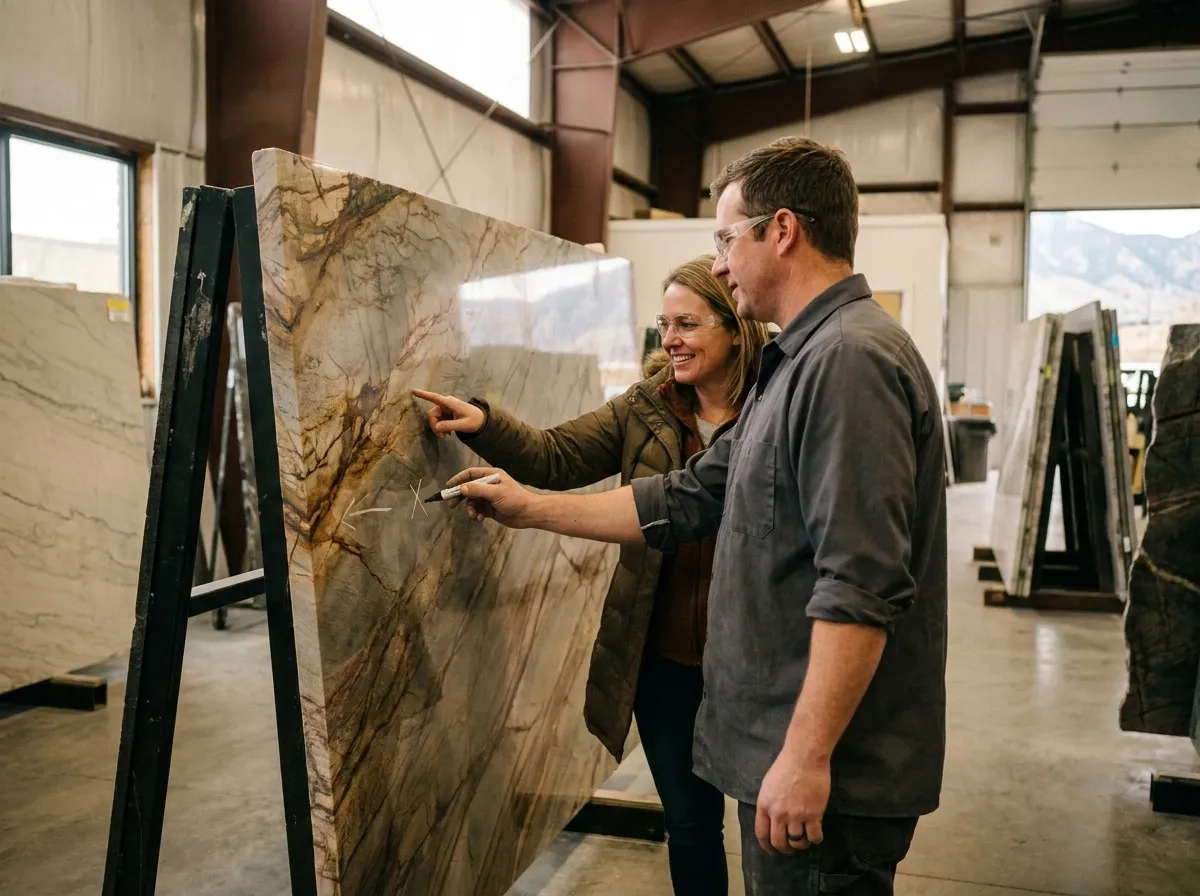
Every time a project passes from one company to another, information and accountability can degrade. The specific failure modes are predictable.
- Slab mix-ups. The slab the customer selected may not be the slab that gets cut, because the selection happened at the seller and the cutting happens at a separate shop working from a description.
- Templating transcription errors. When the templating data passes from one company’s system to another’s, measurements can be misread or re-entered incorrectly.
- Design detail loss. Edge profiles, seam placement preferences, and special features can get lost in the handoff between the sales order and the fabrication instructions.
- Install surprises. An install crew unfamiliar with the fabrication cannot troubleshoot problems on site because they did not cut the pieces.
Each handoff is a place where the customer’s intent can be diluted. In-house work eliminates these handoffs entirely, because the same team that took the order and templated the space also cuts and installs. Nothing has to be translated between companies. Quality stone fabrication depends on that continuity as much as on the equipment itself.
The Accountability Difference
The most consequential difference between the two models is accountability. When a problem develops on an in-house project, there is one company to call, and that company cannot deflect responsibility to a subcontractor. The seam that separated, the edge that chipped, the measurement that was off, all trace back to the same team that did the work.
On an outsourced project, accountability fragments. A homeowner with a problem may find the seller blaming the fabricator’s cutting, the fabricator blaming the seller’s measurements, and the install subcontractor blaming both. The homeowner is left mediating between companies that each have an incentive to point elsewhere. This is not a hypothetical; it is the most common frustration that comes out of outsourced countertop projects. A documented, single-company process like the StoneDoneRight approach exists precisely to keep accountability in one place across every stage.
Quality Control Under One Roof
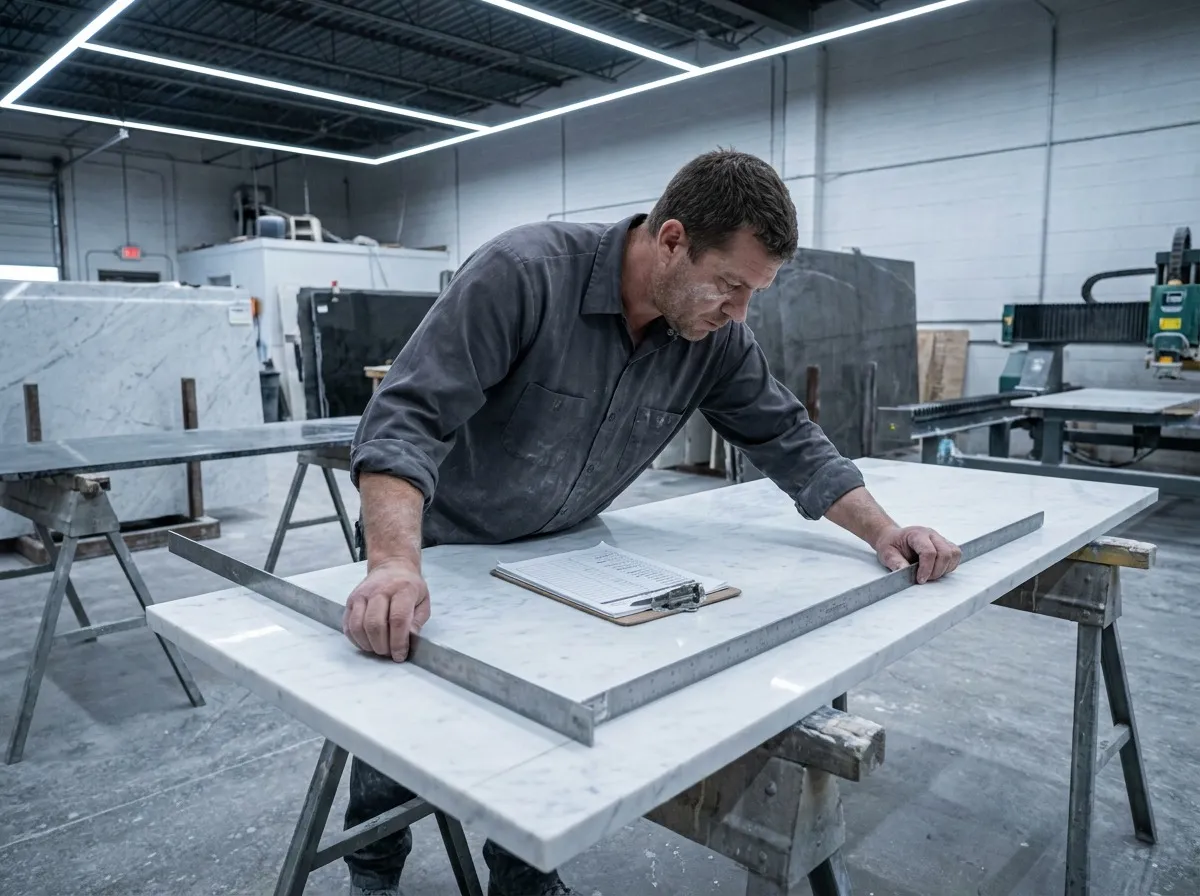
In-house fabrication also allows a documented, continuous quality control process that outsourcing cannot match. When one company controls every stage, it can run each project through consistent quality gates: slab receipt inspection, templating verification, customer layout review, cut quality checks, polish inspection, dry-fit for seams, and final install validation.
An outsourced model breaks this chain. The seller cannot inspect fabrication it does not perform, and the fabricator cannot verify a template it did not create. Quality control becomes a matter of hoping each separate company does its part, rather than a single system with checkpoints. The Numerical control{:target=”_blank”} technology behind modern CNC cutting is only as good as the quality process wrapped around it, and that process is far easier to run and document when one company owns the whole chain.
How to Tell Which Model You Are Getting
The distinction is easy to uncover with a few direct questions during the sales conversation. A homeowner can simply ask who does the fabrication.
The revealing questions are specific: “Do you own the CNC saw that will cut my slab, or do you subcontract fabrication?” “Can I visit the shop where my countertop will be made?” “Is the install crew your employees or a subcontractor?” An in-house operation answers these plainly and often welcomes a shop visit. An outsourced seller tends to answer vaguely, deflect, or reveal that the work happens elsewhere. The answers tell the homeowner exactly which model they are buying into, and therefore how many handoffs their project will pass through.
Key Takeaways
- In-house fabrication means one company controls templating, cutting, polishing, and install; outsourcing subcontracts the actual work to third parties.
- Every handoff between companies is a point where slab mix-ups, templating errors, and lost design details can occur.
- In-house work eliminates handoffs because the same team takes the order, templates, cuts, and installs.
- Accountability stays in one place with in-house fabrication; outsourcing fragments it, leaving the homeowner to mediate between companies.
- Continuous, documented quality control is only possible when one company controls every stage.
- Direct questions about who owns the CNC and does the install reveal which model a seller uses.
Frequently Asked Questions
How do I know if a countertop company fabricates in-house?
Ask directly whether the company owns the CNC saw that will cut your slab and whether the install crew are employees or subcontractors. An in-house operation answers plainly and often invites you to visit the shop. An outsourced seller tends to answer vaguely or reveal that the work happens at a separate fabrication shop. A shop visit is the clearest confirmation, because a real in-house fabricator has equipment and crews you can see working.
Is outsourced countertop fabrication always bad?
Not always. Many outsourced projects turn out fine, and the model exists for legitimate reasons, since it lets sellers offer countertops without owning equipment. The concern is structural: outsourcing adds handoffs between companies, and each handoff is a point where slab selection, measurements, or design details can be lost, and where accountability can fragment. In-house work avoids those risks, which is why it tends to produce more consistent results.
Why does in-house fabrication produce more reliable results?
Because it eliminates the handoffs that cause most countertop problems. When one company templates, cuts, polishes, and installs, the customer’s approved slab and exact measurements never leave that company’s control, so there is nothing to mistranslate between businesses. The same team that made the pieces installs them and can troubleshoot on site. Continuous quality control and single-point accountability follow naturally from one company owning the whole process.
What problems come from outsourcing fabrication?
The common problems are slab mix-ups, where the cut slab is not the one the customer selected; templating transcription errors, where measurements are misread between systems; lost design details like edge profiles and seam preferences; and install surprises, because the crew did not cut the pieces. Beyond these, accountability fragments when a problem develops, leaving the homeowner mediating between a seller and a fabricator who each blame the other.
Can I visit the shop that makes my countertop?
With an in-house fabricator, usually yes, and a shop visit is one of the best ways to confirm the operation is real. You can see the CNC saw, the polishing station, slabs in racks, and crews working. With an outsourced seller, a visit is often not possible because the work happens at a separate shop the customer has no relationship with. If a company cannot let you see where your countertop will be made, that is worth noting.
Does in-house fabrication cost more?
Not necessarily. In-house fabricators own their equipment and skip the margin a middleman adds when reselling subcontracted work, which can offset the cost of running a full operation. Pricing depends more on material, scope, and the specific shop than on the model. The larger value of in-house work is reliability and accountability rather than a guaranteed lower price, though eliminating a layer of markup can help.
Who is responsible if something goes wrong on an outsourced project?
That is exactly the problem with outsourcing: responsibility is often unclear. The seller may blame the fabricator’s cutting, the fabricator may blame the seller’s measurements, and an install subcontractor may blame both. The homeowner ends up mediating between companies that each have an incentive to point elsewhere. With in-house fabrication, one company did every stage and cannot deflect responsibility to a subcontractor.
Does the install crew need to be in-house too?
It helps significantly. An in-house install crew that works for the same company that fabricated the pieces can troubleshoot on site, because they understand how the countertop was made. A subcontracted install crew unfamiliar with the fabrication cannot easily solve a fit or seam problem that arises during setup. Full in-house control, including install, closes the last handoff in the chain and keeps accountability intact through the final walkthrough.
What questions should I ask to uncover the fabrication model?
Ask three specific questions: Do you own the CNC saw that will cut my slab, or do you subcontract fabrication? Can I visit the shop where my countertop will be made? Is the install crew your employees or a subcontractor? Plain, specific answers and a welcome to visit indicate in-house work. Vague answers, deflection, or an inability to arrange a shop visit indicate outsourcing and the extra handoffs that come with it.
Is a big-box store countertop outsourced?
Typically yes. Big-box retailers usually act as sellers and contract independent fabrication shops to template, cut, and install. The customer signs with the retailer but the work happens at a separate company. This is a classic outsourced model with the handoffs and accountability considerations described here. Homeowners who value single-point accountability often prefer a fabricator who controls the whole process in-house over a retail intermediary.
Next Step
Knowing whether a countertop is made in-house or outsourced tells a homeowner how many handoffs their project will pass through and who will answer when something needs attention. The next step is working with a fabricator who controls the whole process.
Author
Elliot Nunes Lead Design Consultant and Senior Stone Specialist Granite and Marble Designs, Denver, CO 80221
Elliot Nunes leads design consultation at Granite and Marble Designs in Denver, where 18 years of in-house fabrication have shown how much smoother projects run when one team controls every stage. The homeowners who ask who actually makes their countertop almost always end up with fewer surprises than those who assume the seller and the fabricator are the same company.