
6 Factors That Affect Your Countertop Project Cost
Countertop project pricing is driven by material grade, slab square footage, edge profile, cutouts, fabrication complexity, and installation conditions. Denver homeowners typically pay a blended per-square-foot rate that bundles slab, fabrication, and install. Understanding each cost driver lets a homeowner compare quotes accurately and avoid post-signing surprises.
The single most common question during a countertop consultation is some version of “what will this cost?” The honest answer is that the price depends on a handful of variables that stack together, and a homeowner who understands those variables can read any quote with confidence instead of guessing whether the number is fair.
Two kitchens of identical square footage can price hundreds of dollars apart because of material selection, edge choice, the number of cutouts, and the condition of the existing space. After 18 years of work as a Denver natural stone supplier, the pattern is clear: the homeowners who understand the cost drivers make better decisions and rarely feel blindsided by the final invoice.
Cost Driver 1: Material Grade and Type
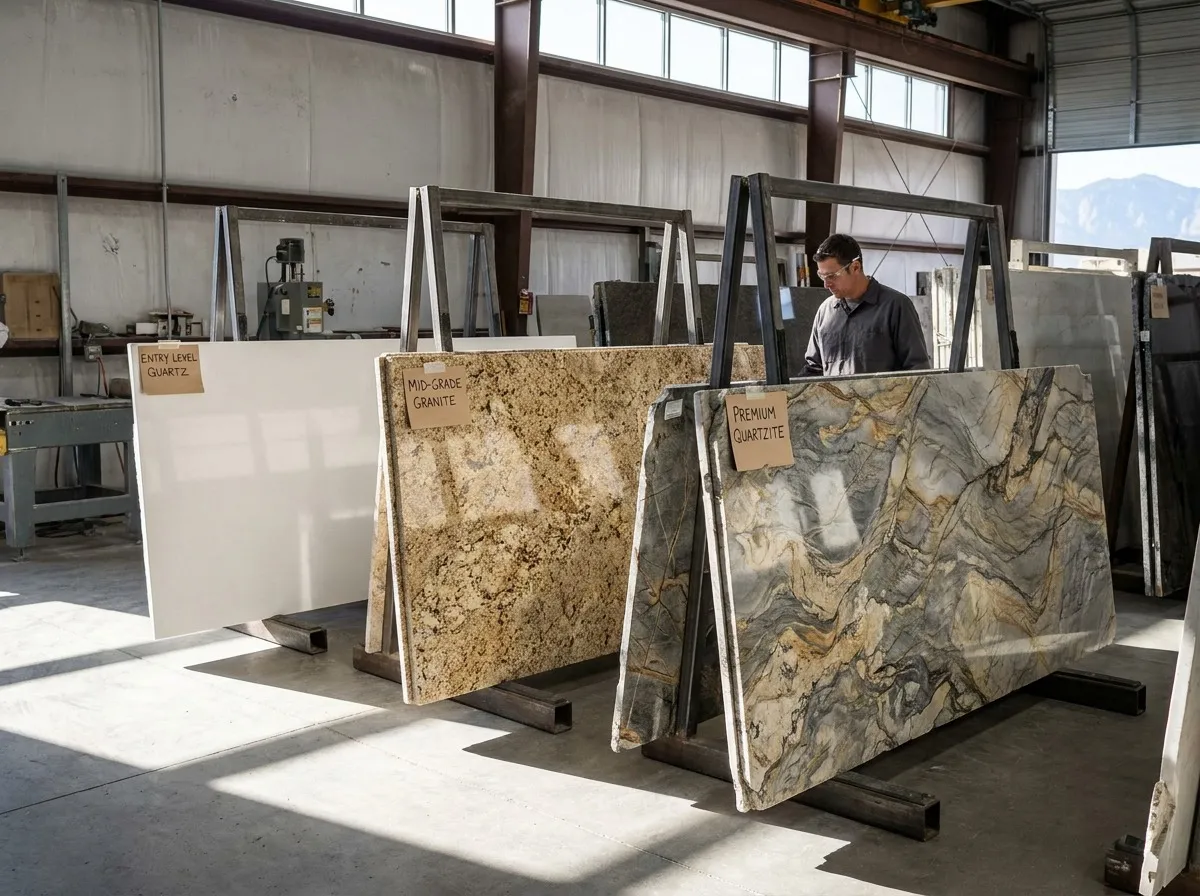
Material is the largest single line item on most countertop quotes, and the range is wide. The material category sets the baseline, and the grade within that category moves the number up or down substantially.
- Entry-level engineered quartz and builder-grade granite sit at the affordable end of the range.
- Mid-grade natural stone and premium quartz patterns occupy the middle.
- Exotic quartzite, rare marble, and dramatic bookmatched slabs command the top of the range.
Natural stone pricing also varies by the individual slab, because color, veining, and origin all affect what a stone yard charges. Two granite slabs on adjacent racks can carry different prices based on rarity and demand. Engineered quartz is more predictable because it is manufactured to consistent patterns, which is one reason budget-conscious homeowners often gravitate toward it. Comparing countertop materials side by side is the fastest way to see where a given look lands on the price ladder.
Cost Driver 2: Total Square Footage
Countertops are priced primarily by area, so the total square footage of the project drives the bulk of the cost. This sounds obvious, but the way square footage gets calculated surprises many homeowners.
Fabricators calculate square footage from the templated layout, which includes the countertop surface plus any backsplash, waterfall panels, and overhangs. A large island with a waterfall edge on both sides adds significant square footage beyond the flat counter area. Overhangs for seating add inches that accumulate across the perimeter.
There is also a slab-yield factor. Stone comes in fixed slab sizes, and a project that needs slightly more than one slab must buy into a second slab. A kitchen that requires 55 square feet from slabs that yield 50 usable square feet each will pay for two slabs even though the second is mostly unused. This is why a small increase in counter size sometimes produces a larger-than-expected jump in price.
Cost Driver 3: Edge Profile
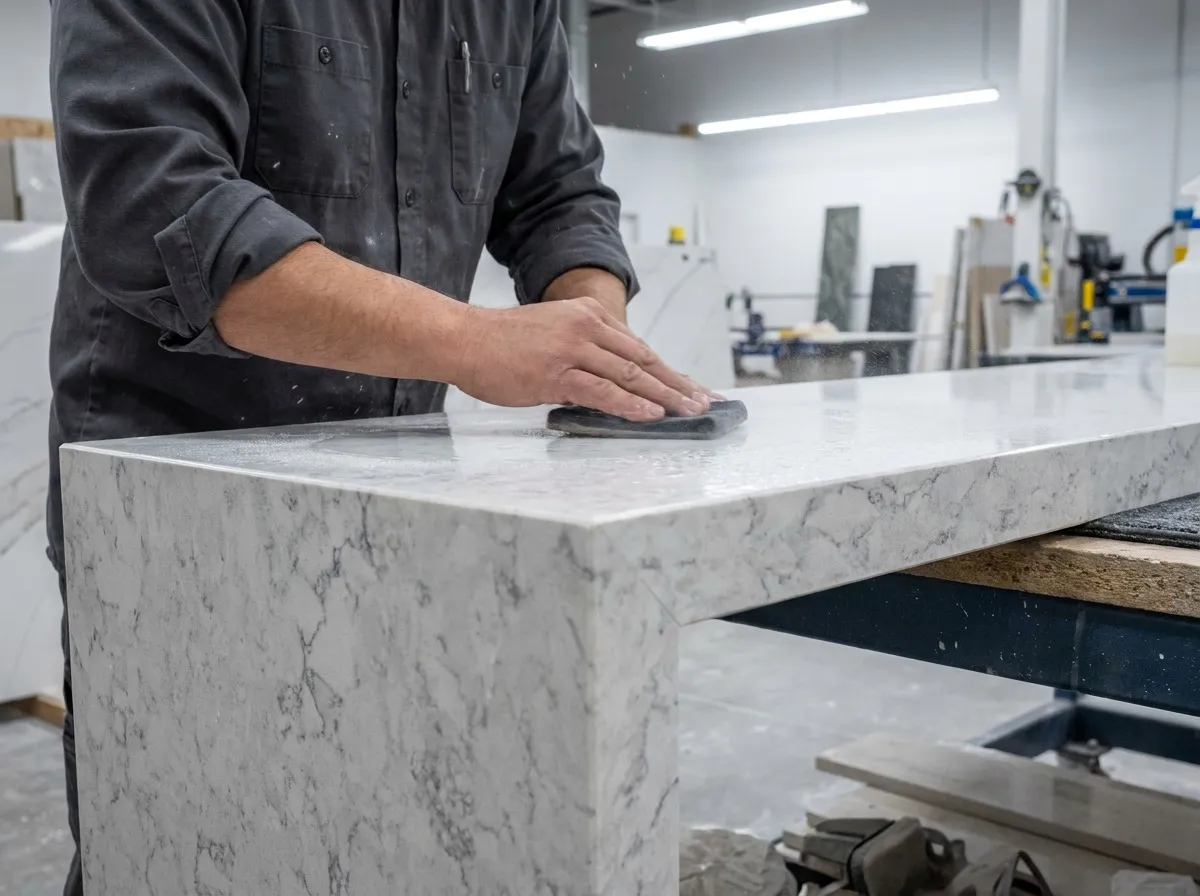
The edge profile is the finished shape of the countertop’s exposed edge, and it affects both labor and price. Standard edges are included in most base quotes; upgraded edges add fabrication time and cost.
- Standard edges (eased, straight, quarter-round) are typically included in the base price.
- Mid-tier edges (bullnose, bevel, ogee) add a moderate per-linear-foot charge.
- Premium edges (mitered waterfall, laminated bullnose, custom profiles) add the most because they require extra material buildup and hand finishing.
A mitered edge that creates the look of a thick slab, for example, requires two pieces of stone joined at a precise 45-degree angle and polished into a seamless corner. That labor is skilled and time-consuming, which is reflected in the price. Homeowners comparing quotes should confirm which edge is included in each, because an edge upgrade quoted by one shop and omitted by another makes the two numbers impossible to compare directly. Detailed stone fabrication work like mitered edges is where craftsmanship and cost meet.
Cost Driver 4: Cutouts and Special Features
Every opening cut into the countertop adds fabrication labor. Cutouts are usually quoted per opening, and they add up on a feature-rich kitchen.
- Sink cutouts (undermount sinks require polished interior edges, which cost more than drop-in cutouts).
- Cooktop and range cutouts.
- Faucet and soap-dispenser holes.
- Outlet cutouts in backsplashes or waterfall panels.
Undermount sink cutouts deserve special attention because the exposed stone edge inside the cutout must be polished to match the countertop surface. Drop-in sinks hide that edge under a rim, so they cost less to fabricate. A homeowner choosing an undermount farmhouse sink is choosing a more labor-intensive cutout, and the quote should reflect that.
Special features like drainboards grooved directly into the stone, integrated trivets, or routed soap channels are premium fabrication tasks that carry their own line items. They are worth it for the homeowners who want them, but they belong in the quote as identified costs rather than surprises.
Cost Driver 5: Fabrication Complexity
Beyond edges and cutouts, the overall complexity of the layout affects fabrication cost. A simple galley kitchen with two straight runs of counter is quick to fabricate. A kitchen with an angled island, multiple seams, a waterfall feature, and book-matched slabs requires more planning, more CNC time, and more skilled hand finishing.
Seam count matters here. Larger kitchens that exceed a single slab need seams, and quality seam work (color-matched epoxy, tight joints, reinforced support) is a skilled task. Book-matched installations, where two slabs mirror each other across a seam, require careful slab selection and precise cutting so the veining flows correctly. That precision is part of what separates a quality fabricator from a budget shop, and it is reflected in both the price and the result.
Cost Driver 6: Installation Conditions
The install itself carries costs that vary with the conditions at the home. A straightforward install on new, level cabinets in a ground-floor kitchen is the baseline. Several conditions push the number up.
- Demolition and disposal of existing countertops, often a $400 to $800 line item.
- Cabinet leveling or reinforcement when existing cabinets are not ready to carry stone.
- Stairs or difficult access that make moving heavy slabs more labor-intensive.
- Plumbing and electrical disconnect and reconnect coordination around sinks and cooktops.
These conditions are knowable in advance if the fabricator does a proper site evaluation during templating. A quote generated without a site visit may omit these costs and add them later, which is one reason an on-site template beats a quote produced from customer-supplied measurements. The Countertop{:target=”_blank”} category spans many materials and installation methods, and the install conditions often matter as much as the material choice for the final cost.
How to Compare Quotes Accurately
The most common pricing mistake homeowners make is comparing the bottom-line number on two quotes without checking what each includes. A lower number that omits demolition, undercounts cutouts, or assumes a standard edge is not actually lower; it is incomplete.
A reliable comparison checks each quote for the same scope: same material and grade, same square footage calculation, same edge profile, same cutout count, same demolition and install conditions, and the same sealer and warranty terms. When two quotes are normalized to the same scope, the real price difference becomes visible. Often the shop with the slightly higher number is including work the cheaper shop plans to add later as a change order.
Key Takeaways
- Material grade and type is usually the largest single cost driver, ranging from entry-level quartz to exotic quartzite.
- Square footage is calculated from the full templated layout, and slab-yield can push a small size increase into a second slab.
- Edge profile ranges from included standard edges to premium mitered and laminated profiles that add skilled labor.
- Cutouts are priced per opening, and undermount sinks cost more than drop-in because of the polished interior edge.
- Fabrication complexity, seam count, and book-matching all add to the price.
- Installation conditions like demolition, cabinet leveling, and difficult access should appear in the quote, not as later surprises.
Frequently Asked Questions
What is the average cost of a countertop project in Denver?
Denver countertop projects vary widely because material and scope drive the number. A modest kitchen in entry-level quartz costs far less than a large island kitchen in exotic quartzite with premium edges. Rather than a single average, homeowners should get an itemized quote for their specific material, square footage, and features. That itemized quote is far more useful than any general per-square-foot figure.
Why do two quotes for the same kitchen differ so much?
Usually the difference is scope, not just markup. One quote may include demolition, undermount cutouts, an upgraded edge, and sealer while the other omits them. Material grade also varies; two shops quoting “granite” may be pricing very different slabs. Normalize both quotes to the same material, edge, cutout count, and install conditions before comparing the bottom line.
Is engineered quartz cheaper than natural stone?
Often, but not always. Entry-level and mid-grade quartz is usually priced competitively with mid-grade granite, and quartz pricing is more predictable because it is manufactured to consistent patterns. Premium designer quartz can cost as much as natural stone. The material category sets a baseline, but the specific grade and pattern determine where a given selection lands.
How much does the edge profile add to the cost?
Standard edges are typically included in the base price. Mid-tier edges like bullnose and ogee add a moderate per-linear-foot charge. Premium edges like mitered waterfalls add the most because they require extra material and skilled hand finishing. On a large kitchen with long counter runs, an edge upgrade can be a meaningful line item, so confirm which edge each quote includes.
Do cutouts really affect the price?
Yes. Each cutout adds fabrication labor and is usually quoted per opening. Undermount sink cutouts cost more than drop-in because the interior stone edge must be polished to match the surface. Cooktop cutouts, faucet holes, and outlet cutouts all add up on a feature-rich kitchen. A quote should itemize cutouts so the homeowner sees what each opening contributes.
What is slab yield and why does it matter?
Slab yield is the usable square footage a fabricator can cut from a single slab after accounting for its fixed size and any defects. Because stone comes in set slab sizes, a project needing slightly more than one slab’s yield must buy a second slab. This is why a small increase in counter size sometimes produces a larger jump in price than expected.
Should demolition of my old counters be included in the quote?
It should be identified in the quote, either as an included item or a separate line. Demolition and disposal of existing countertops is commonly a $400 to $800 cost. A quote that omits it entirely is likely to add it later as a change order. Ask directly whether demolition is included so the comparison between quotes stays accurate.
Does the fabricator need to visit before quoting?
For an accurate quote, yes. An on-site template and evaluation reveals install conditions like cabinet leveling, access challenges, and plumbing coordination that a remote quote can miss. A quote produced from customer-supplied measurements is an estimate that may change once the crew sees the actual space. The on-site evaluation protects the homeowner from surprise costs.
Can I reduce cost without sacrificing quality?
Yes, in several ways. Choosing a mid-grade material instead of an exotic one, selecting a standard edge, minimizing cutouts, and using a remnant for a small vanity all reduce cost without compromising fabrication quality. The place not to cut is fabrication and install quality itself, because a poorly fabricated countertop in a premium material is a worse outcome than a well-fabricated one in a mid-grade stone.
How firm is a countertop quote once signed?
A quote based on a proper on-site template should hold firm unless the homeowner changes the scope. Change orders happen when the customer upgrades material, adds features, or when hidden conditions like unlevel cabinets emerge. A reputable fabricator explains what could change the price before signing, so the homeowner is not surprised by a mid-project adjustment.
Next Step
Understanding the cost drivers turns a countertop quote from a mystery number into a document a homeowner can read and compare. The next step is a specific, itemized quote for the actual project.
Author
Elliot Nunes Lead Design Consultant and Senior Stone Specialist Granite and Marble Designs, Denver, CO 80221
Elliot Nunes leads design consultation at Granite and Marble Designs in Denver, where 18 years of fabrication have produced clear patterns about how countertop projects are priced and where homeowners can save without sacrificing quality. The homeowners who understand the cost drivers almost always feel more in control of their projects than those who treat the quote as a single opaque number.